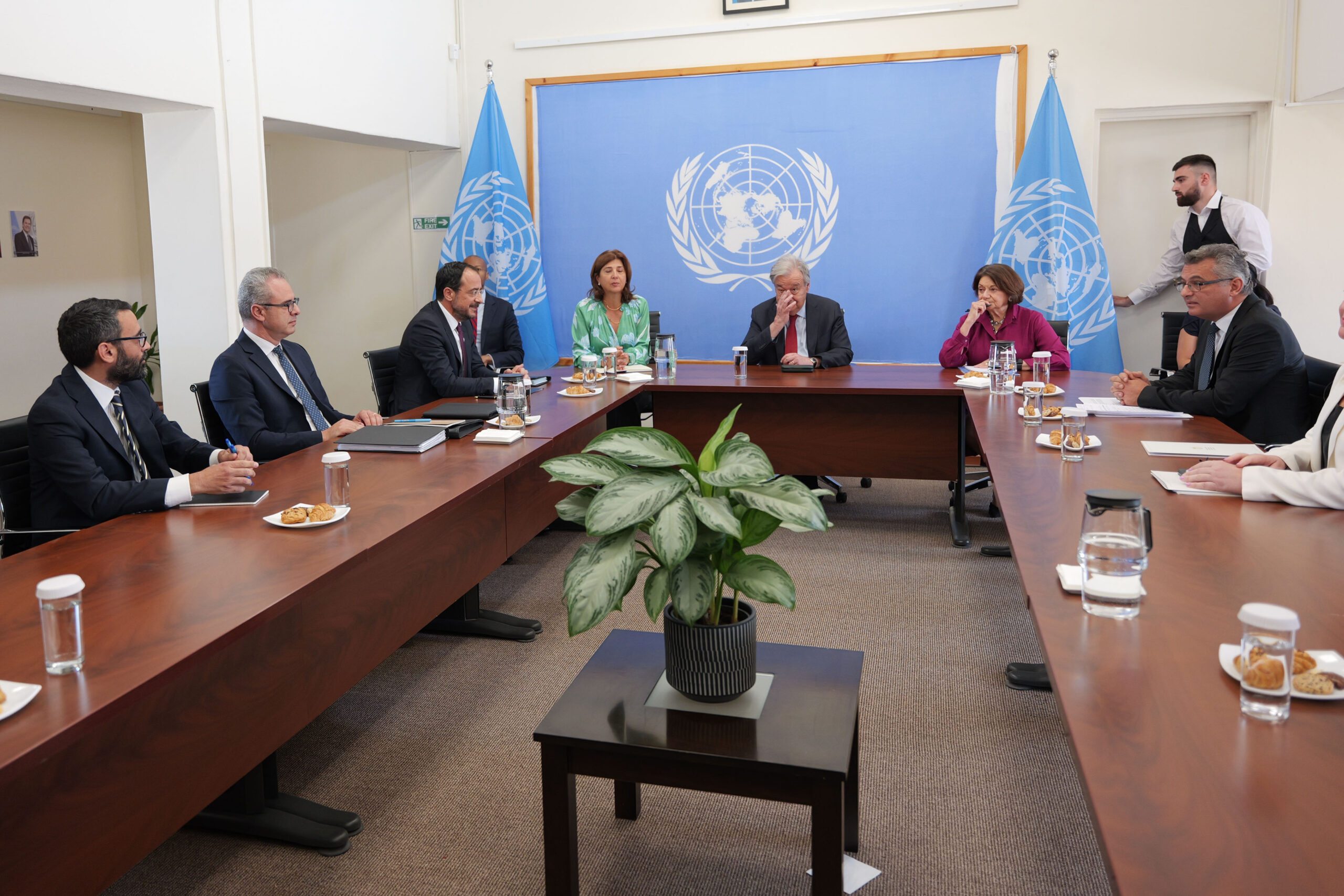
In his latest report on UNFICYP, the UN Secretary-General warns that the situation in the buffer zone in Cyprus remains fragile, with particular concern regarding the Pyla Plateau, military activity along the ceasefire lines, Varosia, unauthorized civilian activity, and threats against peacekeeping operations.
In his remarks, the Secretary-General first welcomes the “recent positive engagement of the leaders in the political process,” adding that “the regularity with which the leaders met during the reporting period is also encouraging.”
ΣΧΕΤΙΚΑ ΑΡΘΡΑ


However, he expresses regret that “no progress has been made” regarding his “repeated calls” to the parties to de-escalate the increasing military modernization activity along their respective ceasefire lines and to reverse their actions in and around the buffer zone.
The Secretary-General calls on both sides “to cease violations involving military installations,” warning that such actions “in practice seek to permanently alter the military status quo of the buffer zone.”
He is particularly critical of the “policy of deliberately blurring the distinction between military and civilian personnel by concealing military posts within civilian structures,” which he describes as a “serious concern.”
Equally alarming, he notes, are actions aimed at “promoting military positions or altering the facts on the ground,” emphasizing that “invoking the imbalance of power on the island cannot justify violations.”
READ ALSO: “Seize the window of opportunity,” Guterres urges President Erciyuman; what he notes regarding the buffer zone, roadblocks, and the Joint Military Committee
He reiterates his request, as well as that of the Security Council, to both sides “to explore mechanisms for direct military contact” and encourages them “to actively seek ways to engage in dialogue through the mediation of UNFICYP.”
“As part of their efforts to promote closer cooperation between the communities, local and international actors continue to face challenges and obstacles linked to the status of the North and to concerns regarding ‘recognition.’ While United Nations policy remains unchanged and Security Council resolutions on the matter are strictly adhered to, I reiterate that concerns regarding recognition should not, in and of themselves, constitute an obstacle to strengthening cooperation,” the UN Secretary-General stated.
Pyla
As for Pyla, the report is particularly clear. “The situation on the Pyla plateau remains deeply concerning,” the Secretary-General states, reiterating “the need for all parties to respect and adhere to the impartial demarcation of the buffer zone by the United Nations—the only demarcation recognized by the Security Council.”
Although UNFICYP “plays an essential role in de-escalating tensions and safeguarding the integrity of the buffer zone,” it notes that its ability “to curb unauthorized activities is limited without the full cooperation of the parties.”
It emphasizes that “the parties have a responsibility to respect the integrity of the buffer zone and the authority entrusted to the UN within it.”
The report notes that the reporting period was marked by “renewed challenges to the buffer zone, particularly regarding access to and land use within it.”
UNFICYP, it adds, must carefully balance “security considerations and the maintenance of the military status quo” with facilitating “reasonable and lawful civilian activities within the buffer zone.” The Secretary-General calls on the parties “to make full use of existing liaison mechanisms with UNFICYP.”
The report also includes a strong message regarding the safety of UN personnel.
“Threats against UNFICYP blue helmets are unacceptable,” the Secretary-General states, calling on the Republic of Cyprus “to investigate the incident involving armed poachers who endangered the safety of peacekeeping operations,” as well as to follow up on accountability measures regarding “the actions of the Foreigners and Immigration Unit against UN personnel during the refoulement of asylum seekers to the buffer zone in 2024.”
Varosia
Regarding Varosia, the Secretary-General reiterates his concern about “the situation in the fenced-off area” and the “lack of response to the Security Council’s call to reverse the actions taken following the announcement of the partial reopening of the fenced-off city in October 2020.” It recalls Security Council Resolutions 550 and 789 and states that “the United Nations’ position on this matter remains unchanged.”
At the same time, it “condemns” the restrictions on UNFICYP’s freedom of movement “in Varosia, Strovilia, and elsewhere,” emphasizing that the mission’s mandate “is not limited to the buffer zone but extends to the entire island.”
CMP
The Committee on Missing Persons in Cyprus also features prominently in the report. Its bicommunal teams of scientists, “with the support of the United Nations,” are mandated “to recover, identify, and return the remains of persons missing from the periods of 1963–64 and 1974, as well as from the intervening period.”
During the reporting period, eight teams of Greek Cypriot and Turkish Cypriot scientists conducted bicommunal exhumations across the island and identified seven individuals as missing persons.
Since the start of its work in 2006, the Commission has “exhumed or received the remains of 1,718 individuals on both sides of the island.” Of the 2,002 missing persons included in its official list, 1,076 have been officially identified.
The report states that during this period, 14 identifications were made, 13 of which concerned individuals on the official list, while “the remains of two missing persons were returned to their families for a dignified burial.”
It also notes that on February 16, 2026, the Pan-Cyprian Peace Council awarded the 2025 Cyprus Peace Prize to the Committee on Missing Persons, “in recognition of the Commission’s outstanding work in investigating the fate of the missing persons in Cyprus.”
The Committee continues to receive requests for “briefings, the exchange of best practices, and participation” in its programs from countries with cases of missing persons, including Armenia, Colombia, and Syria.
With regard to the management of civilian activities and the maintenance of order, UNFICYP continued to manage authorized civilian activities and restrict unauthorized access and activity in the buffer zone, “in order to prevent potential security tensions”.
The Mission intensified its engagement with the local community, holding 154 meetings with local farmers and community leaders, compared to 35 during the previous reporting period. These efforts included “updating and installing signage in certain sensitive areas and increased media coverage.”
Avlona
Agricultural activity in Avlona, within the buffer zone, reemerged as a point of friction. The report states that on several occasions, Turkish forces “advanced into the buffer zone” to protest against two Greek Cypriot farmers, whom they alleged were farming too close to the northern ceasefire line.
It also reports that Turkish forces contested the demarcation of the buffer zone and intervened when UNFICYP personnel asked Turkish Cypriot farmers to leavefrom an area of the buffer zone they were cultivating without the mission’s permission.
Due to the “long-standing and recurring pattern of tensions related to agricultural activities,” UNFICYP has developed an internal action plan, centered on a public awareness campaign to address “misinformation and misconceptions.”
Unauthorized hunting also remained a serious issue. The report states that incidents of hunting with firearms in the buffer zone continued to occur “with high frequency,” despite repeated protests by UNFICYP to the Republic of Cyprus. As of May 31, 33 incidents had been recorded, including cases where shots were fired near UN personnel and facilities.
On February 15, three Greek Cypriots “engaged in intimidating behavior and fired shots at peacekeepers, endangering their safety.” The report adds that representations made to the authorities to ensure accountability “have so far been unsuccessful.”
With regard to public order, UNFICYP cooperated on May 1 with the two police services to successfully maintain order during a large bicommunal May Day march in the buffer zone, in which more than 1,200 people from both communities participated. The Joint Liaison Offices, which are facilitated by UNFICYP under the auspices of the Technical Committee on Crime and Criminal Matters, continued to support “regular information exchange” and to function as “effective coordination mechanisms.”
In Pyla, however, crime linked to “11 illegal casinos and 1 nightclub” continued, while UNFICYP maintained community-oriented foot patrols.
Military Violations
With regard to preventing a resumption of hostilities and maintaining the military status quo, UNFICYP recorded, as of May 31, 166 military violations: 46 by the National Guard and 120 by the Turkish Forces. This figure represents a slight increase compared to the previous reporting period, although it remains “significantly lower than in 2023 and 2024.” Military installations accounted for nearly half of the violations, followed by excessive troop presence and advances.
The report also highlights the ongoing installation of military-style surveillance systems along the buffer zone. The National Guard added two new camera/sensor devices, bringing the total to 30 devices on 34 surveillance towers.
Turkish forces installed five new devices, bringing the total to 71 devices across 64 towers. The report states that these systems “remain a major concern for UNFICYP” because they contribute “to the long-term militarization along the buffer zone” and have a “potentially destabilizing effect.”
Nor has there been any progress on the de-escalation measures called for in Security Council Resolution 2815, nor in addressing serious violations that had previously been reported. The report notes that installations within the buffer zone are a “particular cause for concern,” stating that “the parties have advanced beyond the ceasefire lines and, in doing so, are undermining the neutral status and integrity of the buffer zone.”
It also notes that the authorities of the Republic of Cyprus have not taken measures to reverse the policy requiring civilian buildings along the southern ceasefire line to incorporate military positions, warning that such facilities “dangerously blur the distinction between civilian and military installations.”
Regarding tensions in and around the buffer zone, the report states that UNFICYP continued efforts at the political and military levels to de-escalate the situation, including in connection with the Security Council’s request for direct military contacts and for a reduction in the staffing of military posts where technological facilities already exist or where such facilities could be consideredreasonable substitutes.
In Varosha, however, the report states that “no measures were taken” to respond to the Council’s call for an immediate reversal of the actions taken since October 2020. UNFICYP observed renovations, roadworks, an increasing number of closed-circuit cameras, repeated commercial overflights by unmanned aerial vehicles, as well as the addition of four prefabricated concrete firing positions to the trench and embankment system constructed by Turkish forces south of the built-up area of Varosia.
In the section on UNFICYP’s activities, the report states that the mission maintained its military and police presence in and around the buffer zone, conducted ground and aerial patrols, monitored the ceasefire lines, and worked to ensure respect for the integrity of the buffer zone.
Due to limited resources, UNFICYP adjusted its patrol patterns and increased joint, intelligence-driven patrols at recurring hotspots. Liquidity constraints had a tangible impact, including a hiring freeze, temporary restrictions on the use of aircraft, postponed procurement, reduced training, and restrictions on official travel.
The report warns that restrictions on aerial assets affected the mission’s ability to conduct comprehensive aerial surveillance, noting that helicopters remain “critical for early detection, situational awareness, and verification of violations.”
Personal Envoy and Engagements
Among the significant developments, the report states that the Secretary-General and his Personal Envoy continued their efforts toward a peaceful resolution of the Cyprus issue.
The Personal Envoy traveled to Cyprus in January and June 2026 and met with Turkish Cypriot leader Tufan Erhurman and Greek Cypriot leaderNikos Christodoulides. The report also describes the buffer zone as fragile, especially in Pyla, where the Turkish Cypriot police imposed access restrictions beginning in early February and briefly detained a Greek Cypriot.
Tensions peaked on April 15, when Turkish forces assembled a convoy of 15 armored personnel carriers at the northern ceasefire line and heavily manned a nearby observation post with approximately 20 soldiers. At the time of writing, the situation was “calm but delicate.”
The Secretary-General concludes by stating that it is “essential” for the intergovernmental bodies of the United Nations to continue supporting the mission with “adequate and predictable resources,” while expressing gratitude to UNFICYP personnel for their “steadfast commitment” to implementing the Mission’s mandate and “to the cause of peace on the island.”
Source: CNA