



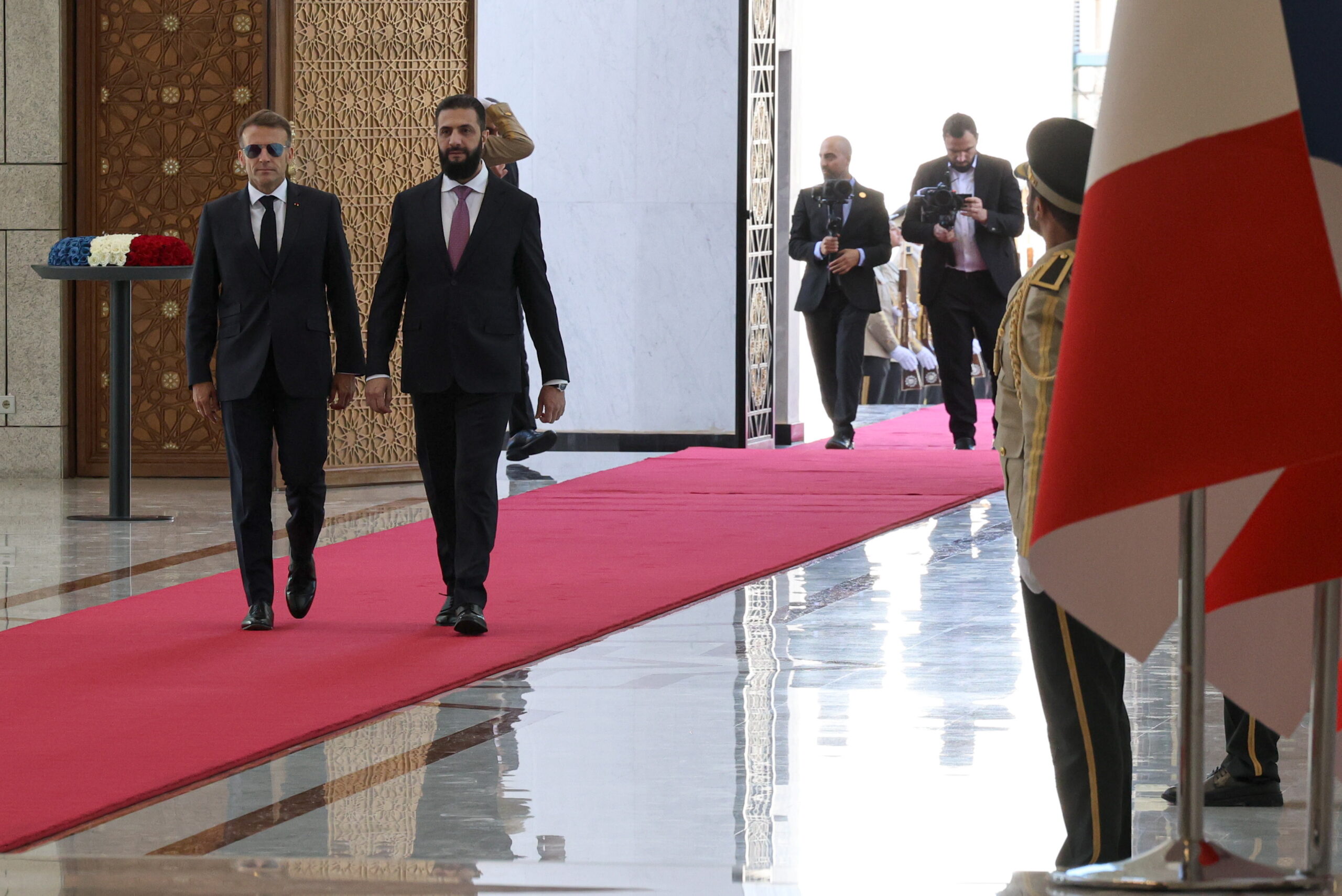
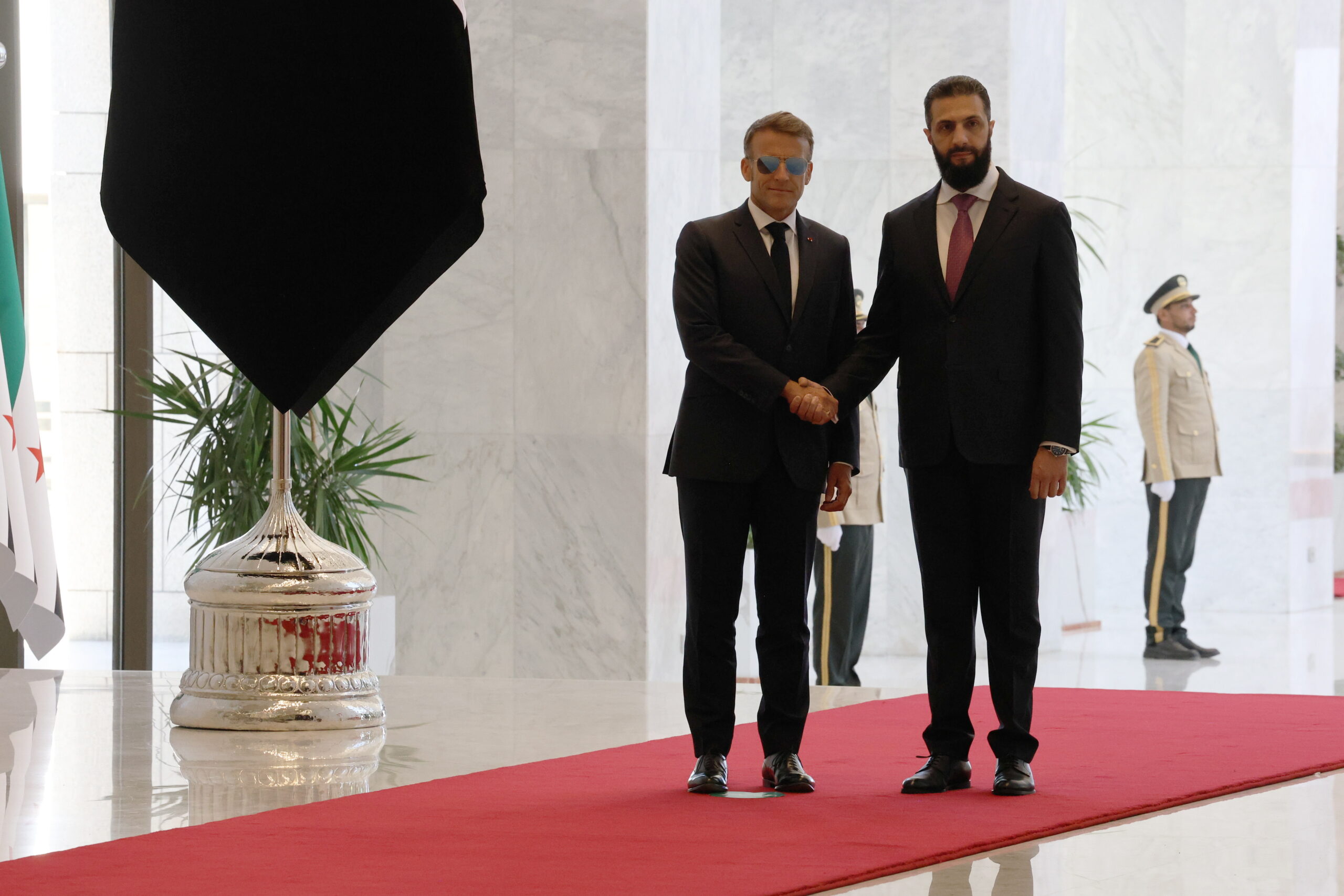
A series of explosions were reported in central Damascus, very close to the hotel where French President Emmanuel Macron was staying. A few minutes before the explosions, the French President had managed to leave his hotel and had already arrived at the Presidential Palace to meet with Syrian President Ahmad Al-Sara.
According to Syrian media outlets considered friendly to Iran and the local Shiite community, the explosions occurred on a bus belonging to the Syrian Ministry of Tourism that was very close to the hotel, and there are reports of injuries.
ΣΧΕΤΙΚΑ ΑΡΘΡΑ


Macron’s Visit to Syria: Why Now?
President Macron’s visit to Syria is part of the Paris government’s effort to gain strategic footholds in a region with which France has special historical ties, as noted by Gabriel Charitos, visiting professor of international relations at Panteion University and an analyst for ALPHA Cyprus on Middle East issues, Gabriel Charitos, speaking on the ALPHA News program with Katia Savva.
Although French foreign policy has always placed particular political emphasis on managing the situation in Lebanon, in recent years—and especially since the outbreak of war in the Middle East on October 7, 2023, and thereafter —France has been constrained by U.S. diplomatic interventions in Lebanese affairs, a fact that serves Israeli interests. It is telling that on the eve of direct Israel-Lebanon talks in Washington, mediated by the U.S., Israel vetoed France’s participation in this process. The new intra-Lebanese balance of power—with all that this implies for Iran’s influence in the country— have created a new situation in which France’s limited role is viewed as “collateral damage” to French regional ambitions.
Macron’s official visit to Syria is clearly linked to the recent signing of a strategic cooperation agreement between France and the Republic of Cyprus, which ensures a significant French presence in the Eastern Mediterranean. However, France’s “exclusion” from neighboring Lebanon has forced the French side to find a “second foothold” in the region, which is none other than Syria.
The signing of strategic and defense cooperation agreements between France and Syria effectively brings to an end a long period of estrangement between the two countries. It is noteworthy that Macron’s visit is the first by a French president since 2009, when Nicolas Sarkozy visited Syria during the Bashar al-Assad regime. With the outbreak of the civil war, however, France chose to freeze its relations with Damascus due to the heavy civilian casualties. Beyond that, however, Macron’s visit to Syria is the first by a leader of an EU member state to the country, a development interpreted as signaling that relations between Paris and Damascus are paving the way for a broader opening between Syria and Europe—and vice versa.
Suspicion in Israel and Turkey over Iran
On the other hand, however, the “Iran” factor cannot be ignored. Suffice it to say that France is one of the major European countries that has always taken care to maintain an open channel of communication with the Islamist regime in Tehran, both in times of relative calm and now, in times of war. Given that the Al-Sarra regime abruptly put an end to any ambition Tehran might have had to continue playing a role in Syrian internal affairs, France’s reemergence in Syria may well signal the beginning of a—albeit indirect and limited—quasi-resurgence of Iranian influence in the region.
Such a scenario would appear to serve the Al-Sarra administration by enabling it to maintain certain useful balances that would place the Iranian role in Syrian affairs within a more “controlled framework.” On the other hand, however, a resurgence—even an indirect one—of pro-Iranian actors in Syria certainly does not thrill either Israel or Turkey. Given the current extremely fragile balance of power, a “French wedge” could very easily be viewed as an “intruder.”
It is clearly no coincidence that the French President chose to time his visit to Syria immediately before traveling to Ankara for the NATO summit, where he will likely be called upon to explain to both the Americans and the Turks exactly what France’s broader strategy is and what the Paris government’s objectives are on the ground.
Watch Gabriel Haritos’ analysis on today’s episode of ALPHA NEWS with Katia Savva





