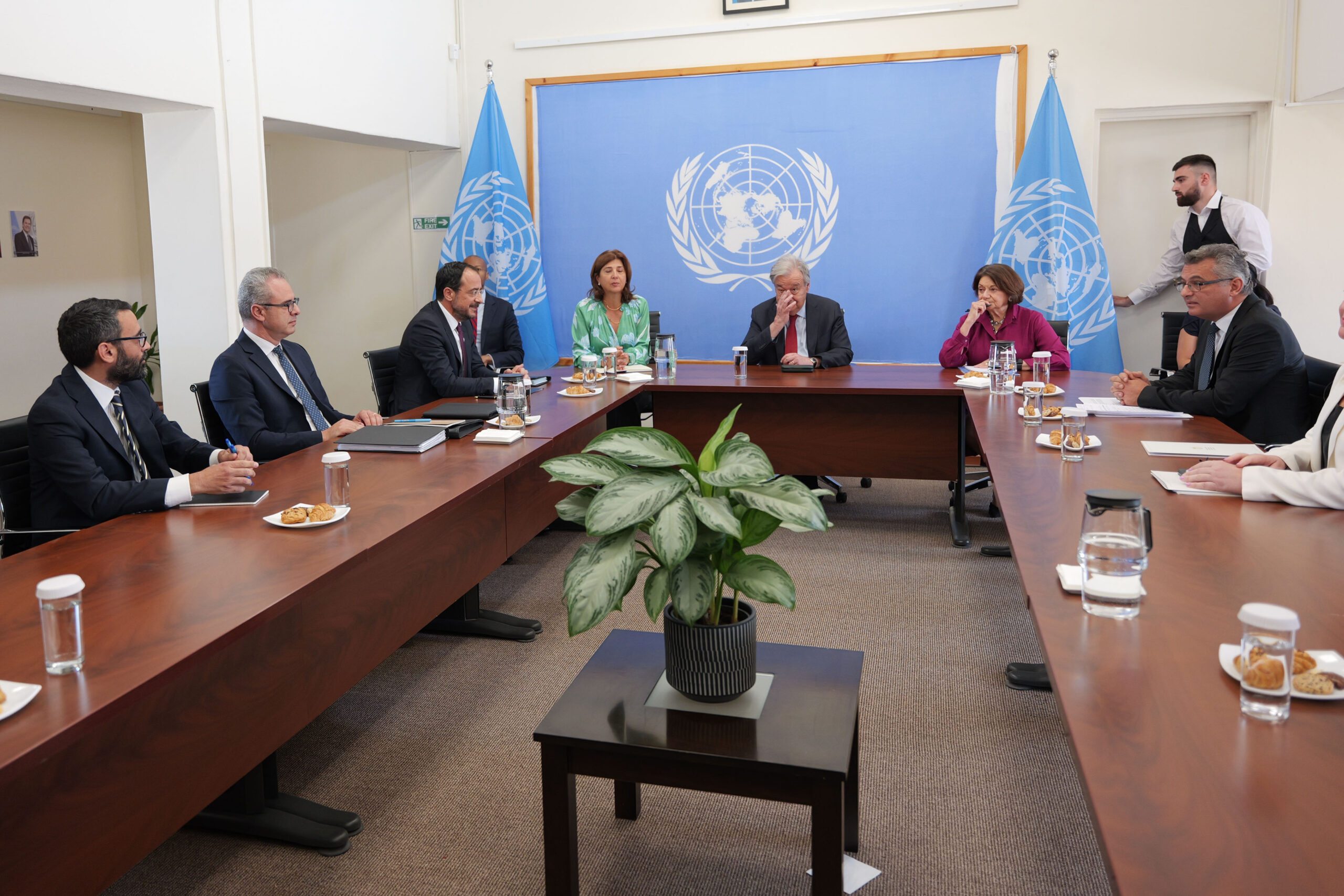
The continued existence of the Republic of Cyprus is an “absolute red line,” and a two-state solution or a disguised confederation is not up for discussion, President of the Republic Nicos Christodoulides stated on Monday, emphasizing that he will not become “the President of partition” nor will he sign a settlement that is not functional, sustainable, and resilient over time.
In a speech at the event commemorating the dark anniversaries of the coup and the Turkish invasion, held at the Presidential Palace, President Christodoulides stated that a solution to the Cyprus problem is “the noblest aspiration” and “the mission” of his life, while noting that the intensified efforts of the United Nations Secretary-General and the European Union’s leading role allow for cautious optimism.
ΣΧΕΤΙΚΑ ΑΡΘΡΑ


He also referred the UN Secretary-General’s visit to Cyprus from July 27 to 29 and the appointment of European Commission Executive Vice-President Raffaele Fitto as Special Envoy for the Cyprus issue, emphasizing that “progress in EU-Turkey relations is directly linked to substantive progress on the Cyprus issue.”
The President of the Republic began his speech by paying tribute to those who fought for the rule of law, freedom, and democracy, and by condemning what he called the ongoing crime against Cyprus and its people resulting from the Turkish invasion. He noted that those who gave their lives for freedom have become beacons of the struggle for justice, which will come only through an end to the occupation, the liberation, and the reunification of the homeland.
“Fifty-two years is a long time, but not long enough to break our spirit and make us abandon the effort to free ourselves from the suffering that the dark summer of 1974 brought upon our homeland,” he said.
President Christodoulides said that history has shown that the coup d’état carried out by the Athens junta and its collaborators in Cyprus provided Turkey with the pretext it sought to implement itsand proceed with the invasion, resulting in the illegal occupation—now in its 52nd year—of 37% of the territory of the Republic of Cyprus.
During its “barbaric rampage” through Cyprus, he said, Attila committed one of the greatest crimes in postwar European history, spreading destruction and suffering, with thousands dead, displaced, and missing. He added that for more than five decades, international law and fundamental human rights have been systematically violated.
The President referred to the ongoing consequences of the occupation, noting that Turkey continues to illegally occupy, by force of arms, more than one-third of the territory of an independent and sovereign member state of the European Union and the United Nations.
At the same time, he said, Turkey denies access to the archives of the occupying army, which are needed to ascertain the fate of those missing, expands illegal settlement and demographic alteration, and reinforces the economic, political, religious, and social manipulation of Turkish Cypriots.
He also referred to the violation of the rights of Greek Cypriots, Turkish Cypriots, Maronites, Armenians, and Latins, the persecution of enclaved communities, and the destruction of ecclesiastical monuments, places of worship, and cultural heritage.
“And all of this, like so much else, is not mere rhetoric but the cold reality in our homeland for the past 52 years,” he noted.
For all these ongoing crimes, he added, Turkey is accountable to the international community, while its efforts to legitimize the status quo blatantly conflict with international and European law.
“Justice cannot be derived from illegality,” he emphasized.
The President noted that the anniversary is a day of sorrow but also an opportunity to send the message that the Cypriot people will not compromise with the current situation nor legitimize theof the invasion and occupation.
Addressing the relatives of the fallen, the families of the missing, the displaced, the victims, those trapped, and the combatants of 1964 and 1974, he assured them that liberation from the shackles of occupation, the liberation and reunification of Cyprus are his top personal and governmental priorities.
“And we are proving this in practice,” he said.
He said that, from the very moment the government took office, initiatives were undertaken and proposals were submitted, while the country’s standing has been enhanced both domestically and internationally, with the ultimate goal of ending the occupation and achieving reunification.
With “clear political will,” a plan, a strategy, and “assertive realism,” he added, the government charted a specific strategy, which over the course of more than three years led to substantial steps toward creating the necessary conditions for the resumption of negotiations.
The desired solution, he emphasized, must be based on the agreed-upon United Nations framework, the negotiating acquis, and the principles, values, and law of the European Union.
Despite the global turmoil caused by the wars in Ukraine and the Middle East and despite the negative stance of the Turkish side, he said, it has been possible to rekindle international interest in the Cyprus issue, following the seven-year stalemate that began in 2017.
“Recently, both the United Nations Secretary-General and the European Union have intensified their efforts, and their strong political will allows us to be cautiouslyoptimistic about the future,” he noted.
The President described the Cyprus issue as an “existential problem” that concerns the very essence of the homeland and affects the lives of all citizens, having shaped the course of the country’s the present, and the future of the country.
The goal, he continued, is a solution that will put an end to the current state of lawlessness and ensure the conditions for a modern, functional, and European state.
“We are asking for nothing more than what every person and every people deserves and is entitled to,” he said.
“We are asking for the bare minimum, the obvious, the fundamental, the self-evident: that all lawful citizens of the Republic of Cyprus, without exception—Greek Cypriots, Turkish Cypriots, Maronites, Armenians, and Latins, to have the right to enjoy exactly the same rights as all other European citizens,” he said.
Human rights and fundamental freedoms, he continued, are not a privilege nor can they be called into question in an EU member state. The solution, he noted, must be sustainable, functional, and resilient, and must guarantee all legal residents the right to live, work, and build a life wherever they choose, in conditions of peace, genuine security, and prosperity.
The President referred to the effort to secure the European Union’s leading role in the Cyprus issue, noting that it has now become clear that this is also a European issue and that the EU must play a decisive role in developments. He referred to the Conclusions of the European Council of April 2024 and to the joint letter from the President of the European Commission and the President of the European Council to theUN Secretary-General in March 2025.
It was also mentioned his meeting with European Commission President Ursula von der Leyen in Paris and the appointment of Commission Executive Vice President Raffaele Fitto as Special Envoy for Cyprus. As she said, the Commission President noted that the appointment reflects the European Commission’s strong commitment to the reunification of Cyprus and reaffirms the Union’s interest in resolving the Cyprus problem as a matter of priority.
At a time when the UN Secretary-General’s initiative is underway—he is scheduled to visit Cyprus on July 27–29—he added, the European Union “is taking a leading role”.
“At this critical juncture, it has become clear to everyone that progress in EU-Turkey relations is directly linked to substantive progress on the Cyprus issue. And this development is the result of the strategy we have charted and are implementing,” he emphasized.
Determination, consistency, international credibility, and the methodical implementation of the strategy, he continued, have generated new momentum and concrete initiatives. The President stated that the Government will continue to make the most of every negotiating opportunity, expressing the hope that all parties—and Turkey in particular—will demonstrate sincere political will.
Addressing Turkey, he said that a settlement beneficial to all parties concerned could be achieved, provided that Ankara abandons anachronistic notions that are incompatible with the present day, especially in a European state such as Cyprus.
Anachronistic aspirations and divisive policies, he noted, not only infringe upon the rights of Greek Cypriots, but “effectively punish” Turkish Cypriots as well, who, due to the Turkish occupation, are deprived of the rights offered by a modern European state.
The President stated that the intentions toward Turkish Cypriots are sincere and selfless, and that the Republic of Cyprus treats them as equal citizens. The unilateral support measures and the policy of non-discrimination and non-exclusion, he said, demonstrate this approach in practice.
“This is also my message to the Turkish Cypriot leader regarding the Cyprus we envision—a country that will be our shared home, our common homeland,” he said.
He added that the European acquis and the EU’s principles, values, and law can serve as the strongest safeguard for a democratic, sustainable, and functional solution and as the foundation for a shared European future, with full respect for one another’s ethnic origins “and certainly not through self-abolition.”
The President then reiterated that his efforts are in line with the mandate he received from the people to seek a solution based on the agreed framework, the bi-zonal, bi-communal federation and the principles, values, and law of the EU.
“The continuation of the Republic of Cyprus is an inviolable red line,” he emphasized. “We are not discussing the dissolution, abolition, annulment, or undermining of the internationally recognized State, which I have pledged to serve and safeguard, in accordance with the constitutional mandate,” he added.
Within this framework, he said, he will not discuss anything that alludes to a two-state solution, a disguised confederation, or contains “constructive ambiguities.”
He also reiterated that he will not present to the people any solution plan that does not have his own approval. The President stated that he is “an absolute realist” and possesses the boldness and courage to negotiate, to stand his ground where necessary, and to compromise where core goals and aspirations are not affected.
“A solution to the Cyprus problem remains my noblest aspiration and my life’s mission,” he said.
“However, I will not come to terms with the idea that I will become the President who signs an agreement that will not stand the test of time, that will not be functional or sustainable. And I certainly will not become the President of division,” he emphasized.
“I want a solution; we want a solution—more than anyone else,” he continued, adding that it must have the necessary safeguards to function and stand the test of time, and be compatible with the Republic of Cyprus’s status as an EU member state.
The President said that the appointment of a sitting high-ranking European official to handle the Cyprus issue, the intensification of the UN Secretary-General’s efforts, and other moves to resume negotiations did not arise by chance, but are the result of continuous and methodical efforts.
He referred to a multifaceted and active foreign policy, with a clear Western and European orientation, which invests in outreach, asserts a role, and highlights the country’s potential. As recent proof, he cited the “extremely successful” Cypriot Presidency of the Council of the EU, for which, as he said, Cyprus earned praise from its partners at the level of states, institutions, and leaders.
Domestically, he said, efforts are continuing to strengthen deterrence, enhance public safety, and bolster the economy’s resilience through responsible fiscal policy. He also referred to investments in health, education, and the welfare state, as well as efforts to address issues such as migration, housing, and the modernization of institutions.
“Especially a country under occupation, if it is not internally strong, cannot claim a role on the international stage,” he said. A country without a resilient economy, a credible defense, and a reliable foreign policy, he added, cannot achieve strategic goals such as ending the occupation and liberating Cyprus.
Addressing the refugees, the families of the fallen and the missing, the resistance fighters, and the veterans of the 1974 war, he said that he draws strength from their resilience, their determination to return, and their longing for justice.
“As the first President of the Republic of Cyprus from the postwar generation, I address you all with reverence, aware of the historic responsibility I have undertaken to work toward handing down to our children a free homeland, greater than the one I inherited,” he said.
He also thanked the Greek people and Greece’s political leadership for their continuous and steadfast support in the effort to free the island from occupation, making special mention of the Greeks who fought for Cyprus’s freedom.
In conclusion, the President noted that the days ahead are full of challenges, which require the utmost seriousness, readiness, and unity. He called on everyone to join forces and extended a “hand of cooperation” to all political forces, organized groups, and every citizen.
“Faced with the responsibility for the future of our country and our people, we cannot afford to prioritize other political plans, partisan agendas, or personal ambitions,” he emphasized. “The Republic of Cyprus remains the shield and spear of the struggle we are waging,” he said, noting that it must be fortified and strengthened.
Guided by “assertive realism,” he concluded, the path being followed will lead “to the sheltered harbor of liberation from the shackles of occupation.” “Our Ithaca is the vindication of our people’s struggles,” he said, adding that the Cypriot people, with patience, perseverance, tenacity, hard work, and dignity, are waiting “for the winds of freedom to blow.”