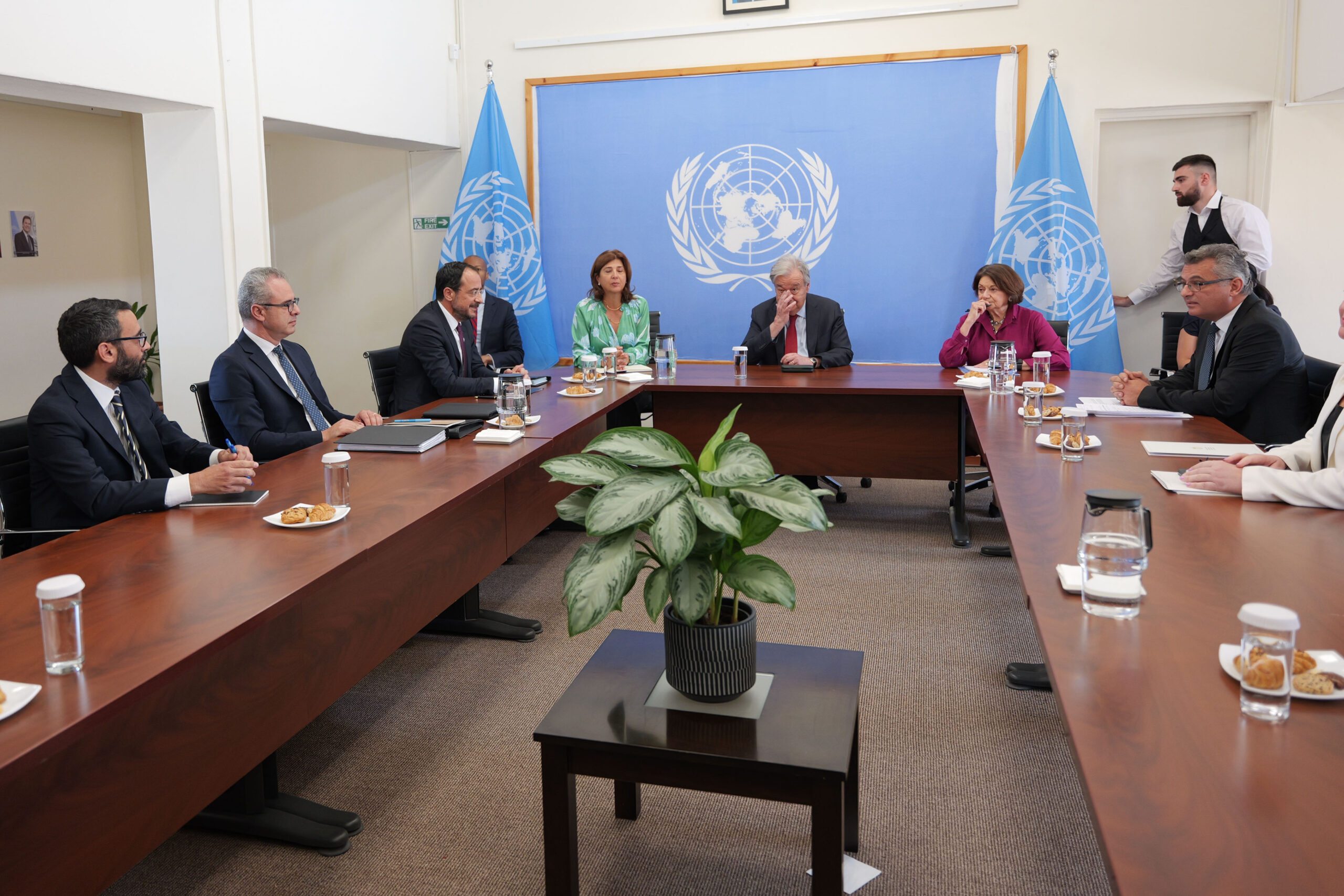
The President of the Republic, Nikos Christodoulides, reaffirmed was reaffirmed by the President of the Republic, Nicos Christodoulides, during his meeting today at the Presidential Palace with Maria Kalbourtzi, President of the Panhellenic Committee of Parents and Relatives of Unidentifiedand Missing Persons of the Cyprus Tragedy, Maria Kalbourtzi, and the President of the Pan-Cyprian Organization of Relatives of Unidentified Prisoners and Missing Persons, Nikos Sergides, in the presence of Presidential Commissioner Marios Hartsoti.
In remarks following the meeting, Mr. Hartsoti described the atmosphere as “very useful and constructive,” noting that the representatives of the two organizations once again raised all issues related to the missing persons, while also having the opportunity to be briefed by the President of the Republic on the initiatives and steps being taken by the Republic of Cyprus at the local, European, and international levels.
ΣΧΕΤΙΚΑ ΑΡΘΡΑ


As he said, during the meeting, views were exchanged and proposals were put forward as part of the intensification of the government’s efforts, with the aim, as he noted, “to determine the fate of the last missing person,” noting that the issue has remained an open humanitarian wound for 52 years.
For her part, the Chair of the Panhellenic Committee, Maria Kalbourtzi, described the meeting as “very constructive,” which, she said, instills hope and optimism that substantive steps can be taken on the long-standing issue of the missing persons.
She made special mention of developments regarding the Republic of Cyprus’s unilateral program for Greek missing persons, noting that progress is being made on the issue of the so-called “sprinkled bones.” As he noted, there has been a positive response from the Cypriot government and the Presidential Commissioner, with procedures moving forward at a rapid pace to verify the identities of the individuals whose remains had undergone chemical treatment. At the same time, he added, work continues on identifying small bone fragments so that families in Greece can be notified and receive the remains of their relatives.
Responding to a related question, Ms. Kalbourtzi stated that there are a total of 32 small containers holding sprayed bones, adding that in one case, with a 99.9% success rate, to create a genetic profile of the individual to whom the remains belong. As she explained, the process is time-consuming; however, efforts are being made to expedite it so that there are no further delays.
Ms. Kalbourtzi also described as particularly important the decision to relaunch an international awareness campaign on the issue of missing persons, with the aim, as she noted, of reminding the international community that there remains a humanitarian issue that has remained unresolved for 52 years.
The President of the Pan-Cyprian Organization of Relatives of Unidentified Prisoners and Missing Persons, Nikos Sergides, also described the meeting as productive, noting that specific ways to advance the issue of the missing persons were agreed upon.
As he said, the President of the Republic briefed the organizations on the recent actions he has taken, as well as on initiatives he intends to undertake in the near future, expressing the view that the measures proposed by the government may this time yield tangible results.
When asked about these initiatives, Mr. Sergidis stated that the international campaign includes engaging the European Union, both through the European Parliament and the European Commission, in order to strengthen international pressure for progress on the humanitarian issue of the missing persons.
When asked whether the issue would be raised during the upcoming visit of the United Nations Secretary-General to Cyprus, the Presidential Commissioner noted that the President of the Republic himself has already announced that he will raise the issue on his own initiative with António Guterres, describing it as an extremely important humanitarian issue.
SEE ALSO: Coordination on migration flows, meeting at the Ministry of Justice | AlphaNews
Source: CNA