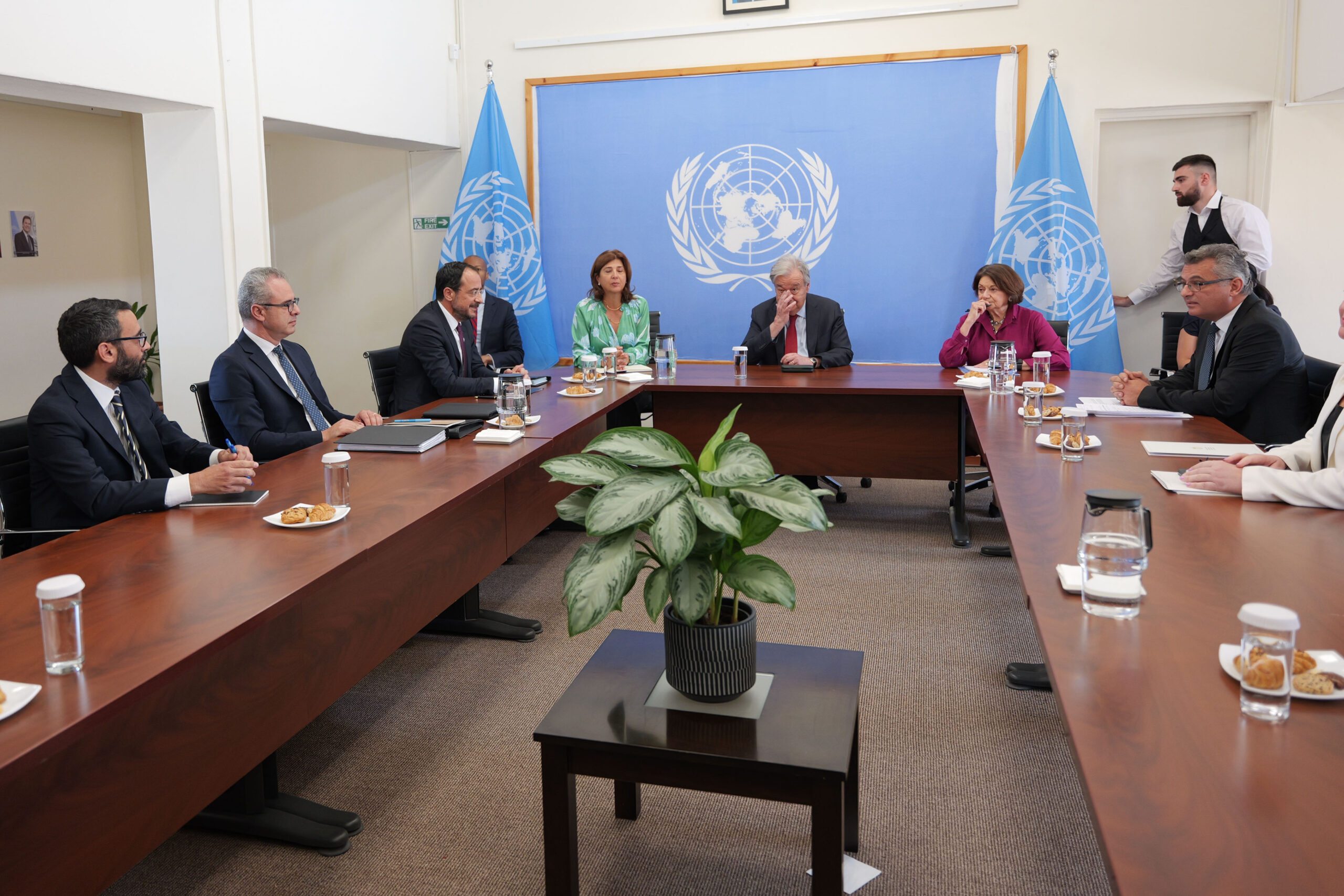
The parties involved in the Cyprus issue are racing against the clock to ensure they don’t miss the window of opportunity for potential developments. In the five months remaining until the end of Guterres’s term, much can be accomplished—but only if both communities are willing, Maria Angela Olguín states in an interview with Politis.
The personal envoy is setting the stage on which the parties involved must compete. She considers the MOEs to be a prerequisite for the future of the process and emphasizes the three-pronged approach of regular meetings, substance, and methodology.
ΣΧΕΤΙΚΑ ΑΡΘΡΑ


For her, these are also the conditions for a five-party convergence, reiterating that the expanded format should not be taken for granted.
“The MOEs are an essential prerequisite for moving forward, alongside substance and methodology. They are indispensable. The UN is not going to proceed with a ‘5+1’ meeting that risks failing in the same way the previous one did. That would be detrimental to the process.”
María Ángela Olguín – Personal Envoy of the UN Secretary-General UN: “We are
investing in the MOEs,” the government states, despite the fact that it does not consider them a prerequisite for convening a five-party meeting, declaring that it is focused on the substance of the negotiations.
“The proposal submitted by the Secretary-General regarding the crossing points is well known; President Christodoulides had accepted it during the UN Secretary-General’s visit. We look forward to sincere political will, and we look forward to the same constructive attitude from the other side so that progress can be made there as well.”
Konstantinos Letympiotis – Government Spokesperson
The discussions, including the one-on-one meeting between the leaders on the 26th of this month, will focus on the opening of the Athienou- Pyroi crossing, as well as the Mia Milia crossing. In the presence of the Secretary-General, however, according to diplomatic sources, on July 28 the Turkish Cypriot leader demanded additional concessions regarding Louroujina and Lybia. However, when Nikos Christodoulides once again put the opening of Kokkina on the table, Tufan Erhurman refused.
“Don’t let this opportunity slip away”
In her interview,
the special correspondent points out that during their meetings, the two leaders shouldn’t just talk when they’re together, while she warns…
“I don’t think we should take it for granted that there will be another opportunity soon if this one is missed. The biggest obstacles remain the fear of change and the lack of political will on the part of all stakeholders. I am deeply convinced that the two communities want to move forward.”
María Ángela Olguín – Personal Envoy of the UN Secretary-General “We
will continue this effort, exactly as the UN Secretary-General himself envisioned it. What is of the utmost importance is for Turkey to return to the negotiating table and realign itself with the UN framework.”
Konstantinos Letympiotis – Government Spokesperson
The Roadmap
María Ángela Olguín and her colleague Patti Londono have taken on the task of coordinating the two sides, while academic John McGary is documenting, based on United Nations minutes, the points of convergence reached up to Crans-Montana. His work is expected to continue until the end of the month. “Alpha tis Kyriakis” contacted the scholar, who, however, does not wish to comment publicly at this time. He does, however, state that he is working to deliver the results of his work to the United Nations as soon as possible, after which they will be presented to both sides.
These meetings will reveal not only the progress made in the talks but also the remaining differences—with thorny issues and unresolved concerns still evident in several aspects of the Cyprus problem, such as the issue of guarantees, troop presence, territorial issues, and property.
Watch Evangelos Agapios’s report: