



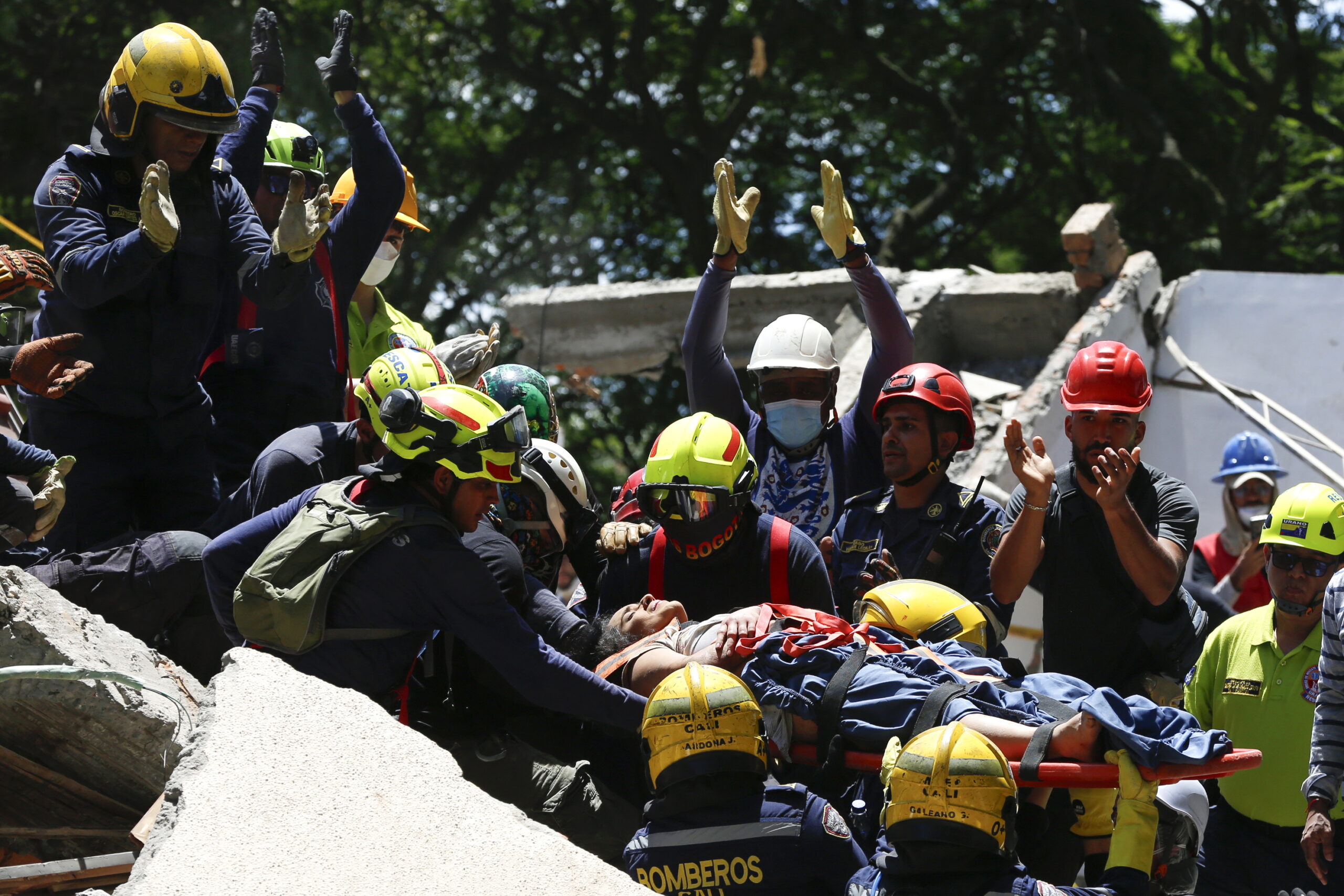
Three days after the devastating earthquake that struck western Colombia, the chances of finding survivors were fading, despair among the earthquake victims persisted, and makeshift camps were springing up everywhere yesterday, Thursday.
Heavy machinery had begun clearing debris from sites where any possibility of survivors from the 7.4-magnitude earthquake that struck on Monday morning (local time)—the deadliest in the country since the beginning of the century.
ΣΧΕΤΙΚΑ ΑΡΘΡΑ


The death toll continued to rise—by the end of the day, President Ambelardo de la Espriega announced that the death toll had reached 281, noting that there were also nearly 4,000 injured and 379 missing.
Nearly 13,000 properties were destroyed, either partially or completely, according to the disaster response agency.
In Cali (southwest), the country’s third-largest city and one of the hardest-hit areas, parks and streets were transformed into makeshift camps.
María del Carmen Rodríguez, 72, lost the apartment she had bought with her life savings. She watched from a soccer field where she now spends sleepless nights in a tent with her 76-year-old husband.
“We’re asking for whatever help we’re entitled to so we can settle somewhere else,” she said, “but it’s all going to take time,” she sighed.
Volunteers and professional rescuers continued to search through the rubble—with their bare hands, using specialized equipment, and with specially trained dogs—for the slightest sign of life.
The stench of decay permeated the neighborhoods that suffered the worst damage.
Yesterday morning, the 72-hour “window” the 72-hour “window” following any major earthquake, after which experts say the chances of finding and rescuing survivors drop dramatically.
The region known as the “land of coffee,” in central-western Colombia, is also counting its losses.
In Pereira, a firefighter was searching a site where a team of volunteers had alerted him that they heard noises coming from beneath the rubble.
He explained that he didn’t want to discourage them or dampen their enthusiasm, since “miracles do happen,” but he confided to Agence France-Presse that “at this stage, it’s now almost impossible to find anyone alive.”
“Collective trauma”
Since Monday, the public’s solidarity with those participating in the frantic search for the missing and those facing shortages has not wavered. Thousands of people have brought water, food, and medicine to the affected areas…
In Cali, a musician came up with the idea of setting up a space where he offers “hugs” to comfort earthquake victims.
“We’ve suffered collective trauma, and I believe the best way to help is to offer my energy,” explained 46-year-old Andrés Solomon, surrounded by signs reading “hugs here” or “stay strong!”
Some discoveries are simply a balm for the soul of people who have been scarred by loss. Viki Hiraldo’s face lit up when volunteers returned her cat, Polux, whom they had found in a building that has now been reduced to a pile of rubble. “My dream has come true,” said the 56-year-old lawyer, holding back her tears with a smile.
Aftershocks and structural damage to many buildings have complicated search and rescue operations.
Criticism
The epicenter of the earthquake was near San José del Palmar, in the impoverished department of Chocó, on the country’s Pacific coast. The search-and-rescue phase there has already ended; however, the need for aid remains great and urgent.
President de la Espriegya, who took office just three days before the disaster, declared a state of “economic emergency,” a measure that allows for the imposition of taxes and budget amendments without requiring parliamentary approval.
He also announced the establishment of a special fund, to be partially financed by international aid, to provide relief to earthquake victims.
However, the way the new head of state—who belongs to the so-called hard right—handled the response to the earthquake drew criticism.
Bogotá accepted search and rescue teams only from the United States, El Salvador, Ecuador, and Israel—countries governed by right-wing governments.
His government nevertheless assured that it handled offers of foreign aid without any “ideological or political” bias.
Left-wing President Claudia Sheinbaum, however, expressed regret yesterday that Colombia did not accept the deployment of experienced military rescue workers from Mexico; Bogotá argued that they did not have the required certifications.
Source: KYPE





