




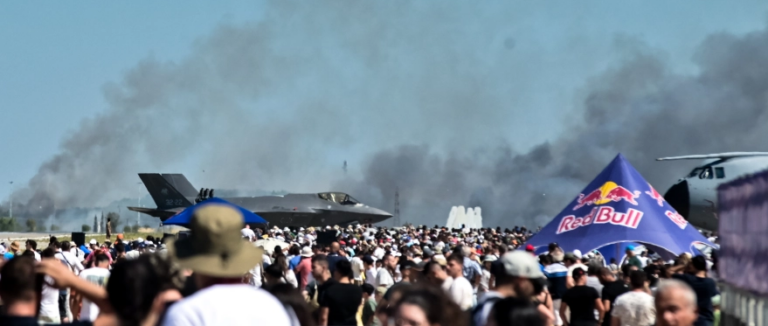
A two-seat F-4 Phantom fighter jet crashed at noon on Saturday at the Tanagra Air Base, during the Athens Flying Week air shows.
The latest reports from Tanagra indicate that, so far, authorities have no evidence that the aircraft’s ejection seat was activated, and a search and rescue operation is underway. So far, there are no images from the search and rescue team that has rushed to the scene.
ΣΧΕΤΙΚΑ ΑΡΘΡΑ

A boiler room in a home in Ayia Napa was destroyed by fire

VIDEO: Cypriot-owned tanker ablaze in the Black Sea
Watch a video of the demonstration and the moment the Phantom aircraft crashed:
#Tanagra crash #Phantom Athens Flying Week 2026. pic.twitter.com/GEHQsnlToP
Advertisement— Matheol (@SMatheol) September 5, 2026
A HAF F-4 Phantom II just crashed at the Athens Flying Week airshow. We can only hope for the best, but I saw no parachutes. It hit the ground coming out of a turn. pic.twitter.com/JtW4YdPJ5x
— Sova
(@sovva1_1) September 5, 2026
The aircraft crashed shortly after it began its demonstration, while hundreds of people were watching from close range. According to eyewitness accounts, the aircraft appeared to be emitting smoke before it crashed. The same eyewitnesses report that the aircraft suddenly began to lose altitude and crashed.
According to initial reports, the aircraft has been split in two and fires have broken out at two different locations. Eighty-five firefighters were mobilized, along with two ground teams from the 1st EMODE, one team from the 1st EMAK, and 23 vehicles. Seven aircraft and four helicopters were deployed for aerial firefighting, one of which was assigned to coordinate the operation.
Reports indicate that the aircraft crashed in the area of operations.
People at the scene were in shock, and event organizers immediately began evacuating the area. Athens Flying Week has been suspended for the time being. Due to the crash of the fighter jet at Athens Flying Week, Defense Minister Nikos Dendias has interrupted his schedule at the Thessaloniki International Trade Fair and is rushing back to Athens.


The History of the Phantom in the Hellenic Air Force
The F-4 Phantom II is one of the most iconic fighter jets in aviation history. It is a two-seat, twin-engine, multi-role fighter of American manufacture, designed to carry out missions of air superiority, interception, bombing, and reconnaissance.
The first F-4s rolled off the production line in the early 1960s, while the Hellenic Air Force incorporated the first Greek Phantoms into its fleet in 1974, as part of the Peace Icarus defense program.
Despite belonging to the second generation of supersonic fighters, the F-4 gained a new operational life through extensive modernization. A total of 36 Greek Phantoms were upgraded with modern electronic systems as part of the Peace Icarus 2000 (PI2000) program, allowing for the extension of their operational service life and the capability to use modern weapons.
Today, the F-4E Phantoms operate out of the 117th Fighter Wing at Andravida Air Base, where they constitute the core fleet of the 338th “Ares” Squadron.
Technical Specifications of the F-4E Phantom
The F-4E Phantom has a two-person crew, with the pilot and the weapons systems officer working together to carry out missions.
Key specifications:
Crew: 2
Engines: 2 General Electric J79 turbojets with afterburners
Thrust: approximately 17,900 pounds
Wingspan: 11.7 meters
Length: 19.1 meters
Maximum speed: 2,370 km/h (Mach 2.2)
Maximum operational altitude: over 15,240 meters (50,000 feet)
The Phantom’s
History in the Hellenic Air Force
In 1972, Greece ordered its first 36 F-4E Phantom aircraft through the Peace Icarus I program. These aircraft equipped two fighter squadrons of the Hellenic Air Force: the 338th Interceptor/Bomber Squadron and the 339th All-Weather Squadron.
The first six Greek F-4Es landed at the 117th Fighter Wing on Friday, April 5, 1974. The first aircraft to arrive at Andravida bore the U.S. Air Force serial number 72-01500.
In 1977, the Air Force further strengthened its fleet ordering an additional 18 F-4E fighters and 6 RF-4E reconnaissance aircraft, thereby significantly increasing its strike and aerial reconnaissance capabilities.
In 1990, as part of the reduction of the U.S. defense fleet, 28 F-4Es from the Indiana National Guard were transferred to Greece through the Southeastern Regional Agreement (SRA). These aircraft were already equipped with upgraded systems, including the Navigation & Weapons Delivery System (NWDS), which significantly enhanced their capabilities for attacking ground targets.
The major upgrade of the Phantoms
In late 1997, after more than two decades of service, it was decided to upgrade the Greek Phantoms to ensure they remained operational and competitive.
The program consisted of two main components:
Structure Life Extension Program (SLEP) for structural reinforcement of the aircraft.
Avionics Upgrade Program (AUP) for upgrading the avionics and combat capabilities.
The contract was signed in December 1998 between the German aerospace company DASA and the Hellenic Aerospace Industry (HAI).
The upgrade included, among other things:
a new AN/APG-65GR radar,
a new mission computer,
a HUD system,
color multifunction displays,
a GPS/INS system,
a new friend-or-foe identification (IFF) system,
modern communications systems,
and an image and data recorder.
These modifications enabled the Greek Phantoms to carry modern weapons, such as the AIM-120 AMRAAM air-to-air missiles, as well as advanced air-to-ground weapons.
The cost of the program amounted to approximately $315 million, and upon its completion, the upgraded aircraft were designated F-4E Peace Icarus 2000.
The first upgraded F-4E made its maiden flight on April 28, 1999. On December 18, 2002, the first production aircraft of the program was delivered to the Air Force at the EAB facilities in Tanagra.
Upon completion of the upgrade, the Air Force concentrated the upgraded Phantoms at the 117th Combat Wing in Andravida, where they continue to serve to this day.
Source: Proto Thema








