



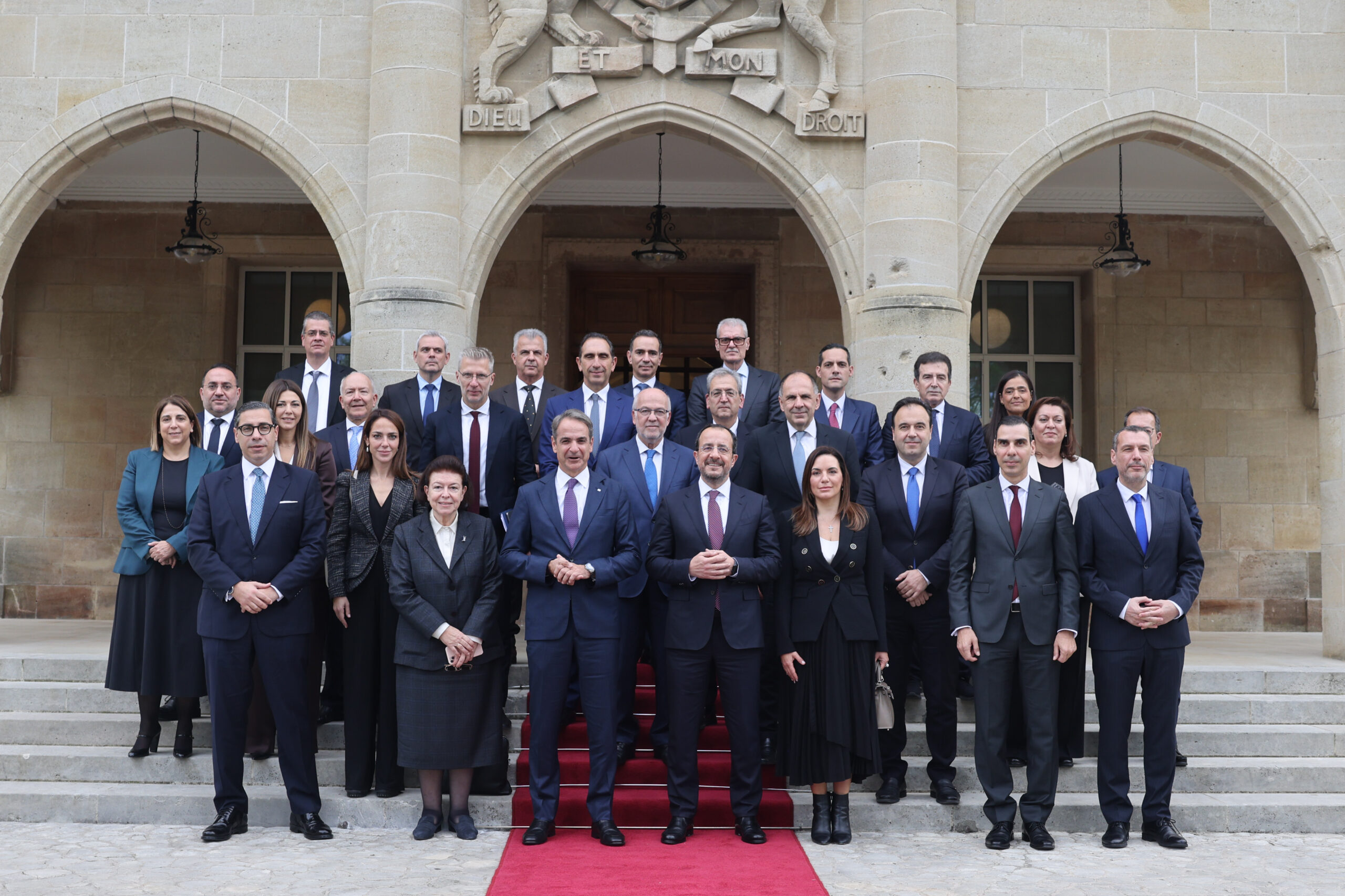
The President of the Republic, Nikos Christodoulides, and the Prime Minister of Greece, Kyriakos Mitsotakis, co-chaired the 4th Cyprus–Greece Intergovernmental Summit today in Nicosia, the second such summit to be hosted by the Republic of Cyprus.
The Summit was attended by ministers and deputy ministers from both countries, who held discussions on issues related to education, health, foreign policy, civil protection, justice and security, housing policy, labor, digital policy, shipping, tourism, and culture.
ΣΧΕΤΙΚΑ ΑΡΘΡΑ


According to the Joint Communiqué of the Summit:
“The two leaders reaffirmed the importance of institutionalizing the Intergovernmental Summits as a permanent mechanism for policy coordination, monitoring agreed-upon actions, and producing concrete results that have a positive impact on citizens’ daily lives. It was noted that cooperation has now established a steady annual rhythm and covers a broad range of public policies that affect citizens, the competitiveness of economies, and the effectiveness of public services.
In an international environment marked by heightened uncertainty and complex challenges, the two leaders reaffirmed the close coordination between Cyprus and Greece in promoting security and stability in the Eastern Mediterranean and the broader region. They emphasized the role of the two countries as pillars of stability and cooperation, serving as a bridge between the European Union and the region, with a steadfast commitment to the principles of international law and good neighborliness.
The two leaders welcomed the progress on the Cyprus issue and the prospect of a meeting with the Secretary-General of the United Nations, emphasizing the importance of capitalizing on the current circumstances to resume substantive negotiations from the point where they were suspended in 2017 at Crans-Montana, to find a solution based on the agreed framework and the relevant United Nations Security Council resolutions, in accordance with the principles and acquis of the European Union. The Prime Minister of the Hellenic Republic reiterated Greece’s steadfast support for the efforts of the President of the Republic of Cyprus.
This year’s Summit focused on three main pillars of cooperation: drawing on Cyprus’s experience from its Presidency of the Council of the European Union in preparation for the Greek Presidency, Artificial Intelligence, and Civil Protection. This choice responds to the need for continuity and coordination on the European agenda, to harness new technologies for more effective public services and more competitive economies, as well as to strengthen preparedness and bilateral cooperation in the prevention and response to natural disasters. These three pillars offer specific areas for exchanging experiences and developing joint actions for the benefit of both countries.
Particular emphasis was placed on drawing on the Republic of Cyprus’s recent experience from its successful exercise of the Presidency of the Council of the European Union and on the transfer of know-how to the Hellenic Republicin view of Greece’s assumption of the Presidency in the second half of 2027. The two sides agreed to maintain close working-level cooperation so that the experience, procedures, and tools developed can be put to practical use during the upcoming Greek Presidency.
A central pillar of the meeting was artificial intelligence and the exploration of its practical applications for the benefit of citizens and businesses. Cyprus and Greece examined opportunities for developing joint pilot projects and exchanging expertise on issues related to data governance, computing power, and the implementation of the European regulatory framework. The discussion covered potential areas of application in education, health, labor, justice, civil protection, tourism, culture, shipping, and consular services.
Civil Protection constituted the third main pillar of the Summit, with an emphasis on prevention, preparedness, and timely response. Both sides commended their cooperation during the 2026 wildfire season, with particular reference to Cyprus’s first participation as a host country for a pre-positioned firefighting force, through the presence of a 21-member team from the Hellenic Fire Service, within the framework of the European Civil Protection Mechanism.
Discussions focused on the further exchange of expertise regarding the assessment of natural hazards and the applications and infrastructure being developed under the National Civil Protection Program “AIGIS.” At the same time, opportunities for joint training and exercises were explored, with the aim of strengthening operational readiness and coordination among the relevant agencies. Furthermore, the use of modern technologies—including artificial intelligence applications and unmanned aerial vehicles—was discussed for the prevention, the early detection of wildfires, and support for operational response.
As part of the discussion on foreign policy, the possible participation of a relevant Greek agency in the consortium currently being formed for the CRAFS Regional Aerial Firefighting Center was discussed, with a view to strengthening cooperation with countries in the EasternMediterranean and the wider region.
In the area of justice and public order, possibilities were explored for utilizing artificial intelligence to combat organized crime, facilitate operational information sharing, audio data processing, the translation of court documents, and the interpretation of testimony, with full respect for the rule of law and fundamental rights. The possibility of further upgrading case management systems was also discussed, with the aim of enhancing accessibility, transparency, and efficiency in the administration of justice.
In the field of education, cooperation was explored regarding the responsible use of Artificial Intelligence in school education and the possibility of piloting relevant tools in Cyprus, drawing on Greece’s experience with initiatives such as EDUPLAN.AI and AI in Schools. The promotion of a joint student competition on media and information literacy was also discussed.
In the field of employment, the possibility of developing a pilot program for skills upgrading and retraining was examined, featuring personalized training pathways and better alignment of qualifications with labor market needs. Possible applications of Artificial Intelligence in training and in the management of insurance and pension records were also discussed.
In the health sector, opportunities for exchanging expertise on digital health assistants, epidemiological surveillance and data analysis, as well as potential applications of Artificial Intelligence in oncology and hematology care.
In the shipping sector, the possibility of developing the AI Maritime Career Navigator as an information tool for maritime and shipping professions was explored. The exchange of expertise was also discussed regarding the digitization of maritime administrations through the use of modern applications, as well as specific key aspects of the digital transformation of the Ministry of Maritime Affairs and Island Policy of the Hellenic Republic and the Deputy Ministry of Maritime Affairs of the Republic of Cyprus.
In the tourism sector, possibilities were explored for leveraging artificial intelligence and drawing on Greece’s experience with the mAiGreece digital assistant and the digital transformation of the Greek National Tourism Organization. Furthermore, it was agreed to draft a Joint Action Plan between the Greek Ministry of Tourism and the Deputy Ministry of Tourism of the Republic of Cyprus, with the ultimate goal of developing joint initiatives.
In the field of culture, discussions focused on the use of the PHAROS AI Factory for linguistic and cultural data and the preservation of the Greek language, including the Cypriot dialect, climate resilience of monuments, and pilot applications of AI for the protection of cultural heritage. The use of image recognition algorithms to identify illegally traded cultural goods online and combat antiquities trafficking was also examined. In the field of AI, intellectual property, and contemporary creation, emphasis was placed on protecting creators’ rights and the possibility of exempting their works from text and data mining processes.
Furthermore, recognizing the great importance both countries attach to addressing the housing issue, a special exchange of views took place regarding the policies implemented in both countries and the possibilities for further cooperation and the exchange of know-how.
In the field of digital policy, the possibilities for utilizing data from Greek Earth Observation microsatellites were examined, in combination with the ground-based infrastructure for receiving and processing satellite data in Cyprus and Greece, as well as the potential for utilizing the Cypriot AI Factory Antenna “Pharos-CY” and the Greek AI Factory “Pharos,” with the aim of developing and adopting innovative solutions that leverage Artificial Intelligence to address common needs and challenges through collaboration between the research, public, and private sectors. At the same time, prospects for collaboration were discussed regarding the implementation of the European Artificial Intelligence Regulation, as well as in areas such as the use of Artificial Intelligence in public administration, data governance, and computing infrastructure.
Recognizing the importance of Artificial Intelligence across all policy sectors, it was agreed that the Deputy Ministry of Research, Innovation, and Digital Policy of the Republic of Cyprus and the Ministry of Digital Governance of the Hellenic Republic will assume overall coordination and support for the agreed actions concerning Artificial Intelligence, in cooperation with the relevant ministries and agencies of both countries.
In the health sector, a Memorandum of Cooperation was signed for the training of ambulance crews, with the aim of strengthening operational readiness and upgrading prehospital emergency care.
Two Declarations of Intent were also signed regarding the enrollment of Cypriot students in the Greek Police Officers’ Academy and the Naval Academies for Officers and Non-Commissioned Officers to staff the CypriotCoast Guard, thereby strengthening bilateral cooperation in the training of security forces.
The two governments agreed to continue regularly monitoring these actions at the political and administrative levels. The next Intergovernmental Summit will take place in Athens in 2027, on a date and with an agenda to be determined jointly.








