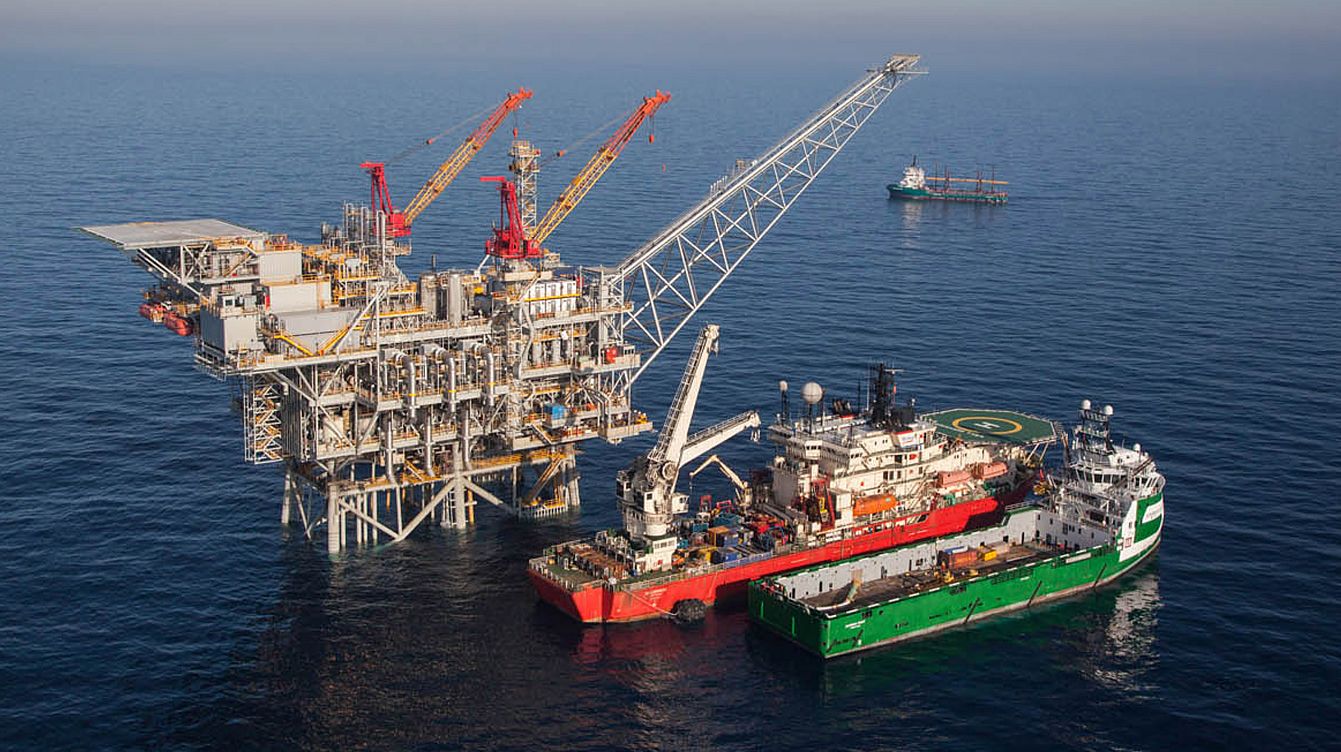




The “Kronos” field is more than just a natural gas project; it demonstrates the importance of regional cooperation in strengthening European energy security, said Diego Portoghese, ENI’s head of operations for North Africa and the Levant, on Tuesday.
Speaking at the 14th Energy Symposium in Nicosia, Mr. Portoghese noted that the goal is to begin natural gas production from the “Kronos” field, in Block 6 of the Cypriot EEZ, during the first half of 2028. This, he said, is a significant milestone for both ENI and Cyprus, which will become a natural gas-producing country for the first time.
ΣΧΕΤΙΚΑ ΑΡΘΡΑ


As he noted, the field is estimated to initially contain more than 3 trillion cubic feet (Tcf) of natural gas, while production is expected to reach up to 500 million cubic feet per day.
As he explained, the natural gas will be transported to Egypt, where it will be processed at existing facilities connected to the Zohr field and then liquefied at the Damietta liquefied natural gas (LNG) terminal, before being shipped to international markets, primarily in Europe.
Mr. Portoghese noted that the approval of the field’s Development Plan in May 2026, the issuance of the production license, and the recent award of the main contract for the design, procurement, construction, and installation of the relevant infrastructure mark the transition from discovery to development and from potential resources to their commercial exploitation.
In particular, he noted that the project highlights the importance of speed and realistic planning, as rather than waiting for the construction of entirely new extraction facilities, it makes use of existing regional infrastructure. In this way, he said, the start of production is accelerated, investment costs are reduced, and the project’s financial viability is improved for all parties involved.
At the same time, he emphasized that the project would not have been possible without the strong cooperation between the Republic of Cyprus and Egypt, adding that it demonstrates how neighboring countries can create shared value by interconnecting their energy resources, infrastructure, and capabilities.
Referring to European energy security, he said that “Kronos” offers new natural gas resources at a time when Europe is seeking diversified and reliable energy sources. He added that this is an example of harnessing local energy resources, which can help ensure a reliable, affordable, and lower-emission energy supply.
The ENI executive also noted that the “Kronos” is the company’s first deepwater field development project in Cyprus and provides the capabilities and expertise needed to develop future projects.
Speaking more broadly about the Eastern Mediterranean, he said that the region’s strategic importance is becoming increasingly evident, not only because of its significant natural gas reserves but also because of its potential to offer solutions through cooperation and regional integration. As she noted, Cyprus is at the center of this effort due to its geographical location between the region and European markets.
READ ALSO: Anita on Energy Projects: Let’s Move from Discussions to Implementation | AlphaNews
Reducing energy costs for citizens and businesses, strengthening energy security, and accelerating the green transition in a socially just and economically sustainable manner are the three objectives of the government’s energy strategy, stated Deputy Minister to the President Irini Piki at the same symposium, conveying the greetings of the President of the Republic, Nikos Christodoulides.
She emphasized that we are living in a time of constant geopolitical and economic change, with energy at the center of these developments, affecting the competitiveness of economies, the security of nations, and the cost of living for our citizens. “In this environment, Cyprus is consistently and realistically pursuing its path toward a safer, more sustainable, and more competitive energy model,” he said. He also said that the completion of the liquefied natural gas import terminal at Vasilikos is a priority, noting that the new competitive bidding process currently underway represents a very important step toward completing the project in a way that fully safeguards the interests of the Republic of Cyprus and its citizens.
Reducing Energy Costs
Regarding the goal of reducing energy costs, he noted that the amount of electricity bills remains one of the greatest challenges for both households and businesses. “That is why our actions are not limited to short-term support measures, but focus primarily on permanent and structural solutions,” he said, citing the opening of the competitive electricity market as a milestone in this direction. “A reform that contributes to the modernization of our economy, creates new choices for consumers, and lays the groundwork for a more efficient and competitive environment for the benefit of citizens and the economy,” he said.
Increased Use of Renewable Energy Sources
Regarding the increase in the use of renewable energy sources, he noted, for example, that by July 2026, more than 105,000 consumers—households and businesses—had installed photovoltaic systems for self-consumption, while applications for net metering are steadily increasing.
He noted that this development confirms that the green transition is no longer a future goal, but a reality that is already shaping our country’s energy landscape.
He noted that the progress recorded in renewable energy sources is particularly encouraging, adding that, at the same time, it highlights the need for an even faster upgrade of the country’s energy infrastructure.
He explained that the transition to a modern energy model is not just about producing clean energy but “it concerns our ability to transmit, manage, and utilize it in a more efficient manner.”
He also said that, in this context, efforts are underway to modernize the electricity transmission and distribution networks, introduce digital technologies, and the installation of smart meters that will allow for greater flexibility in the energy system.
Regarding the development of energy storage systems, he noted that they are a critical factor for the proper utilization of renewable energy sources and their integration into the energy mix.
National Observatory on Energy Poverty
Ms. Piki also referred to the operation of the National Observatory on Energy Poverty, which was approved this summer by the Council of Ministers, and which aims to strengthen the state’s capacity to more effectively identify citizens’ needs and design targeted policies. He added that for the energy transition to be truly successful, it must also be socially just so that its benefits are not limited to a few.
He also noted that, at the same time, significant European funds have been secured to address energy poverty and support our most vulnerable families.
“Our goal is for these funds to be utilized in a way that will produce real and lasting results,” he said, adding that at the same time, the government is continuing to implement energy retrofit programs for homes and businesses through various grant schemes, acknowledging that energy conservation is one of the most effective forms of investment for both households and the economy as a whole.
Referring to the recent “Save – Upgrade” program, she said that it had been well received, with the available budget being exhausted in a very short period of time, which, as she noted, confirms that energy-saving policies address society’s real needs.
“For us, this success is a sign of confidence and an incentive to continue investing in initiatives that reduce energy costs, enhance energy efficiency, and contribute to our national goals for the green transition.”
The country’s energy security is a priority
Regarding the terminal in Vasiliko, he emphasized that its completion is a priority, while adding that, regarding the development of domestic energy resources, 2026 was a particularly significant year for the hydrocarbons sector. The “Glafkos” and “Pegasus” discoveries in Block 10 were officially declared commercial, while ExxonMobil and QatarEnergy are now evaluating development options for the fields, with the aim of submitting development and production plans in early 2027.
“These developments confirm that Cyprus is gradually transitioning from the exploration phase to the development phase,” he said, adding that this transition creates significant economic prospects for our country, strengthens our country’s geostrategic importance, and elevates the role of the Republic of Cyprus in the broader energy landscape of the region.”
Regarding the GSI, he noted that the recent Intergovernmental Summit between Cyprus – Greece reaffirmed the two governments’ strategic commitment to implementing the project, which strengthens energy security, regional cooperation, and the integration of the European electricity market.
“There is ongoing cooperation and coordination with the Greek Prime Minister and the French President regarding this project, as it is of strategic importance for the energy future of the country and the wider region,” she said.
The Deputy Minister noted that Cyprus’s energy policy has a clear geopolitical dimension and is directly linked to Cyprus’s role in the Eastern Mediterranean and Europe.
“Through our partnerships with neighboring countries, we are working to create conditions of security, stability, and mutual benefit,” he said, adding that the Republic of Cyprus’s energy initiatives serve both national and European interests by contributing to the diversification of Europe’s energy sources and supply routes.
“The government’s energy policy is based on realism, responsibility, and long-term planning. There are no easy solutions or immediate results. However, there is a clear direction, a concrete plan, and systematic work,” Ms. Piki concluded.
Source: CNA