Speakers raised concerns during the event regarding the economic benefits Cyprus will ultimately derive from the exploitation of its natural gas reserves, as well as regarding its negotiating position vis-à-vis major energy companies, were raised by speakers during a discussion on the hydrocarbon market at the 14th Energy Symposium titled “Major Challenges in Energy and the Future.”
Energy expert Charles Ellinas noted that Cyprus’s negotiations took place under pressure, noting that the funds the country will ultimately receive may not be as substantial as expected from the “Kronos” field. He also emphasized that the goal should not simply be to sell the natural gas, but to secure terms that will yield a satisfactory economic return.
ΣΧΕΤΙΚΑ ΑΡΘΡΑ


“Selling is the easy part. The hard part is securing the terms that will bring us a satisfactory economic return,” he said, stressing that Cyprus should not proceed with the development of the fields solely for the purpose of putting the natural gas on the market.
For his part, petroleum geologist and energy economist Konstantinos Nikolaou criticized Cyprus’s negotiating position, saying that the country is vulnerable and that large companies are exploiting its vulnerability vis-à-vis Turkey to impose their own positions.
He also noted that the benefits Cyprus will derive from the development of its reserves will depend largely on the negotiations regarding the sale of natural gas. Referring to the delays in their development, he attributed them, among other things, to the relatively small to medium size of the fields, the fact that they belong to different business groups, and the distance between them.
Dimitris Fessas, General Manager of the Cyprus Hydrocarbons Company, Dimitris Fessas, who emphasized that the participation of large companies is crucial for the development of Cyprus’s reserves, as the discoveries are located at great depths and require specialized expertise and significant investment capital.
As he noted, the participation of major companies and their investments are important for Cyprus, while the available infrastructure in Egypt helped the Kronos field development project move forward quickly.
Regarding the final financial outcome, he said that this will depend on future market prices and the quantities of natural gas that can be recovered from the field, noting that no one can predict the amount of revenue at this time.
Mr. Fessas added that there are clauses in the contracts with the companies and that efforts are being made to maximize natural gas recovery and production from the fields.
Egypt as a Market and the Prospects for the Fields
Referring to the prospects for the sale of Cypriot natural gas, Mr. Ellinas described Egypt as an important market, as it faces a growing deficit between domestic production and consumption. As he noted, the deficit amounted to approximately 20 billion cubic meters last year and is even larger this year.
As he noted, the supply of 4to 5 billion cubic meters of natural gas from the Kronos field could help diversify Egypt’s supply and reduce the need for LNG imports, though it would not free the country from its dependence on Israel.
As for the European market, he noted that it is not an obvious destination for natural gas from the Eastern Mediterranean, as the EU aims to gradually reduce its dependence on natural gas by 2035–2040.
Referring to the development prospects for Cyprus’s gas fields, he expressed doubts about the production and export timelines. According to the estimates he presented, the Aphrodite field is not expected to produce natural gas in 2032, while ExxonMobil aims to begin exporting natural gas to Egypt in 2033.
Mr. Ellinas noted, however, that the company is planning further exploration in both the Cypriot blocks and in Egypt, and estimated that potential new discoveries and an increase in reserves could lead it to reevaluateits export strategy, leaving open the possibility of revisiting the option of natural gas liquefaction in Cyprus.
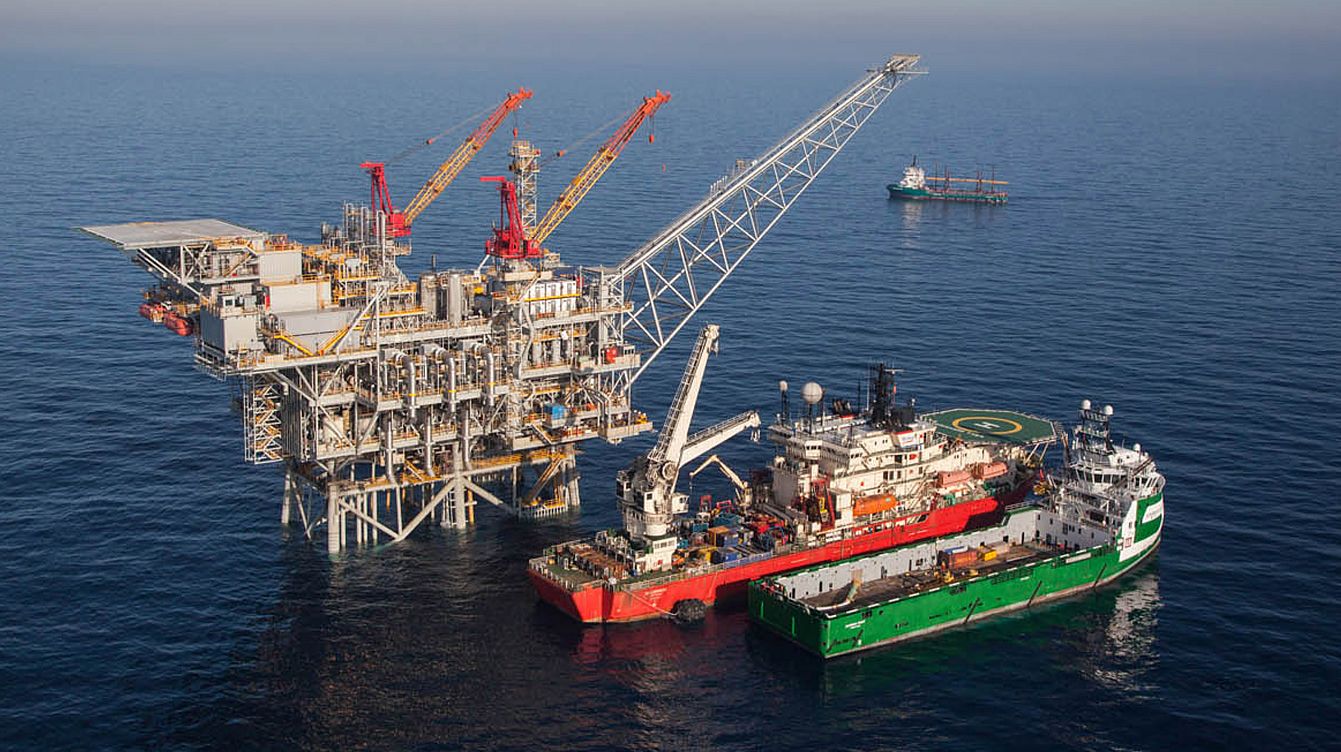
Mr. Fessas presented the development plan for the Kronos field, with estimated resources exceeding 3 trillion cubic feet. The plan calls for four wells at a depth of approximately 2,400 meters deep and a 110-kilometer-long subsea pipeline to the existing infrastructure of the Zor field in Egypt. From there, the gas will be transported for processing and then to the Damietta LNG facilities for liquefaction and export. First production is scheduled for the first half of 2028.
Regarding the Aphrodite field, he noted that the basic design study is expected to be completed by the end of 2026, with the final investment decision scheduled for 2027 and first production in 2031. In Block 10, he said that the joint development of the Glafkos and Pegasus discoveries is being considered, with first production targeted for 2033.
Plans for a Pipeline from Turkey to Occupied Kyrenia
Mr. Nikolaou also presented plans for the construction of a 101-kilometer-long natural gas pipeline, which will connect the Anemurium region in Turkey to a power plant in occupied Kyrenia.
As he noted, according to the information he presented, the agreement for the project was signed in July, and seabed surveys were conducted in August.
He pointed out that, while the natural gas needs of the Turkish Cypriots are estimated at approximately 0.3 billion cubic meters per year, the planned capacity of the pipeline amounts to 10 billion cubic meters. He added that it had initially been reported that the project would serve the needs of Turkish ships; however, the plan was subsequently presented as a bidirectional pipeline for natural gas transportation.
He described this development as significant, noting that Cyprus should monitor it closely, as it could cause turmoil in the region.
Impact on electricity prices remains uncertain
The President of DEFA and ETYFA, George Pistentis, noting that it is not yet possible to determine by how much electricity prices will decrease.
As he explained, the impact will depend on the final terms of the natural gas supply agreement, the cost of completing the terminal at Vasilikos and the portion of the investment that will be incorporated into the cost of electricity, as well as other factors, taxes, and fees.
“It would be very difficult to give a precise figure. However, you can provide a range,” he said, noting that efforts to secure a natural gas supply are still in the early stages.
Regarding the terminal at Vasilikos, he said the goal is to complete it in 2029–2030, while the selection of a new contractor is expected in the first half of 2027.
Referring to Cyprus’s energy needs, Mr. Pistentis noted that electricity demand last year far exceeded even the most extreme scenario that had been predicted. At the same time, he stated that the country’s energy system should be based on three pillars: renewable energy sources, the electricity interconnection, and natural gas.
Mr. Pistentis explained that, while renewable energy sources are an important and cost-effective source of electricity generation, they require grid reinforcement and storage solutions, while electricity interconnections provide access to other markets but cannot, on their own, meet all needs. Natural gas, he added, can complement the other two pillars by supporting controlled electricity generation when needed.
Source: CNA