



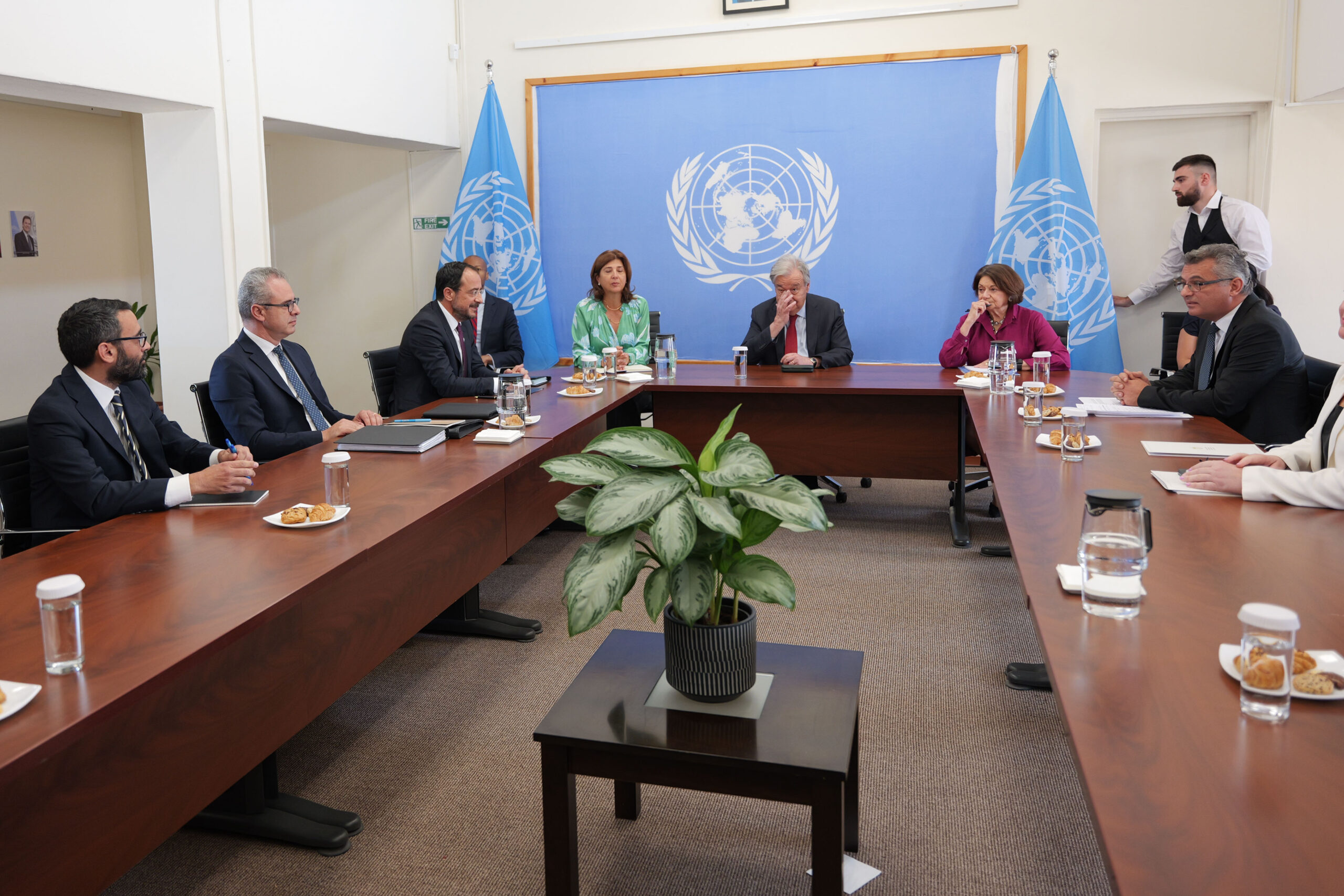
The President of the Republic, Nikos Christodoulides, and the Turkish Cypriot leader, Tufan Erhurman, are calling on UN Secretary-General António Gto set the date and location for the new Trilateral Meeting he has announced.
Immediately upon his return to the Presidential Palace, Nikos Christodoulides explained that the most significant outcome of today’s meeting between the two leaders is the joint call and the strong conviction they expressed that the opportunity presented by Guterres’s presence at the helm of the UN, and he expressed hope for an immediate response.
ΣΧΕΤΙΚΑ ΑΡΘΡΑ


SEE ALSO: President Christodoulides: In a positive mood ahead of the meeting with Erhurman, “the goal is to achieve results”
The President of the Republic noted that the Trilateral Meeting will provide an opportunity to discuss the pending Confidence-Building Measures, as well as the substantive and methodological issues of the Cyprus problem. At the same time, he emphasized that the outcome of the meeting will determine the convening of a new Informal Five-Party Conference on the Cyprus problem, a move that is the intention of the UN Secretary-General, which he also expressed during their recent meeting in Antalya, on the sidelines of the International Climate Summit.
Regarding the opening of the Athienou and Mia Milia roadblocks and the return of the enclosed town of Varosia, Nikos Christodoulides made no secret of the fact that these issues were discussed today and that there are disagreements.
When asked about the new Turkish threats that have been made, the President of the Republic said that the government does not downplay them; however, he noted that the occupied territories are currently in the midst of an election campaign.
READ ALSO: Deal on Two Projects: Christodoulides and Erhurman Discussed the MOU and Stated They Are Ready to Meet with Guterres
Christodoulides and Erhurman agreed, meanwhile, to allocate more square meters of space for excavations being conducted in the occupied territories by the CMP to locate the remains of missing persons and to simplify the process regarding the ongoing submission of requests to the pseudo-state to secure “permits.”
At the same time, the two leaders agreed to schedule religious services in the occupied and free areas for the next six months, with the aim of ensuring that requests from Greek Cypriot worshippers who wish to travel in groups—primarily to restored churches—are not rejected.








