



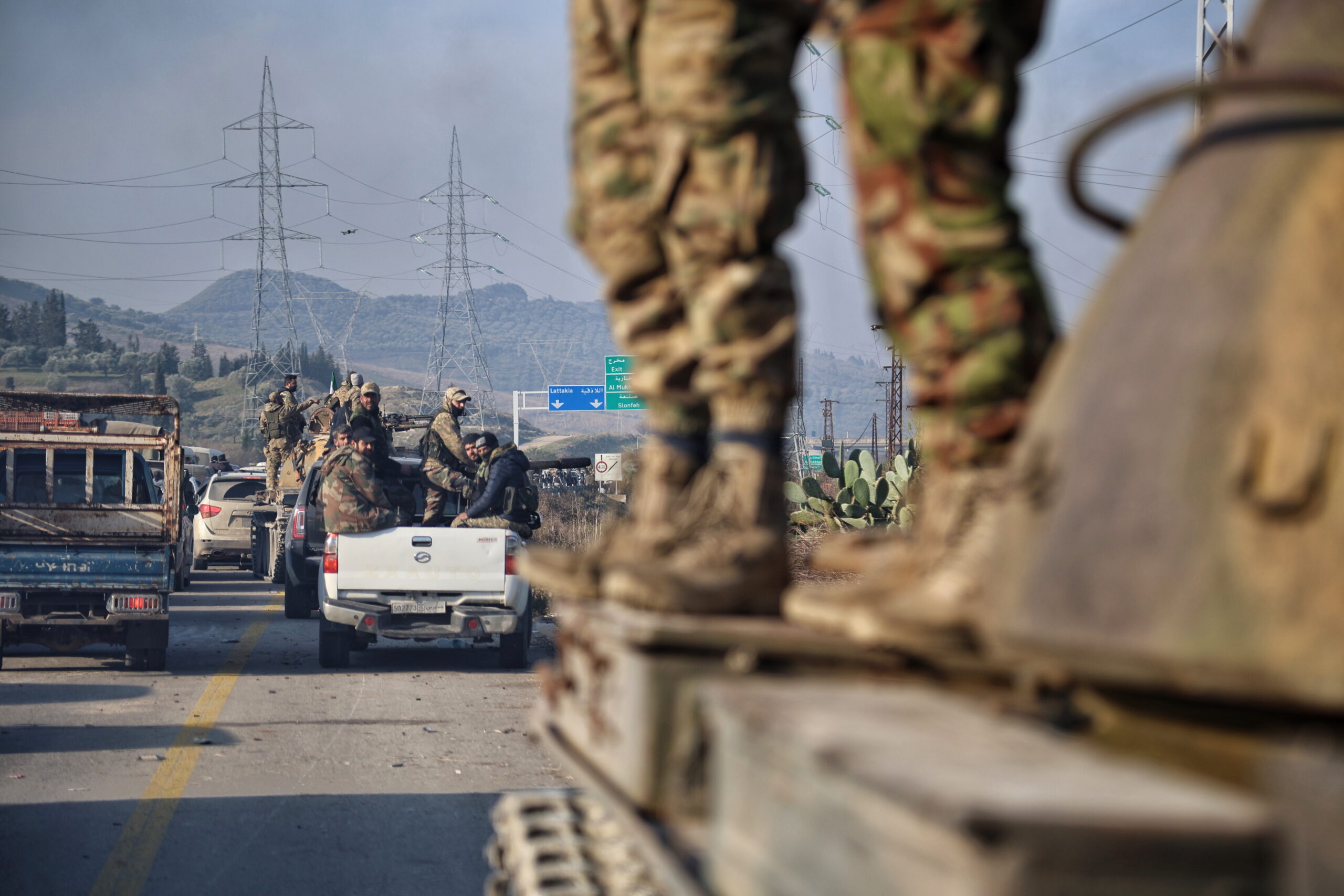
Syrian Kurdish leader Mazlum Abdi announced Tuesday night the dissolution of the powerful Syrian Democratic Forces (SDF), which had been the spearhead in the battles that led to the defeat of the Islamic State jihadists, in accordance with an agreement signed earlier this year with Syria’s de facto President Ahmad al-Sarra, who has declared his determination to “reunite” Syria.
“We are announcing today the end of the mission of the Syrian Democratic Forces and declaring, with full responsibility, their dissolution as an independent military force,” said Mr. Abdi during a speech he delivered in two languages—first in Arabic, then in Kurdish.
ΣΧΕΤΙΚΑ ΑΡΘΡΑ

Is Iraq being “neutralized”?

Series of explosions in Aleppo, Syria
He made this announcement at the presidential palace in Damascus, following a meeting with the Islamist president—the former leader of al-Qaeda’s Syrian branch, who has, however, over the years assured that he has severed all ties with the organization—, in the presence of other Syrian Kurdish military and political leaders.
The de facto Syrian government and the Kurds had been negotiating for months over the implementation of an agreement signed in January that provided for the full integration of Kurdish institutions into the new state apparatus.
Since taking power in 2024, the new de facto president, who overthrew Bashar al-Assad, has emphasized that his goal is to “reunite” the country that had been torn apart by the long-running civil war and to dismantle all armed groups.
Amid the chaos of the civil war (2011–2024), the Kurds seized control of vast swaths of northern and northeastern Syria and established autonomous administrations.
According to Syrian state television, Mr. Abdi’s announcement also calls for the dissolution of the autonomous administration and all military and political structures affiliated with it, as well as their full integration into the Syrian state apparatus.
Mr. Abdi noted that the dissolution of the organization follows “the agreement reached with President Sara and the completion of the integration of our forces (…) into the Syrian army.”
The U.S. Ambassador to Turkey and President Donald Trump’s special envoy to Syria, Tom Barak, describing it as a “true integration” that “strengthens the national sovereignty” of the country.
This development follows the U.S. announcement the previous day that it was removing Syria from the blacklist of states accused of supporting “terrorism,” a key step toward the reconstruction and recovery of its economy.
The SDF, founded in 2015, at Washington’s initiative, served as the military arm of the autonomous Kurdish administration in Syria and played a pivotal role in the defeat of ISIS, with the support of the U.S.-led international anti-jihadist coalition.
At their peak, they numbered, according to some estimates, as many as 100,000 fighters, mainly Kurds and Arabs, and they controlled vast swaths of territory in the northern and northeastern parts of the country—areas rich in oil.
“Since the SDF’s founding, our fighters have shouldered a great deal of responsibility during one of the most difficult periods” in Syria’s history, said their leader.
“They liberated many cities and communities, first from the Ba’athist regime, then from Daesh’s terrorism,” he added, referring in turn to the government of ousted President Assad, the heir to the Ba’ath Party in Syria, and to ISIS, using the Arabic term for the jihadist organization.
The disbandment of the SDF, which for a long time was considered the best-trained and most organized force—perhaps in the entire country—signals, according to some experts, the end of an era for the Kurds in the country.
For decades, the minority had dreamed of—and, after the civil war broke out, had begun to fight for—greater autonomy, until the fall of former President Assad — a development that led Washington to change its stance and side with the new de facto authorities in Damascus, who are favorably disposed toward the U.S.
Remnants of ISIS, although the jihadist organization was defeated in Syria in 2019 when its its “caliphate” collapsed and it lost the territory it held, remain active in the country.
“Circumstances have changed today, and the country has entered a new phase,” said Mr. Abdi, speaking of “peace” and “participation.”
However, he pointed out that “the right to education in the Kurdish language is among the most important rights that the Kurdish people have been demanding for decades” and recalled that de facto President Sara has repeatedly expressed his commitment to defending it.
According to analysts, there are an estimated 2 million Kurds in Syria, where the total population stands at 20 million.
In January, Syria’s de facto president signed an executive decree recognizing the rights of the Kurds and Kurdish as a national language, for the first time since Syria’s independence in 1946.
Source: KYPE





