



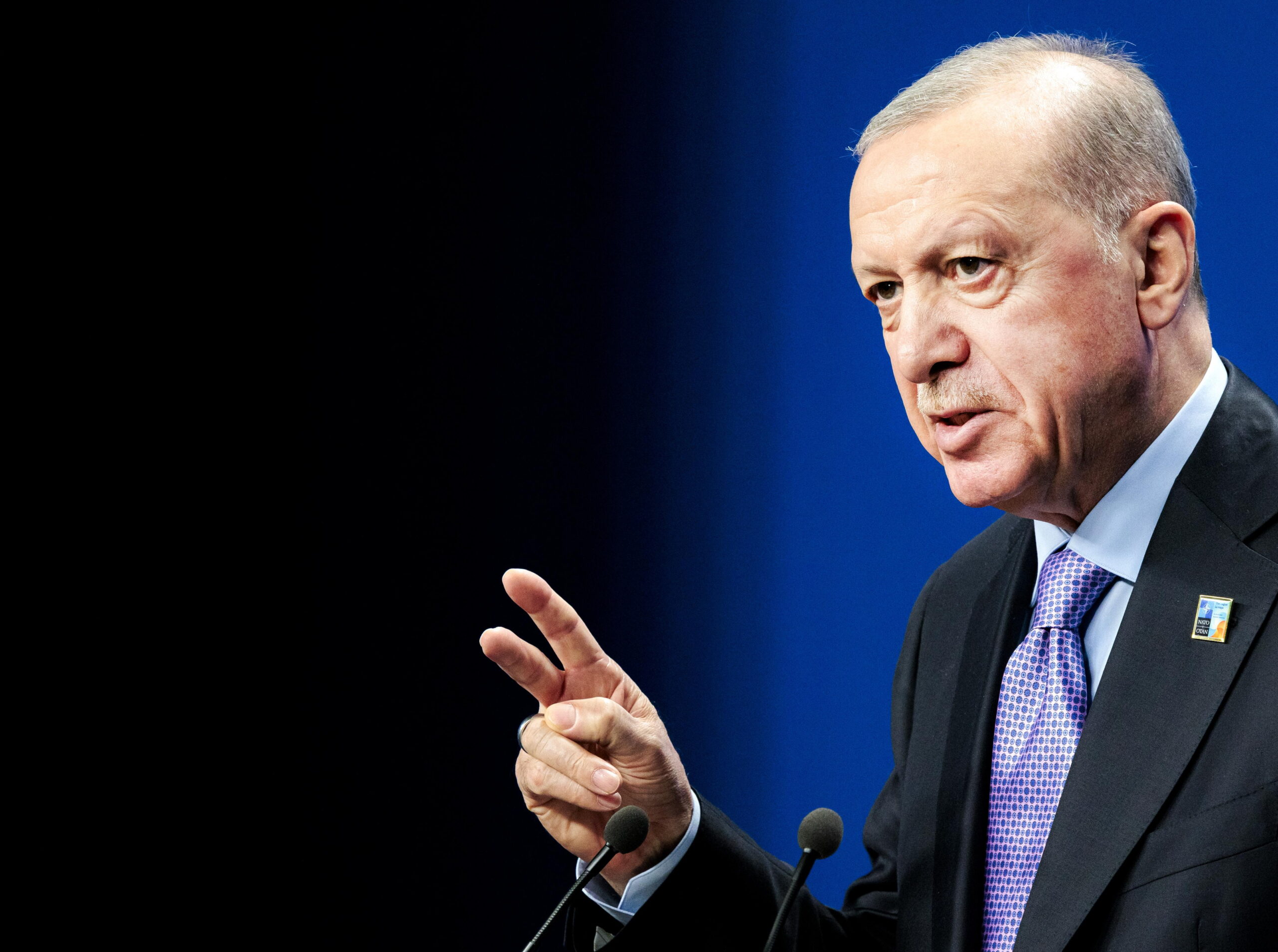
Recep Tayyip Erdoğan faces a double challenge as he hosts the leaders of NATO member states in Ankara for the NorthAtlantic Alliance on Tuesday and Wednesday (July 7 and 8). This is because, on the one hand, he wants the summit to be a success that will bolster his own prestige and that of his country, and on the other hand, he wants to take advantage of Donald Trump’s presence to reap as manyfrom the U.S.
That is why many consider the meeting between the two leaders at the White House at noon on Tuesday (July 7), shortly after the U.S. president’s arrival in the Turkish capital.
ΣΧΕΤΙΚΑ ΑΡΘΡΑ


According to reports, four key issues are expected to be raised at the meeting.
Pressure over the F-35s
The first item on the agenda will be defense cooperation. The meeting is expected to cover the lifting of CAATSA sanctions, Turkey’s reinstatement in the F-35 program, the sale of engines for the KAAN fighter jets, and new defense cooperation programs.
Turkey has made no secret of the fact that its primary goal is the lifting of certain U.S. sanctions and, above all, Turkey’s reinstatement in the F-35 fighter jet program, from which it was excluded following the purchase of the Russian S-400 systems.
In fact, when asked by a reporter if he would travel to Turkey with a “gift” for Erdogan—namely, the F-35s—the U.S. president replied:
“I think so. He’s a member of NATO. Some people don’t take him seriously, but he’s actually a strong member of NATO. I’ll probably do something that will make him very happy (i.e., the Turkish president, Recep Tayyip Erdogan).”
What will ultimately happen remains to be seen, but consultations are ongoing at all levels, as on Monday (July 6), Turkish Foreign Minister Hakan Fidan held a one-on-one meeting with U.S. Ambassador Tom Barak.
The second topic will concern trade. Plans are in place to explore new avenues of cooperation with the goal of achieving a bilateral trade volume of $100 billion.
Cooperation in the energy sector will be the third key topic of the talks. Following the signing of the Memorandum of Strategic Cooperation on Civil Nuclear Energy during Erdogan’s visit to Washington in 2025, it is expected that the talks in Ankara will address new agreements in the energy sector.
The fourth item on the agenda will be regional developments. According to reports, the meeting is expected to cover cooperation on the reconstruction of Syria, the eradication of terrorism from the region, the resumption of peace talks regarding the Russia-Ukraine war, the reconstruction of Gaza, preventing ceasefire violations by Israel, as well as halting the activities of FETÖ leaders in the United States.
Focus on Ukraine and Iran
Ukraine and Iran will be the focus of the leaders’ discussions at the NATO summit. Shortly before departing for Turkey, Trump stated that a solution to the war in Ukraine “is closer than people think” and that he would discuss this issue during his meetings.
“We’re talking; we’ll see if we can end” the war, said the U.S. president, speaking to reporters in the Oval Office, and adding that his Russian counterpart, Vladimir Putin, “is feeling the pressure.”
Regarding Iran, Trump reiterated that the U.S. is not seeking regime change in that country and warned that Tehran “would be better off making a deal.” The U.S. will either reach an agreement with Iran or “finish the job,” he added.
For his part, NATO Secretary General Mark Rutte pledged contracts “worth billions of dollars” to strengthen the Alliance’s defense capabilities, on the eve of the summit in Ankara.
“We will announce new contracts worth tens of billions of dollars that will allow us to procure the necessary equipment for deterrence and defense,” he announced during a press conference in the Turkish capital.
A tense summit
This does not mean that tensions will be absent, as has been the case in the past.
However, tensions ahead of the summit in Ankara are running much higher than in previous years. This is due to the fact that the Trump administration has expressed its intention to reduce its involvement in European security.
President Trump is arriving in a bad mood because the other allies did not support U.S. action against Iran to the extent he had hoped. For his administration, this is an example of what they view as “exploitation” of European security at the expense of the U.S., as they believe their actions in the Middle East will benefit global security as a whole.
The U.S. president’s dissatisfaction with the Iran issue has led to serious disagreements with several European leaders, including UK Prime Minister Keir Starmer, Italian Prime Minister Giorgia Meloni, and German Chancellor Friedrich Merz.
All three of these leaders had maintained relatively close ties with President Trump and had received praise from him, but that is no longer the case.
Disagreements Over Defense
U.S. threats against Greenland in January and February served as yet another source of tension between the U.S. and Europe. Europe now views Washington’s intentions with much greater skepticism. The U.S. is now seen as an ally with a short memory, one that forgets the support of the Europeans when the U.S. requested the invocation of Article 5 to provide assistance following the September 11 attacks.
According to reports, U.S. officials have privately warned several European allies that their orders from American defense contractors may be delayed, as Washington prioritizes replenishing its own stockpiles following the war with Iran, reinforcing the sense that the U.S. is distancing itself from Europe.
For Europeans, this shift justifies a focus on rebuilding European defense industrial capabilities. This will allow them to reduce their dependence on the U.S. with regard to future procurement contracts.
However, this growing independence will undoubtedly exacerbate tensions between the U.S. and its European allies in the future: Although the U.S. has encouraged its European allies to increase their defense spending, there also appears to be an expectation that this will take the form of continued purchases of American equipment. If the number of European orders declines over time, the U.S. may no longer view a Europe that secures its defense more independently in such a positive light.
Source: Cnn.gr
*File photo





