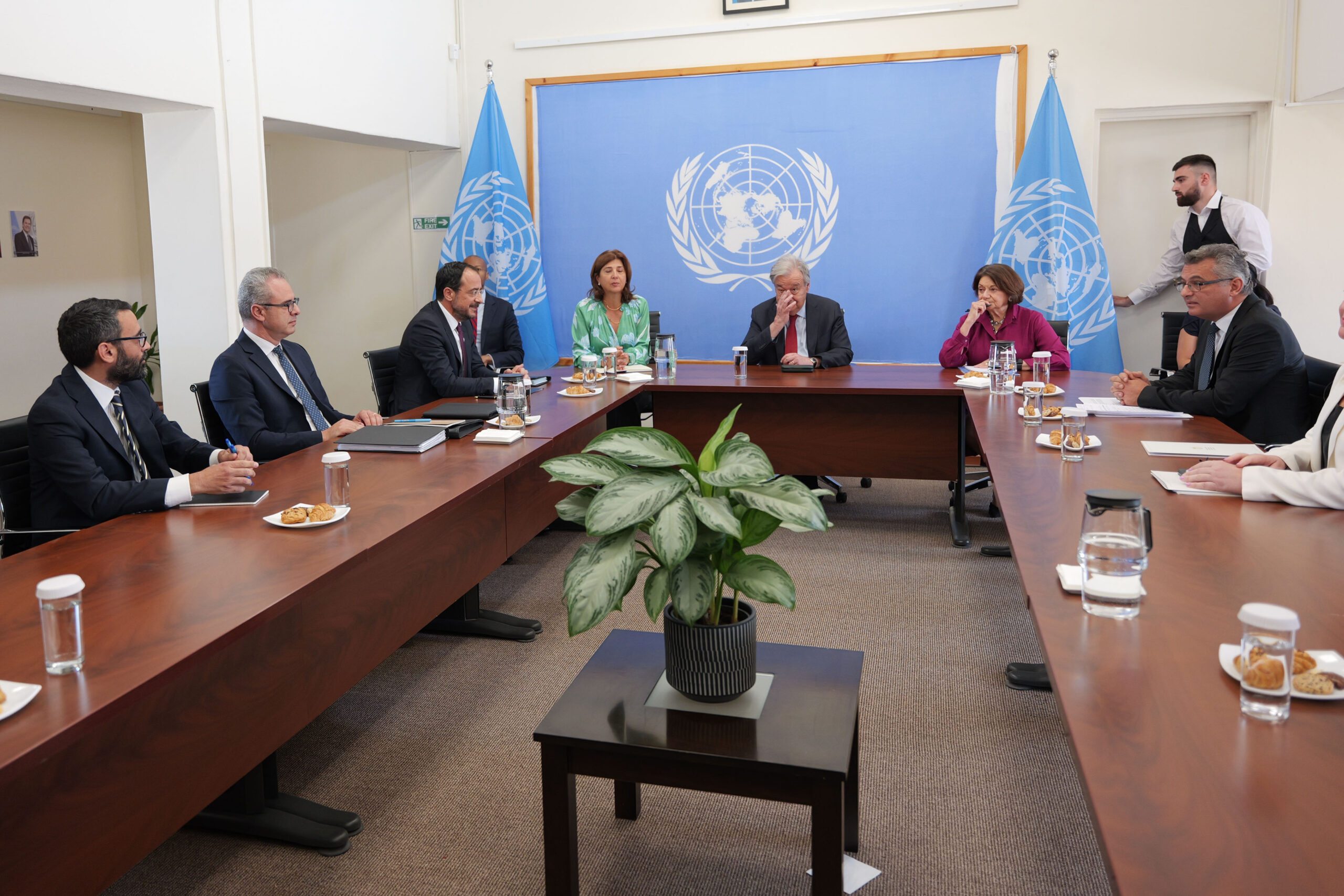
Diplomatic turmoil over the Cyprus issue, with the United Nations changing its timetable before announcing the convening of the new informal five-party meeting.
While everyone was expecting the Secretary-General’s Personal Envoy to arrive tomorrow, Monday, in Brussels, the schedule has changed, with Maria Achnella Olgin now waiting first for the results of the NATO Summit, which will take place in Ankara on July 7 and 8.
ΣΧΕΤΙΚΑ ΑΡΘΡΑ


Change of Plans
Key topics of discussion at the NATO Summit will be the strengthening of collective defense, the situation in Ukraine, and the Middle East in the wake of the agreement to end the war; however, Euro-Turkish relations will also be discussed on the sidelines of the summit.
European officials, such as António Costa and Ursula von der Leyen, will also be attending the NATO summit—with whom Olgin will meet afterward, specifically on July 13 in Brussels.
What António Guterres’s Personal Envoy will seek to do is to bring the outstanding issues between Ankara and Brussels to the table and to explore how Turkey’s European perspective can be linked in a way that will positively influence developments in the Cyprus issue.
Cyprus and NATO
A United Nations source told “Alpha on Sunday” that the Europeans’ visit to the NATO summit is by no means coincidental.
The summit is considered of exceptional importance for global geopolitical security, as a new world order requires Cyprus to break free from the anachronistic system of guarantees that exists today.
“The Europeans will make it clear to Erdogan that, since he does not accept the European Union as a guarantor for the island, he could then accept Cyprus’s accession to NATO. They will point out that, in any case, the three current guarantor countries are members of the Alliance.”
The Cyprus Issue and Turkey
At the same time, parliamentary parties are assessing these developments, with the Speaker of the House and DISY President, Anita Dimitriou, stating that it is still too early to speak of momentum on the Cyprus issue, while clarifying her position on the link between EU-Turkey relations and the Cyprus issue.
“Progress in EU-Turkey relations must be linked to substantive steps on the Cyprus issue. Turkey cannot demand everything without offering anything in return. Recently, at the EPP Summit, we succeeded in having our proposal incorporated into the final joint document, with a specific reference to Cyprus: “that the European security architecture cannot be completed as long as an EU member state remains under Turkish occupation.”
For his part, AKEL Secretary-General Stefanos Stefanou insists in an article in the Sunday press that the Greek Cypriot side should take specific steps.
“It must insist on resuming negotiations from the point where they were suspended in 2017. It should request that the UN document the areas of convergence. It should reject any attempts to introduce so-called new ideas on issues that have already been agreed upon.”
Meanwhile, Stefanos Stefanou also refers to the major chapters that remain unresolved—namely, property and the guarantee system—and puts AKEL’s ideas on the table.
See Giorgos Chrysanthos’s report: