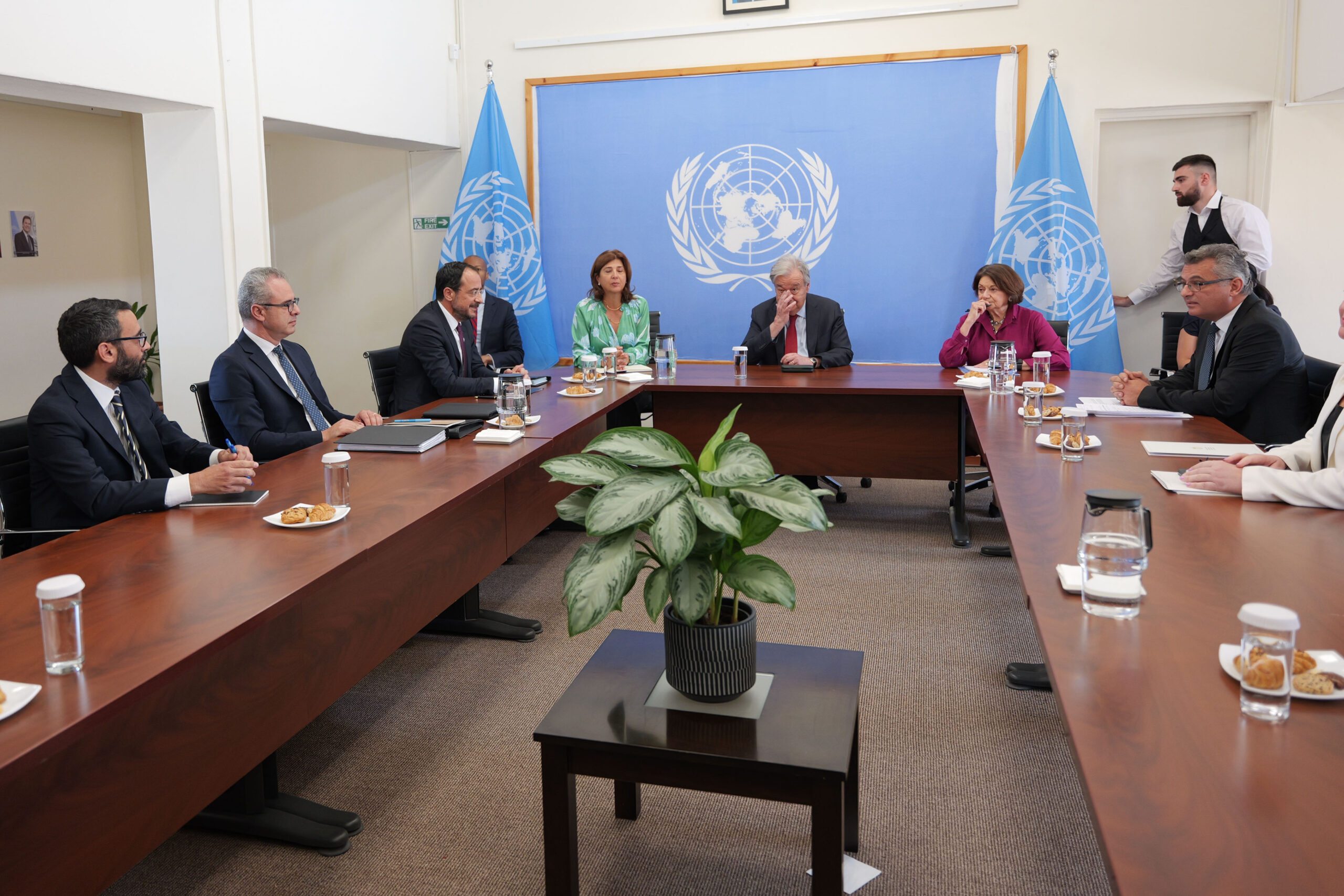
United Nations Secretary-General António Guterres, in the Good Offices Report, urges the leaders of the two communities to take advantage of “this window of opportunity for progress,” which, he notes, “should not be taken for granted,” while noting the intensification of the dialogue as a positive development.
It also reiterates, among other things, the importance of approaching the dialogue process “in a spirit of openness, flexibility, and compromise,” as well as the need for the parties to demonstrate “the necessary political will and commitment.”
ΣΧΕΤΙΚΑ ΑΡΘΡΑ


The UN Secretary-General notes the intensified dialogue between the two leaders as a positive development, but warns that, without the implementation of agreed confidence-building measures and without the resumption of substantive negotiations, “a lasting solution may remain out of reach.”
In his remarks, the Secretary-General notes that “the intensification of dialogue between the Greek Cypriot and Turkish Cypriot leaders during the reporting period remains positive.” As he notes, this “demonstrates their commitment to building a relationship based on trust and finding a way forward on the Cyprus issue.”
He states that he is “encouraged” by the agreement on the framework for establishing an advisory body for civil society participation in the peace process. He describes it as “an important step,” as requested by the Security Council and by the Cypriots themselves, toward “a more inclusive peace process, where the public remains informed and engaged.”
Despite this positive assessment, the Secretary-General emphasizes that “several confidence-building measures agreed upon in March and July 2025 remain unimplemented,” including the opening of additional crossing points. Their implementation, he notes, “would improve the daily lives of Cypriots” and would demonstrate “in a concrete way that the sides have the political will to make progress.”
The Secretary-General calls on the leaders to continue their “constructive engagement” with one another and with his Personal Envoy, with the aim of resuming negotiations that will lead to “a lasting and comprehensive settlement.” He urges them to seize “this current window of opportunity for progress,” which, as he emphasizes, “should not be taken for granted.”
In the same vein, he calls on both sides to engage “with determination to build a common future,” reaching an agreement that takes into account “the interests and rights of all Cypriots.” He also reiterates the importance of approaching the dialogue process “in a spirit of openness, flexibility, and compromise,” as well as the need for the sides to demonstrate “the necessary political will and commitment.”
As he notes, this is based on the continued support of the guarantor powers and the broader international community, including the European Union.
Mr. Guterres emphasizes that “the unstable situation in the Middle East has attracted significant public attention, including, among other things, the deployment of significant foreign military forces in and around Cyprus, causing some tension between the sides.”
Special mention is made of the participation of women, young people, and underrepresented groups. The Secretary-General emphasizes that the implementation of the “Women, Peace, and Security” agenda and the “Youth, Peace, and Security” agenda, as well as the participation of women, religious minorities, youth, and people with disabilities in the peace process, are “critical.”
It commends both sides for maintaining gender-balanced representation on the technical committees and reiterates its call on the leaders to implement the April 2022 Action Plan for the “full, equal, and meaningful participation of women” in the settlement process.
Regarding the technical committees, the Secretary-General expresses satisfaction that they “continued to capitalize on their increased importance,” emphasizing the “added value” of their work and their contribution to strengthening dialogue and the peace process. He calls on the two leaders, however, to support progress in areas such as education, crisis management, and the environment. He reiterates that education is essential for fostering “reconciliation, forgiveness, and cooperation” among school-age children.
The Secretary-General also refers to sports, noting that, although it remains “underutilized” as a tool for reconciliation and trust-building, particularly among young people, it has demonstrated “a unique ability to bring together people who might otherwise not interact.”
However, the report also includes a clear warning about unilateral actions in and around the buffer zone. The Secretary-General states that he remains “deeply concerned” about the actions of both sides, as well as the lack of progress on de-escalation measures.
As he notes, these actions “undermine the military status quo in the region, the integrity of the buffer zone, and the Security Council’s mandate” and “do not contribute to the broader peace process.”
Regarding Varosia, it reiterates that it continues to monitor the situation in the enclosed area and emphasizes that “the United Nations’ position on Varosia remains unchanged,” including the need to comply with Security Council Resolutions 550 and 789.
On the issue of crossing points, the Secretary-General once again calls on the two leaders “to explore ways to overcome the deadlocks” surrounding the opening of new crossing points. He also calls on both sides to cooperate in facilitating the movement of people and goods through existing crossing points. It specifically notes that the full benefits of the expansion of the Agios Dometios/Metahan will depend on adequate staffing for document checks and services, as agreed by the leaders on December 11, 2025.
At the same time, it calls for the full implementation of the Green Line Regulation in order to increase the volume of intra-Cypriot trade and cooperation between the two communities. It welcomes, however, the fact that the two leaders agreed to cooperate on other important issues affecting the economy and trade.
The report also welcomes the leaders’ agreement on May 8 to work on a preliminary plan for the conduct of religious services. The Secretary-General notes that religious leaders have in the past been “a strong common voice for peace” and in support of dialogue between the two community leaders and the efforts of the United Nations. He encourages them to work together toward “a common approach” on issues of importance to the entire island.
Among the key events of the period, the report notes that the Secretary-General continued his efforts to achieve a peaceful resolution of the Cyprus issue, meeting separately with Greek Cypriot leader Nicos Christodoulides and Turkish Cypriot leader Tufan Erhurman. His Personal Envoy, María Ángela Olguín, “stepped up her efforts” to support the Cypriots “in finding a way forward” and reaching a negotiated solution.
Ms. Olguín visited Cyprus in January and June 2026. During her January visit, she met separately with the two leaders and hosted a joint meeting on January 28. The report states that she strongly encouraged them to adopt measures that would build trust and improve the daily lives of Cypriots. In June, she met twice with each leader, as well as with political parties in the south following the May 2026 parliamentary elections, representatives of the two leaders, and other stakeholders.
The Personal Envoy also held talks with the foreign ministers of Turkey and Greece, in Ankara and Athens, respectively, as well as with senior officials from the United Kingdom, the European Union, and the United States. In her discussions with High Representative/Vice President Kaya Kallas, she emphasized “the need for young Cypriots to engage with the dynamics and realities of the island” and the importance of the European Union’s support for the Secretary-General’s efforts.
The report also notes that the two leaders met bilaterally, under the auspices of the United Nations, three additional times during the reporting period, continuing the “significantly higher frequency of meetings” that began late last year after Mr. Erhurman took office. In addition, 26 meetings were held between representatives of the two leaders.
Of the ten confidence-building initiatives agreed upon at the expanded-format meetings in March and July 2025, the sides moved forward with the civil society consultative body, the restoration of cemeteries, and the creation of a Technical Committee on Youth. Conversely, “there have been no significant developments” regarding the opening of new crossing points, demining, the construction of a solar park in the buffer zone, the exchange of works of art and artifacts, or environmental initiatives.
In the context and background of the report, it is noted that the situation in the buffer zone remained fragile, particularly on the Pyla Plateau. The outbreak of foot-and-mouth disease among livestock was also a “major issue” that affected both communities and bicommunal relations, with accusations flying back and forth over containment measures and protests by livestock farmers.
The Republic of Cyprus, the report notes, assumed the Presidency of the Council of the European Union on January 1, 2026, for a six-month term. The report notes as noteworthy that leaders continued to meet regularly during this period, unlike in 2012, when the Republic of Cyprus last held the Presidency of the Council. It is also noted that parliamentary elections were held in the south on May 24.
Regarding the Good Offices mission, the report states that it promoted contacts within the island, cooperation, and confidence-building, holding 128 meetings with representatives of the leaders, political parties, religious leaders, civil society organizations, women and youth, the European Union, the World Bank, the diplomatic community, and senior officials from member states.
The increased commitment of the two leaders strengthened the work of the technical committees. During the reporting period, 174 meetings were held across all 13 technical committees, under the auspices of the mission and with the support of UNFICYP. The most active committees were those on crossing points, cultural heritage, culture, economic and trade issues, health, and youth.
The Technical Committee on Crossing Points held an event to mark the completion of the long-awaited expansion of the Agios Dometios/Metechan crossing point in Nicosia. The project, implemented by the United Nations Development Programme, added lanes, booths, a pedestrian walkway, and space for solar lighting and greenery.
The Technical Committee on Cultural Heritage continued its cemetery program, with restoration and maintenance work on approximately 70 cemeteries having been completed, currently underway, or in the planning stages. The committee also promoted digital cultural heritage through 3D reconstruction and virtual reality, with the aim of enhancing access, youth engagement, and intergenerational learning.
The Technical Committee on Culture organized the exhibition “Through Ordinary Eyes,” featuring photographs of daily life and experiences of people on both sides of the division in Nicosia.
The Technical Committee on Economic and Commercial Affairs oversaw a pilot exchange of worn euro banknotes located in the north for new ones, totaling 2 million euros, and organized an event for women entrepreneurs.
The Technical Committee on Gender Equality resumed its work in January 2026, following a hiatus in 2025. For International Women’s Day, it issued a joint statement and a video in Greek, Turkish, and English, emphasizing that women’s full and equal participation in public life and decision-making is vital for trust, strong institutions, and lasting peace.
The Technical Committee on Health reviewed patient cases and, through the Subcommittee on Veterinary Affairs, monitored the foot-and-mouth disease outbreak and helped ensure the availability of vaccines for animals of EU origin throughout the island.
The report also highlights the youth dimension. The Secretary-General notes that the increased visibility of the youth agenda, peace, and security was “remarkable,” making the current dialogue process “more inclusive and responsive to the views of young people.” The Technical Committee on Youth organized an event on mental health and the challenges faced by young people across the island, visited EU institutions in Brussels, and raised the issue of “sports for peace” in its discussions.
The Secretary-General states that he remains committed to maintaining contact and dialogue with the parties and the guarantor powers, “in search of a path toward a peaceful settlement,” guided by the relevant Security Council resolutions.
“I call on these countries to continue to engage constructively in the ongoing efforts, fully recognizing the important role they play in the Cyprus peace process,” he emphasizes.
Mr. Guterres stresses that, although he has been encouraged by the implementation of certain confidence-building initiatives, these “cannot replace negotiations aimed at a comprehensive settlement.”
He concludes by expressing his conviction that “a lasting solution has the potential to enhance security, prosperity, and development,” allowing the two communities “to live together in an environment of tolerance, solidarity, and respect.”
“My Personal Envoy and I will remain at the disposal of the parties,” the UN Secretary-General said.
Source: CNA