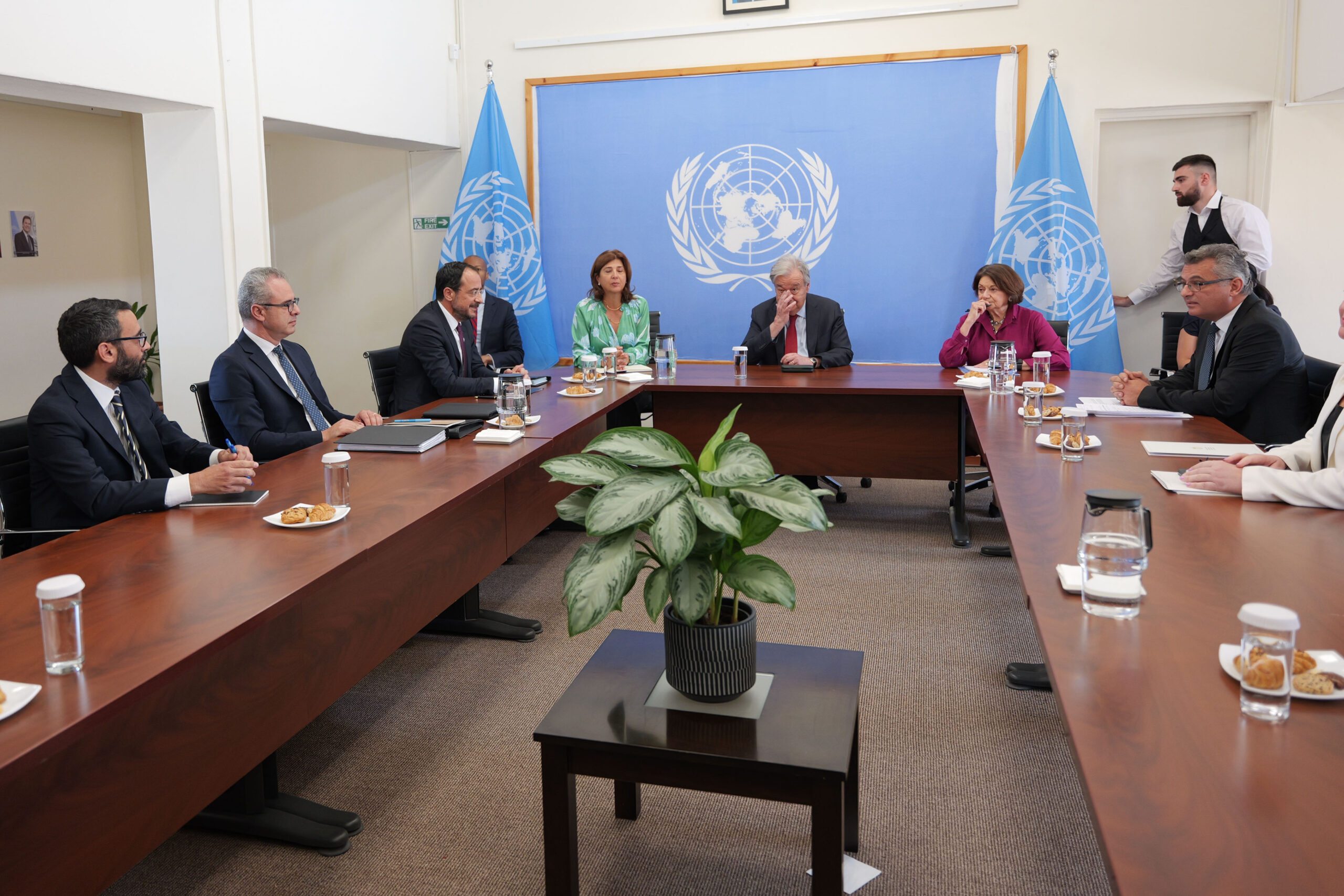
Ahead of the meeting between UN Secretary-General António Guterres and Turkish Cypriot leader Tufan Erhurman, the situation remains uncertain as to whether an informal five-party meeting on the Cyprus issue will take place in New York, international relations expert Petros Zarounas told CNA, noting, however, that if this ultimately proves unfeasible, it will be difficult to hold another informal meeting on the Cyprus issue before Guterres’s term ends at the end of the year.
“Much will depend on the stance and responses Mr. Erhurman will provide” during his meeting with the Secretary-General, Mr. Zarounas noted.
ΣΧΕΤΙΚΑ ΑΡΘΡΑ


When asked to comment on the conclusions drawn from the leaders’ speeches at the UN regarding the Cyprus issue, Mr. Zarounas said that “we must consider the audience a politician is addressing at any given time,” noting that the statements by Turkish President Recep Tayyip Erdoğan, calling for recognition of the “TRNC,” were directed at a domestic audience in Turkey, but “also at us, to put pressure on the Republic of Cyprus and Greece,” he said.
In contrast, he added, his shift in rhetoric—referring to Greece as a “neighboring country” and calling for a peaceful coexistence—was directed more toward European or NATO audiences, “to show that he operates within the framework of international legitimacy.”
However, according to Mr. Zarouna, his change in rhetoric “may be a sign that we can move on to the next procedural step, at least, in the negotiations.”
“I want to hope—and I think we all would—that the moderate Erdogan will prevail and that some solutions will be found to continue the process on the Cyprus issue,” said the international relations expert.
He also emphasized that “we are at a critical juncture. If, even this time, with the President and Erhurman present in New York, we fail to hold an informal five-party meeting, then things will reach a complete impasse. It will be up to the next Secretary-General to reassess the situation and decide whether it is worth continuing the efforts or whether he should officially declare an impasse and turn to theSecurity Council for guidance on how to proceed,” he said.
When asked whether he believes there is no further scope for convening a five-party meeting after New York, before the end of Guterres’s term, Mr. Zarounas said that “such meetings cannot be easily arranged,” noting that this opportunity is tied to the work of the General Assembly. He then noted that the Secretary-General would begin the process of handing over his files to the new Secretary-General.
If, however, it becomes possible to hold a meeting in New York, the UN Personal Envoy for Cyprus, María Ángela Olguín, might take charge of the process until the new Secretary-General takes office.
When asked to comment on the apparent lack of progress by the two leaders on the points raised by the Secretary-General during his visit to Cyprus, Mr. Zarounas said that the leaders are trying to find ways to take some “safe steps with regard to their domestic audiences. “They are both under pressure from some of the more negative voices within their communities. At the same time, they do not want to be blamed for the lack of progress,” he said.
However, he noted that things are difficult, especially for our side. “Turkey isn’t bothered if the talks are declared a deadlock. The deadlock will either lead to a new process or change the framework within which the discussions take place. In other words, we won’t be discussing a bi-zonal, bi-communal federation based on the latest United Nations resolutions, but we will have to find common ground again—and I don’t know if we will.” As he emphasized, if the process fails and an impasse is declared, “we will have lost everything we have built over the past 50 years.”
That is why the responsibilities of the President of the Republic, Nikos Christodoulides, “are significant,” Mr. Zarounas noted, adding that the President’s latest “new ideas” might “be his final attempt to salvage the entire process.”
According to Mr. Zarounas, it appears that the Secretary-General also wants to show some results, which is why “he is latching onto the President’s ideas.” Beyond that, whether Turkey will respond or maintain its current intransigent positions is something we are waiting to see. In a few days, we’ll know Turkey’s official position,” he said.
When asked what President Christodoulides’ new ideas might entail, Mr. Zarounas said that the information available indicates they concern both the substance of the negotiations and the terms of reference and the process. Possibly, he noted, they might involve some flexible formulas that avoid arbitration but convey the message that the sides are moving quickly and are not slowing down or stalling.
He noted that President Christodoulides would not want to settle for the standard “I did my duty,” and that is why “he wants to prove to the skeptics that he is willing, but can only go so far. I think at this point he will exhaust whatever room for maneuver he has, through the proposals he has put forward, and we’ll see if this gesture by the President finds a response from the other side. The Secretary-General appears to support them, and this will put Turkey in a difficult position; if Turkey had intended to reject them, given that even the United Nations is taking a friendly and positive stance toward them, it will be more difficult for Turkey to maintain a completely negative position.”
In conclusion, Mr. Zarounas cited the current uncertainty, pending further developments, and urged that “we not jump to conclusions” and that we remain calm. “Let’s see what the President’s proposals are, on the one hand, and the reaction of Erhurman and Turkey, on the other, as well as the United Nations’ stance, and from there reassess the situation based on an understanding of what is actually happening,” he said, noting that anything else would be premature.
Source: CNA