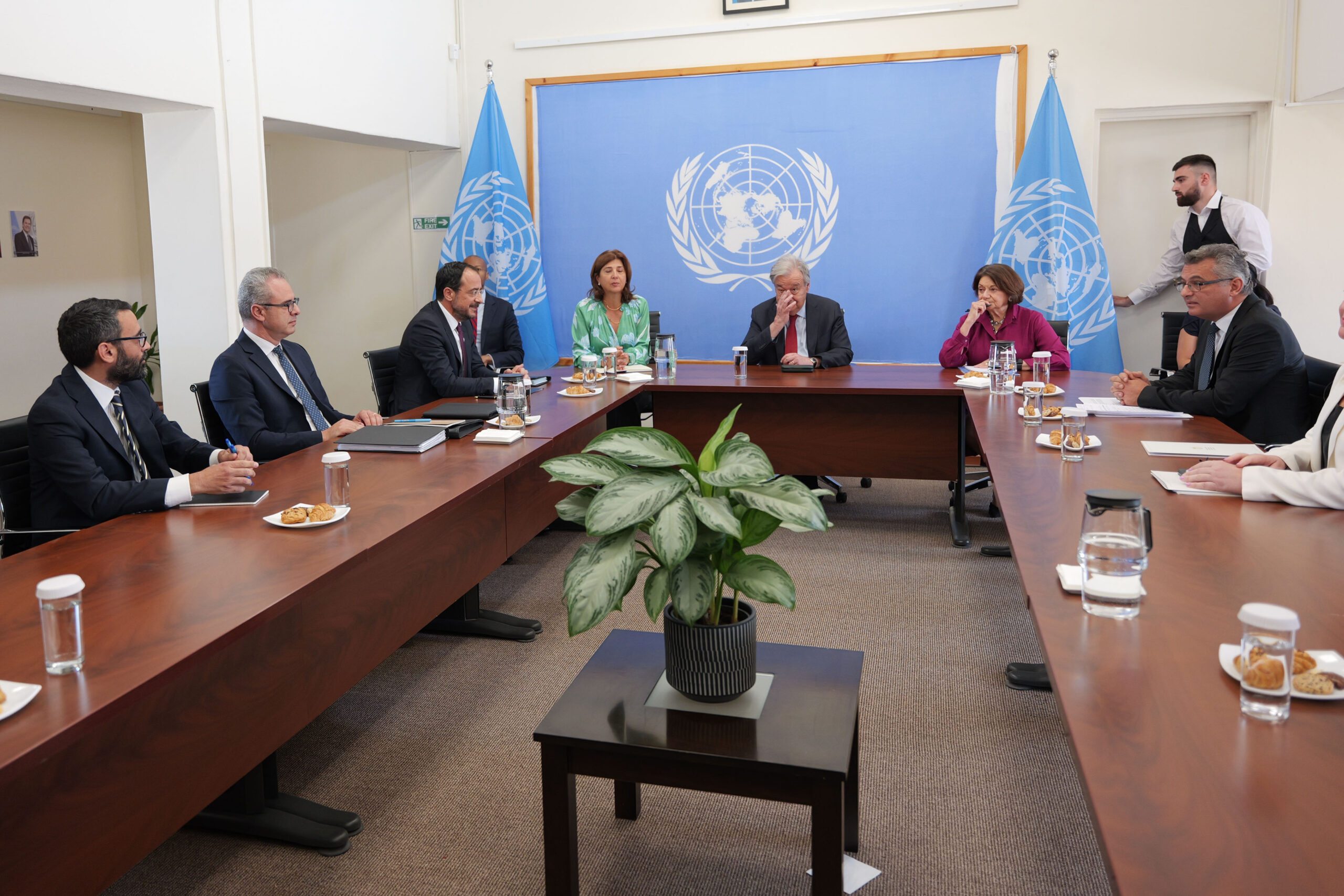
UN Secretary-General, Antonio Guterres, has specific plans in mind for the immediate future, said the Greek Cypriot negotiator, Menelaos Menelaou, said on Tuesday during a discussion at the Cyprus Forum in Nicosia.
He also said that it is necessary to continue the effort because abandoning it would not be a solution, and that the situation will only continue to worsen, given the already dire circumstances surrounding the Cyprus issue.
ΣΧΕΤΙΚΑ ΑΡΘΡΑ


During a discussion with the Executive President of the Cyprus Forum, Nikolas Kyriakides, regarding the Cyprus issue, Mr. Menelaou noted that, based on the meetings and discussions they had in New York, it appears that the Secretary-General “will not give up on this effort; he will exhaust every possible avenue”.
“He has specific steps in mind for the immediate future, and we’ll see to what extent it will be possible to take action that puts things back on track and ensures that we preserve what Icall the ‘achievements of the talks,’” he said.
Noting that “lately we have been facing a recurring pattern of delays” from the other side, he stated that “the effort continues.”
Mr. Menelaou noted that with the change in leadership of the Turkish Cypriot community, it was expected that the situation we were facing would be different. “This has not been confirmed, at least not in practice so far,” “despite the fact that there have been some small steps, a shift, which we had recognized from the beginning, and which we had also worked to facilitate,” he added.
He noted that the most significant feature of such a step is the reference—made following the meeting between the two leaders last December in their joint statement—to political equality.
He noted that this was “significant” because it signaled a shift from the previous discussion—which centered on the demand for sovereign equality—toward a gradual, “slow, albeit incomplete yet significant, return to the federal framework.” This, however, has not yet taken a complete form.
At the same time, Mr. Menelaou pointed out that, on Turkey’s part, its positions remain the same as before, namely in favor of a two-state solution.
“Due to these delays, it has not been possible, to the extent we would have liked, to take the steps that would have accelerated this effort,” said Mr. Menelaou, noting that the Greek Cypriot side attended the meetings held in New York on the Cyprus issue with the aim of identifying the next step, which would facilitate the entire ongoing effort.
“Unfortunately, it was not possible, because there was no response from the other side to the efforts made right up until the last moment, before our departure from New York, to hold a trilateral meeting,” he added.
He noted that the Greek Cypriot side does not prioritize the blame game and that this would serve no purpose. He also said that it is only natural that no one on the other side would admit that things are not moving forward because of their own fault.
“Hence, the Turkish Cypriot side also attributes the lack of progress to us,” he said, noting that regardless of what each side says, the facts “are irrefutable.”
Mr. Menelaou emphasized that it is necessary to continue the effort “precisely because abandoning it would not be a solution,” it would not merely be a situation in which things remain at a standstill; it would be a situation in which “things will keep getting worse” due to the already very dire situation regarding the Cyprus issue, but also taking into account the broader instability, and the uncertainty prevailing in the regional context as well.
When asked whether the other side shares the desire to continue, Mr. Menelaou said that “based on what they say, yes, but there is a discrepancy with what they do,” which reflects Ankara’s line, as he noted.
He pointed out that the Greek Cypriot side is not talking about an impasse and that it is facing obstacles preventing this effort from gaining momentum.
Referring to confidence-building measures, both in terms of methodology and substance, Mr. Menelaou said that, in terms of substance, progress has been made in identifying areas of convergence.
Referring to the statement by the Personal Envoy of the UN Secretary-General, María Ángela Olguín, that the document outlining the areas of convergence will be made available to the parties involved once the talks begin, Mr. Menelaou said that “we believe it should be provided now, in order to expedite the next steps and reach the point where the talks can resume.”
He noted, however, that the recording of the proceedings is “a very important step” because it is a step toward safeguarding what is referred to as the “acquis” of the talks.
Regarding the methodology, he recalled that upon assuming the leadership of the Turkish Cypriot community, Mr. Erhurman put forward four proposals/conditions: the reaffirmation of points of convergence, the reaffirmation of the policy of equality, a timeline for the next steps, “and what have been termed the pre-agreed consequences.”
“We believe that three of the four have been addressed,” the two through the documentation of convergences, for which, paradoxically, once again, the obstacles preventing their submission—and thus accelerating the steps toward the resumption of talks—stem from Ankara.
Mr. Menelaou noted that it is “very paradoxical to ask, on the one hand, for a reaffirmation of the points of convergence, a reaffirmation of political equality, and yet, when these matters are moving forward and are ready to be presented to all parties involved, to consider that the time is not right and the conditions are not ripe for this to happen.”
He reiterated that it is not our goal, “nor is it our priority at this moment to engage in the blame game,” nor will it benefit us in any way, and that “it is not a solution to the issue of us appearing as the good guys and the others as the bad guys.”
“We want to find a way forward, to move things along,” he added.
He noted that regarding the timeline, once an expanded meeting is convened, the next steps will be taken and things will get moving “with what we consider to be a very short timeframe for reaching a conclusion,” provided that the points of agreement are preserved and we focus on the remaining issues.
Regarding the issue of the pre-agreed consequences, “we believe that, once again, a way forward can be found, by implementing steps that assist and provide incentives for reaching a solution, rather than serving as incentives that reward failure,” he added.
In the technical committees, he said, “a great deal” has been done, but more could be done. He noted that over the past 12 months, the technical committees have met 119 times and have recently implemented 39 projects. Most of the projects decided upon at the 2025 expanded meetings have been implemented, and others are in the process of being implemented; as for those facing difficulties, there are solutions, he said.
In response to a question from Mr. Kyriakides about whether discussions and issues at the political level are harmful to the Cyprus problem, Mr. Menelaou said that at the political level, things are not as negative as they may seem. He said that at the leadership level, 11 meetings have taken place over the past 11 months. He noted that these meetings provided an opportunity for very substantive discussion.
“There is a substantive discussion on issues concerning the essence of the Cyprus problem—its political essence—as well as on technical issues,” he added.
That is not the problem, he said. The problem, he said, is that within the broader context at this moment, the tactical approach—which appears to originate from the individual who holds the decisive say on the other side, Turkey, is a tactic aimed, at the very least, at slowing down and obstructing efforts to accelerate the process.
Source: KYPE