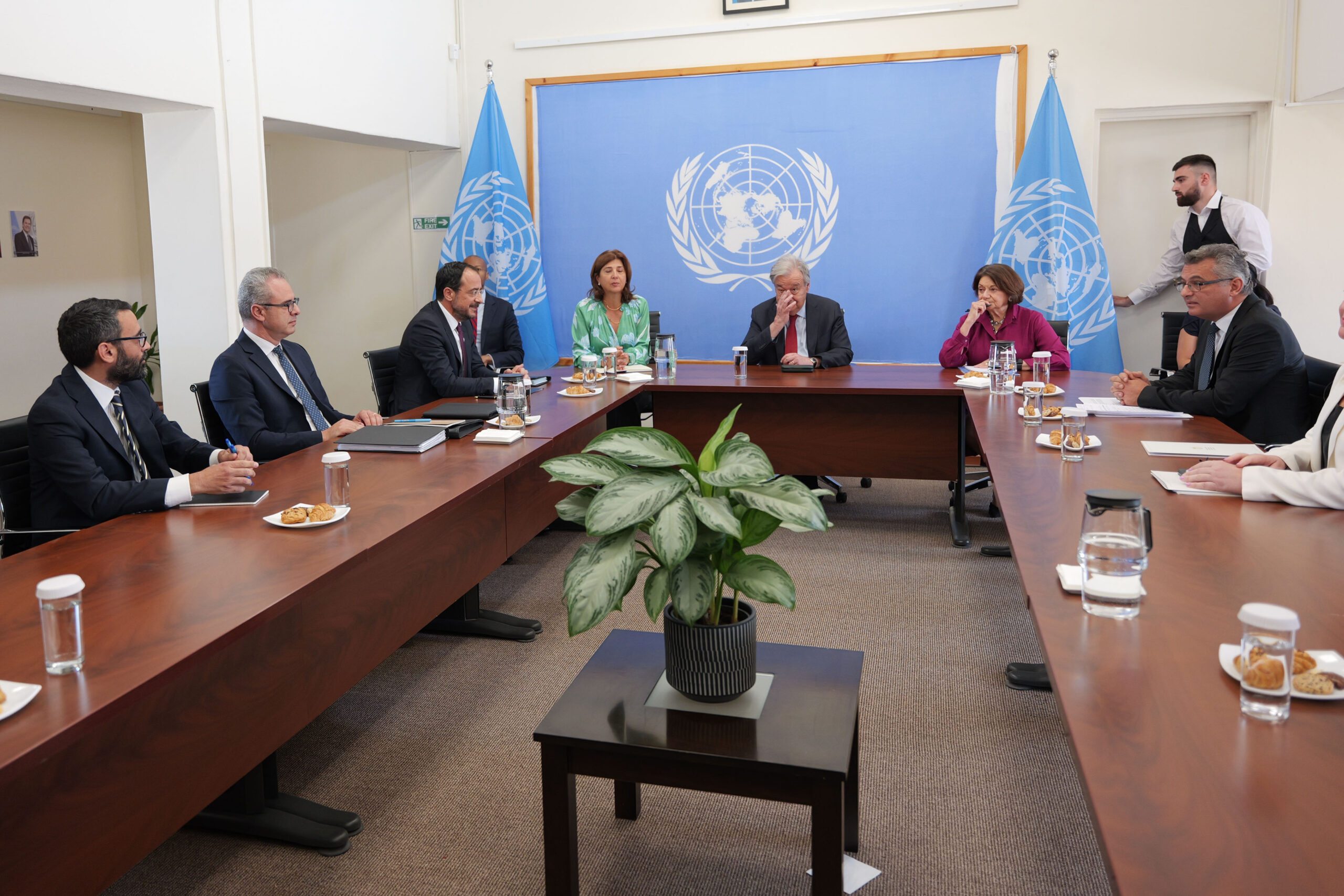
We know exactly where we want to go and what levers we must use to achieve our goal in the effort to resolve the Cyprus problem, and in this major effort we are undertaking, we seek the cooperation of all, said the President of the Republic, Mr. Nikos Christodoulides, tonight.
In a speech at an event organized by the “Enosis Neon Trust” Association in Nicosia, the President of the Republic described the Association as historic, with a presence in public life dating back to 1924, and of which he himself is a member.
ΣΧΕΤΙΚΑ ΑΡΘΡΑ


Referring to the Association’s founders and leaders, the President of the Republic said that they are protagonists and witnesses to significant events that have shaped Cyprus’s course.
Referring to the strategy the Government has been following since the very first day it assumed governance of the country, the President of the Republic said, among other things, that “our top priority is the resolution of the Cyprus problem, the liberation, and the reunification of our homeland.
Our goal, through every policy decision we make, is to strengthen all of our country’s sources of strength. This includes five key priorities of our governance program, which guide every decision we make in the Cabinet, as follows:
A clear, outward-looking foreign policy with a distinct European-Western orientation, without any doubts, qualifications, or vacillations, coupled with a strong, deterrent military capability.
In 2027, we are now preparing the budget with the Minister of Finance; and one of the ministries that will see the most significant budget increase is the Ministry of Defense, precisely because we believe that strengthening our country’s deterrent power is of crucial importance. Therefore, this is the first pillar of our priorities.
Our second priority is a strong and resilient economy, as it is perhaps the most decisive factor in our efforts to strengthen all aspects of our country’s power.
The third pillar of our priorities concerns the modernization of the state. We must transform the state as it existed in 1960. It is now 2026; many things must change—we must reform and modernize our state. We underwent a major modernization in 2004 with our accession to the EU, but if we want our country to progress, we must continually move forward with bold reforms—and reforms are never easy. There is always resistance and backlash, and that is perfectly normal when it comes to change.
The fourth point is transparency and accountability. We are in a period—not only in Cyprus but also at the European level—and you can see what is happening in various electoral processes, there is a sense of skepticism and disillusionment among the public toward politicians, toward politics, and toward public life—and this can be addressed through transparency and accountability.
The fifth pillar of our priorities is improving citizens’ daily lives. And what does a citizen expect from their government? The most fundamental needs are education, health care, and the welfare state. It must be able to offer its citizens, wherever they choose to live, the same rights in these three fundamental areas: health, education, and the welfare state.
Starting with a strong defense and security, our dynamic foreign policy with a European, Western orientation is one of our five key priorities. “And we must tell it like it is, without implying that we are criticizing anyone.”
The President of the Republic then gave a detailed account of events since the founding of the Republic of Cyprus, noting, among other things, that the country had never had a clear foreign policy until 2004, when it joined the EU.
He also referred to the Republic of Cyprus’s efforts to forge and leverage alliances within a chaotic international system, noting that our country, as a small and occupied nation, faces real dangers, which makes it imperative to fortify it and strengthen its defensive capabilities. This, he said, is what the government is doing without making many public statements.
President Christodoulides cited as an example the immediate response from many countries following the attack on the British Bases last spring.
Referring to the migration issue, the President of the Republic said that today there has been a 90% decrease in migrant arrivals and an increase in returns of over 85%. He added that the Republic of Cyprus is no longer an attractive destination for migrants.
He also referred to the decline in unemployment and the strengthening of the local economy.
He further stated that Cyprus, situated in a very important geopolitical location of particular geostrategic significance, has forged strong alliances with countries in the region.
“Yesterday I was in Egypt; tomorrow the President of Israel will be in Cyprus; in October I will be in Saudi Arabia; and we have many other visits planned from countries in the region, which are our priority in terms of our foreign policy,” said the President.
He also noted that the government has reached out to many countries, such as by signing a strategic agreement with France, with tangible results, such as the easing of tensions following the events at the British Bases this spring. He added that Cyprus is also reaching out to countries that the government considers to be of great importance on the political, economic, and commercial levels, such as India, and highlighted Prime Minister Monti’s visit to Cyprus and his own visit to India.
He added that “after overcoming many obstacles posed by certain parties, we had
also made my visit to Kazakhstan, a country with ties to Turkey.” He also highlighted the opening of diplomatic missions by both Cyprus and Kazakhstan.
The President of the Republic also emphasized the shift in other countries’ approach toward the Republic of Cyprus, which has altered its single-issue policy through various initiatives and actions, including its initiatives on international humanitarian issues, such as the “Amaltheia” maritime humanitarian corridor.
Regarding the Cypriot Presidency of the Council of the EU, the President of the Republic said that “when we took office, no one believed that a small country could achieve so much. And yet you heard from heads of state and the leaders of the institutions how they spoke about the Cypriot Presidency. You can appreciate the significance of all this for our country as we make our case in Brussels. And there are results.
The EU has decided to spend 150 billion euros to strengthen its defense because it has realized that it can no longer depend on the U.S.
Our country has secured from this fund 1.2 billion euros, which will be used for our defense, and we have already begun to utilize the first 170 million euros to strengthen the defense of the Republic of Cyprus.”
He added that “our first goal was to be clear at the foreign, international, and regional levels. We know where we’re going, who we stand with—not that we’re against everyone else—who we’re close to, and who we’ll work with.
Our second goal is a strong and resilient economy. We all know what our country went through in 2012–2013 due to our economic situation.
I said this during the campaign, and I say it now as President of the Republic: we do not play games with the economy. And this is not just a slogan. It is a political philosophy, deeply rooted in the conviction that without a strong economy, you cannot achieve your goals. And for our government, this economic responsibility is the very foundation that shapes our policy decisions.
Today, any decision that comes before the Cabinet—if it has an economic dimension—is not included on the Cabinet’s agenda unless the Ministry of Finance has given its approval. We don’t even discuss it. No minister can bring a proposal with a financial dimension unless it has been approved by the Ministry of Finance and ensures that we remain within our budgets, which, of course, are in surplus.
And for the first time since 2011, we have managed to be rated in Category A by all international rating agencies. We have managed today, with two assessments— one in our neighborhood in the Middle East and the other in Ukraine, to achieve a growth rate of 3.3%, one of the highest growth rates in the Eurozone, unemployment at 2008 levels—around 3.6%—and we have the highest rate, a historic record, of labor force participation among Cypriots. And in fact, this rate is on the rise among young people.
I sometimes hear people say that the indicators are improving but the people aren’t, and they question what a rating upgrade by credit rating agencies and these indicators actually mean. It means that as a country, we have the ability to invest in education, to establish another 200 full-day schools, to invest in healthcare, we now have funding for projects in public hospitals totaling more than 126 million euros, we have the ability to carry out a tax reform—the first in 23 years—that has benefited everyone. And today we are moving forward with pension reform for the first time since 1980. And along with many benefits, such as the child allowance for all income brackets—which we can provide because we have a robust economy—because, based on our philosophy of Social Liberalism, growth must be reinvested in society through education, health care, the welfare state, and housing.”
President Christodoulides also referred to the two housing plans announced today by the Minister of the Interior.
He added, however, that our country faces challenges, such as energy costs, while noting the potential of renewable energy sources, noting that the government is moving forward with one year’s worth of energy storage and an upgrade of the grid, along with the arrival of natural gas, for which the government has issued tenders for Vasilikos.
The President of the Republic said that “without strengthening our country, without bolstering all our sources of strength, negotiations on the Cyprus issue are clearly difficult,” noting that “the recognition of our country and its added value have helped reactivate the international community on the Cyprus issue,” noting that we have proven that we are not a problematic state but rather the solution to many problems.
Finally, President Christodoulides emphasized that the UN Secretary-General himself said that after seven years, there have been developments in the Cyprus issue, adding that “things are not easy; there are problems and difficulties, but we know clearly where we want to go and what levers we must use to achieve our goal. And in this major effort we are undertaking, we seek everyone’s cooperation. When it comes to the future of our country and national issues, we cannot afford not to work together.”