



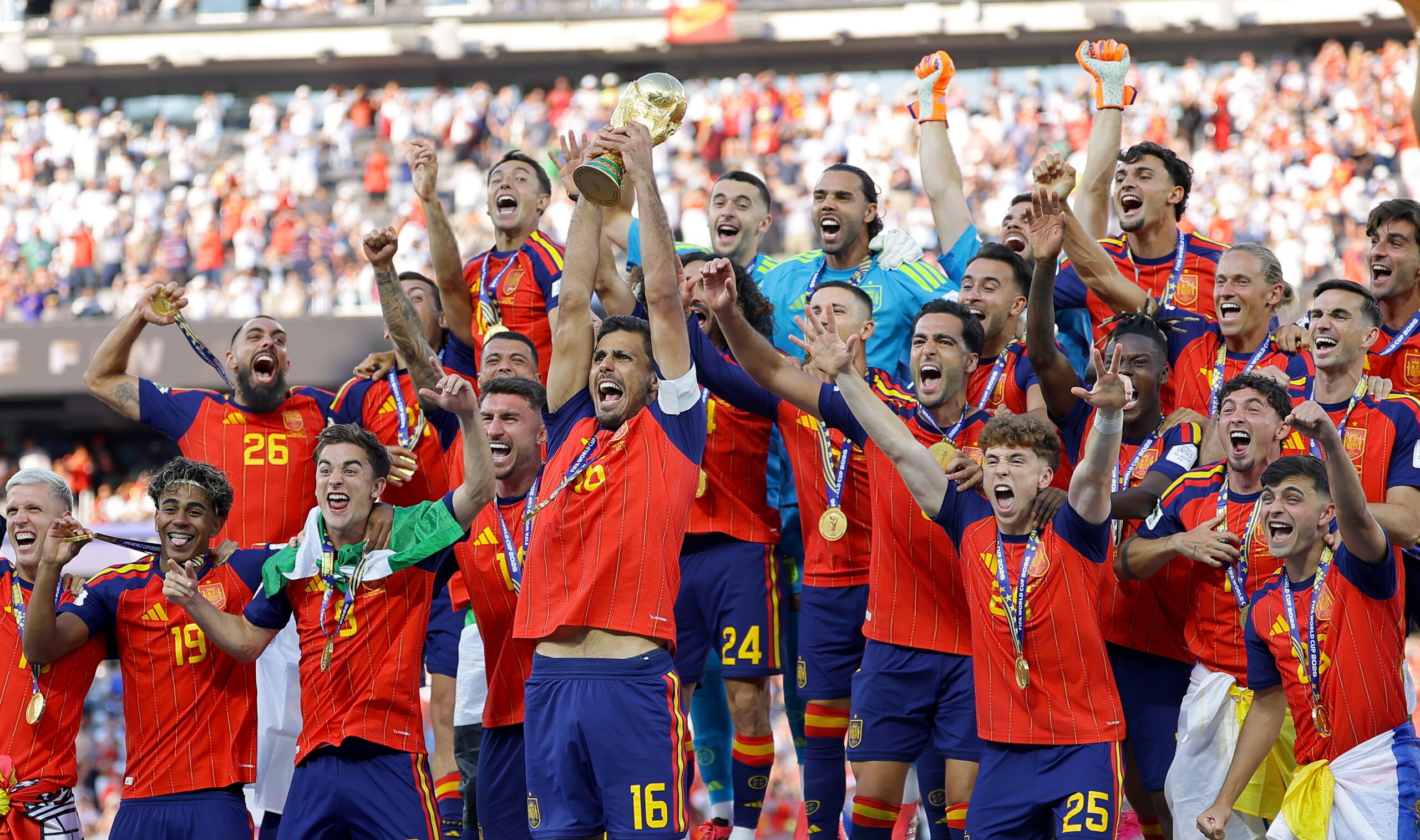
Sixteen years after winning its first World Cup on the fields of South Africa, Spain returned to the top of world soccer, defeating Argentina 1-0 in extra time in the 2026 World Cup final, held in New Jersey, United States.
Ferran Torres’s goal in the 106th minute proved enough to give “La Roja” its second World Cup title in history, following the 2010 victory, capping off a tournament in which Luis de la Fuente’s team combined efficiency, defensive solidity, and footballing maturity.
ΣΧΕΤΙΚΑ ΑΡΘΡΑ


By winning the trophy, Spain reached two World Cup titles, tying France and Uruguay on the list of multiple champions, behind only Brazil (5), Germany and Italy (4), and Argentina (3).
This success, however, is not limited to winning the title. Spain concluded the tournament by setting a series of historic records that rank it among the top teams ever to appear in a World Cup final tournament.
The most significant of these was its defensive performance. La Roja became the first team to win the World Cup having conceded just one goal throughout the entire tournament. The only goal they conceded came in the quarterfinal against Belgium, when Charles de Ketelaere temporarily equalized, before Mikel Merino secured the victory for the Spaniards in the final minutes.
The world champions’ overall run reflects their dominance. They started with a scoreless draw against Cape Verde, but this was followed by seven consecutive victories against Saudi Arabia (4-0), Uruguay (1-0), Austria (3-0), Portugal (1-0), Belgium (2-1), France (2-0), and, finally, Argentina (1-0 in extra time).
At the same time, Spain finished the tournament with 14 goals, the best offensive performance in its history during a World Cup final tournament.
Luis de la Fuente’s team made history not only during this World Cup but also over the long term. With its victory in the final, it extended its unbeaten streak to 38 matches, breaking the previous European record of 37 consecutive matches without a loss set by Italy between 2018 and 2021.
Spain’s last defeat came on March 22, 2024, in a friendly match against Colombia. Since then, the team has won EURO 2024, competed in the UEFA Nations League, played World Cup qualifiers, participated in international friendlies, and remained undefeated throughout the World Cup.
For many, the team’s performance evoked memories of Vicente del Bosque’s historic “golden generation,” which won the 2010 World Cup. This time, however, success came through a different blend of experience and youthful talent, with De la Fuente building a team that relied more on balance and cohesion than on individual brilliance.
Rodri was the central figure in this run. The Spanish midfielder was named the tournament’s most valuable player, serving as the ultimate playmaker for his team. With more than 650 successful passes and an accuracy rate exceeding 93%, he dominated the midfield throughout the tournament.
Meanwhile, goalkeeper Unai Simón won the “Golden Glove,” finishing the World Cup having conceded just one goal. He also broke the record for consecutive minutes without conceding a goal in a World Cup final phase, reaching 650 minutes, including his appearances in Qatar in 2022.
Another standout of the tournament was Pau Kubarsi, who was named the World Cup’s best young player. The young center back was a cornerstone of Spain’s defense, demonstrating maturity and consistency that stood out throughout the tournament.
On offense, Spain’s leading scorer was Mikel Oyarzabal with five goals, while Mikel Merino also made a decisive contribution with two goals. Ferran Torres may have scored only one goal in the tournament, but it proved to be the most important one, as it secured the trophy for Spain in the championship final. Lamine Yamal also made a significant impact; in addition to the one goal he scored, he stood out for his creativity and his 30 successful dribbles during the tournament.
This success was accompanied by significant financial rewards. As world champion, Spain will receive 43.3 million euros from FIFA, the largest cash prize ever awarded to a winning nation in the history of the tournament.
The final whistle of the championship match sparked an outburst of celebration throughout Spain, centered in Madrid, where hundreds of thousands of fans flooded the streets to celebrate the national team’s return to the top of the world.
With a second star on their jerseys, a new generation of stars, and a series of historic achievements that will be hard to replicate, Spain didn’t just win the 2026 World Cup. It delivered one of the most complete and dominant runs ever recorded in a World Cup final tournament, confirming that it is once again at the pinnacle of world soccer.
*photo source: KYPE








