



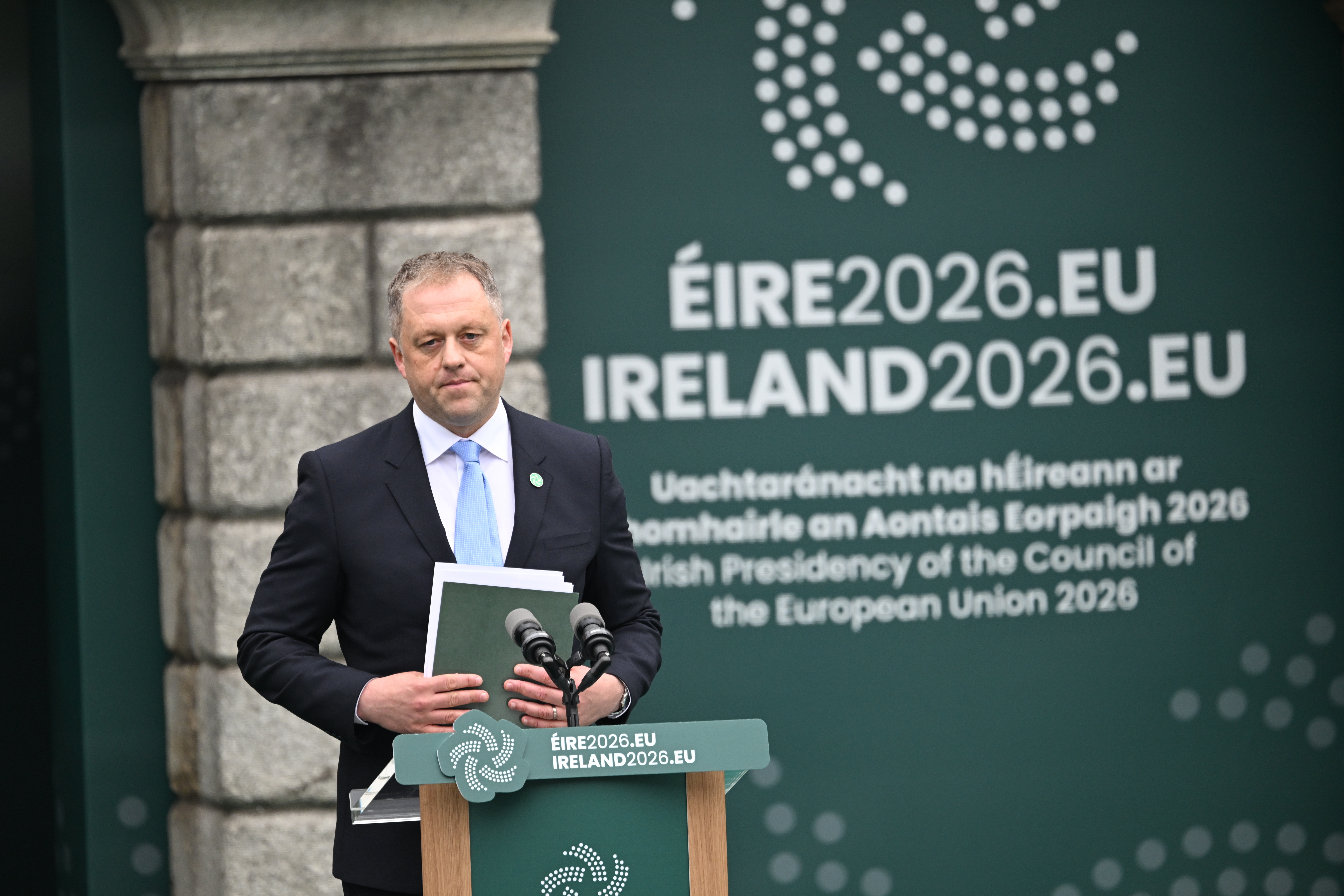
Ireland assumes the six-month Presidency of the Council of the EU today, July 1, taking over from the Cypriot Presidency. Ahead of the official opening ceremony to be held this afternoon at Dublin Castle, Irish Prime Minister (Taoiseach) Michael Martin welcomed European Council President António Costa on “the first day of our eighth Presidency of the European Union,” noting that Irish officials are already chairing meetings in Brussels.
As Martin said, Ireland will play “a central role in shaping decisions that affect the lives of every citizen across our Union,” with citizens remaining “at the heart of everything we do.” The motto of the Irish Presidency is “Strength through Unity.”
ΣΧΕΤΙΚΑ ΑΡΘΡΑ


The Irish Prime Minister also noted that discussions with Costa focused on three key areas: competitiveness, through the “One Europe, One Market,” security, and the Union’s values—namely “freedom, democracy, equality, the rule of law, and respect for human rights”—which are also priorities of the Presidential Trio (Ireland, Lithuania, and Greece)—as well as support for Ukraine.
Mr. Martin pledged that the Irish Presidency “will continue to stand by Ukraine,” emphasizing that the Ukrainian people “have endured more than four years of brutal Russian aggression” and deserve “a just and sustainable peace.” He also announced that he would meet with Ukrainian President Volodymyr Zelenskyy later that afternoon.
On the issue of enlargement, the Irish Prime Minister stated that the Presidency will work to ensure that candidate countries, “including Ukraine,” to move closer to joining the Union, while regarding the next Multiannual Financial Framework (MFF) negotiated by the Cypriot Presidency, Martin said that the goal is to move forward with negotiations “with President Costa, so that, ideally, an agreement can be reached by the end of the year.”
For his part, President Costa wished the Irish Prime Minister every success, describing the three pillars of the Irish Presidency—competitiveness, values, and security, as “fully aligned with the priorities of the European Council.” As he said, “Following defense, which was the main focus in 2025, 2026 is the year of European competitiveness,” adding that it would be difficult to find a better “steerer” for implementing the “One Europe, Single Market” agenda than Ireland.
Costa emphasized that the EU will continue to support Ukraine “with whatever is needed until a just and sustainable peace is achieved,” noting that “the situation on the battlefield is changing thanks to the courage of the Ukrainian armed forces” and that Russia “must understand that time is not on its side.”
Regarding the Middle East, he advocated for a two-state solution, “in accordance with the relevant UN Security Council resolutions,” with Israel and Palestine coexisting “within secure and recognized borders.”
He made a special mention of enlargement, noting that the Irish Presidency could “finalize accession negotiations with Montenegro before the end of the Presidency,” while humorously remarking that there was “no pressure.”
The President of the European Council pointed out that the MFF remains the biggest common challenge, calling for an agreement “by the end of the year” on a budget “commensurate with the Union’s ambitions.” He reiterated that the Irish Presidency is expected to present a revised “nego-box” in October, in accordance with the mandate from the “27” at the June summit, with ambitious proposals for new own resources, concluding: “It won’t be easy. But significant achievements are never easy,” he remarked.
In the questions that followed, Costa referred to the entry into force, as of today, of the EU-U.S. trade agreement on industrial goods, emphasizing that the Union “does not favor tariffs; it prefers trade agreements,” and noting that the EU already has 84 trade agreements, with another 27 or so in the works.
When asked about Ireland’s military neutrality amid discussions on European rearmament ahead of next week’s NATO summit, Prime Minister Martin recalled that his country is not a member of NATO but has participated in the EU’s Common Security and Defense Policy from the outset, and expressed support for strengthening defense capabilities “particularly in areas such as cybersecurity and the protection of undersea cables.”
In this regard, Costa noted that European security “goes beyond NATO” and includes all four neutral member states—among them Cyprus—adding that “only with a stronger economy can we spend more and more effectively on defense.”
SEE ALSO: Cypriot Presidency, European Agenda, and the Cyprus Issue at the Rauna–Hatzivassiliou Meeting | AlphaNews
Source: CNA






