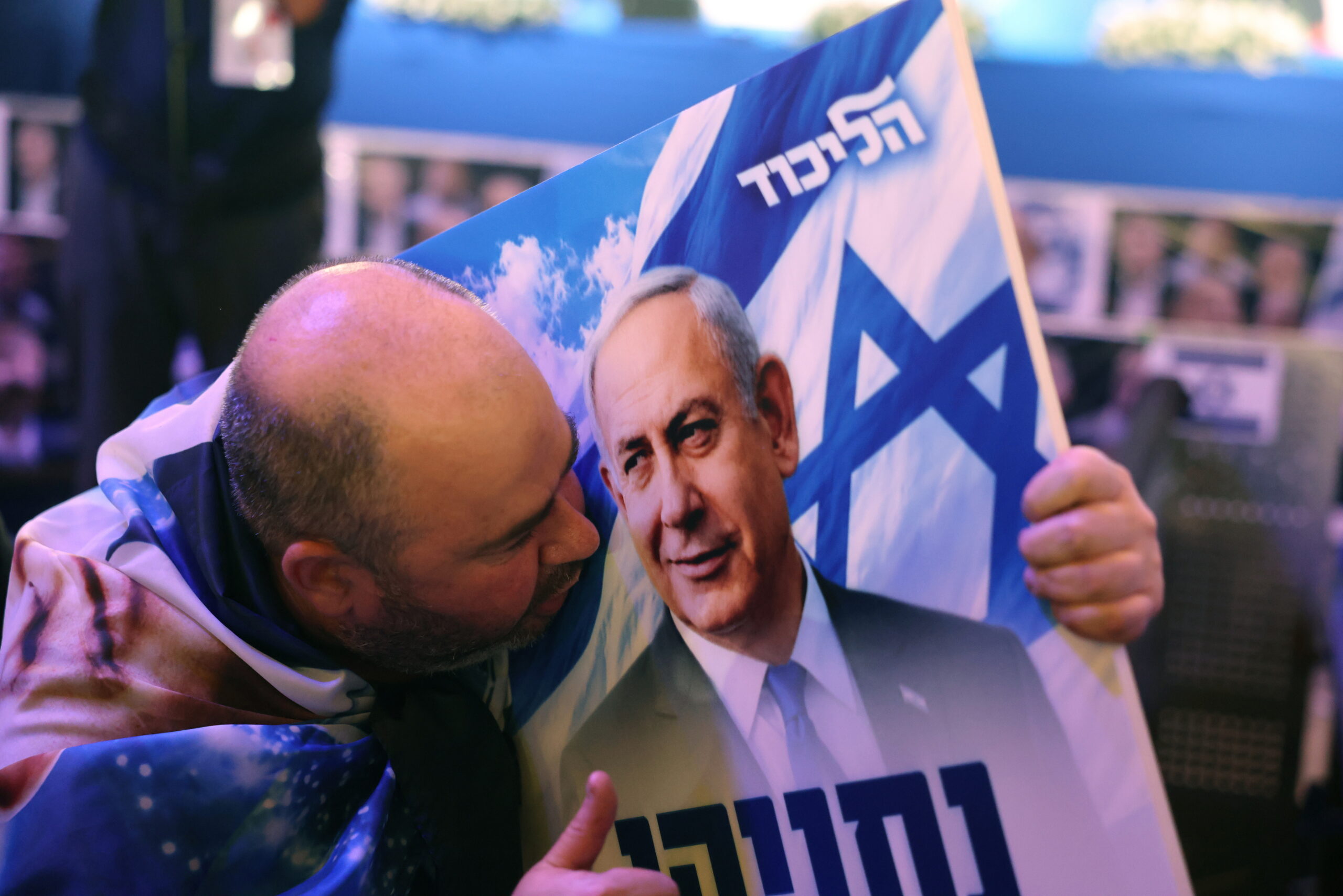
The paradox of Benjamin Netanyahu remaining in power, even though his governing coalition does not secure a parliamentary majority, is taking shape in Israel following last Tuesday’s elections (October 27).
The inability of his opponents to agree on a joint government structure threatens to plunge the country into a prolonged political deadlock, with the possibility of another election now on the horizon.
ΣΧΕΤΙΚΑ ΑΡΘΡΑ

According to the results so far, neither Netanyahu’s camp nor that of his main rival, Gadi Eizenkot, appears to have secured the 61 seats required for a majority in the Knesset, Israel’s 120-seat parliament.
SEE ALSO: Netanyahu remains Israel’s acting prime minister; new elections possible in 2027
ISRAEL ELECTION RESULTS: 88.6% OF VOTES COUNTED With 5,024,919 valid votes counted, Netanyahu’s bloc is projected to win 53 seats, 8 short of the 61 needed for a majority. Projected seats:
— Open Source Intel (@Osint613) October 28, 2026Likud: 26
Yashar (Gadi Eisenkot): 21
Joint List: 12 (Arab)
At the same time, the strengthened presence of Arab parties complicates the political landscape, as, although their seats could give the opposition a majority, most political forces in the Eizenkot bloc rule out cooperating with them.
As the BBC notes in its analysis, forming a government appears to require that at least one of the major political forces renege on key campaign promises.
As things stand, a new election may be the most likely outcome, leaving Netanyahu in the position of caretaker prime minister in the meantime.
The Four Scenarios for the Day After
The American network is examining four possible scenarios for the days ahead, ranging from a national unity government to the formation of a coalition government with the support of Arab parties.
1. A national unity government with Netanyahu and Eizenkot
The first scenario envisions an agreement between Netanyahu and Eizenkot to form a government of national unity, headed by the outgoing prime minister. This is, however, an option that runs counter to the opposition leader’s core commitments.
Eizenkot built his entire election campaign around the need to remove Netanyahu from power, presenting himself as the only credible alternative.
On election night, in fact, speaking from the podium of his campaign headquarters, he called on Netanyahu to “announce his retirement from political life today,” arguing that Israelis have grown tired of the “culture of lies,” “divisiveness, and incitement to hatred.”
These statements were made before one of the key exit polls was revised; it had initially projected a lead for the Eisenkot bloc but later placed Netanyahu in first place.
A possible coalition scenario would be for Eisenkot’s Yashar party to join a government with Likud, provided that Netanyahu would abandon his current far-right and ultra-Orthodox coalition partners.
However, he sent a different message during his speech at Likud headquarters, thanking his “loyal partners” and calling for the formation of a “strong right-wing government.” These remarks were interpreted as a sign that he does not intend to dissolve his existing alliances.
According to the BBC’s analysis, one factor that could change the situation is a new conflict with Iran, which would create strong pressure for national unity.
In the days leading up to the election, Israeli and American media reported that Netanyahu was seeking new military strikes against Tehran and was pressuring Donald Trump to approve U.S. involvement.
In such a case, however, his critics could accuse him of attempting to salvage his political position through a new regional conflict.
2. An Eisenkot government supported by Arab parties
The second scenario would constitute a historic upheaval for Israel’s political system, as it presupposes cooperation between the opposition and the Arab parties, which are emerging as the big winners of the election.
In the country’s history, only once—in 2021—did an independent Arab party officially participate in a governing coalition, which did not last long.
Today, Eizenkot and all but one of the Jewish parties in his bloc have ruled out the participation of Arab parties in the government. However, based on the election results so far, this cooperation appears to be the opposition’s only path to a parliamentary majority.
The Arab parties appear to have exceeded expectations, securing a total of up to 19 seats—a record number—thanks to the significantly higher turnout among Arab citizens of Israel.
They make up about one-fifth of the country’s population, with many identifying as Palestinian citizens of Israel.
For years, a significant portion of the Arab community abstained from voting, believing that participation would legitimize a political system that, in their view, treats them as second-class citizens.
This time, however, the desire to oust the most right-wing governing coalition in Israel’s history served as a powerful incentive to turn out at the polls.
The Joint Arab List, which is projected to win about seven seats, has expressed its willingness to join an opposition government. The Joint List, which is expected to win 12 seats, has stated that it is willing to provide parliamentary support without assuming government positions.
As for the Jewish parties, the only one who publicly supports such an option is Yair Golan, leader of the Democrats.
Even so, however, even if an agreement were reached, the cohesion of such a government would be severely tested on issues concerning Gaza and the occupied West Bank.
The shared refusal of most Jewish parties to form a coalition government with Arab parties—despite the deep differences between them—highlights the divisions that continue to characterize the Israeli political scene.
3. Netanyahu’s Outreach to the Right-Wing Opposition
The third scenario involves Netanyahu’s attempt to attract right-wing parties from Eisenkot’s camp, in order to secure the necessary parliamentary majority.
His two most likely partners in these talks could be Naftali Bennett, co-chair of the Beyachad political alliance, and Avigdor Lieberman, leader of Yisrael Beiteinu.
Both come from the Right, take hardline stances on national security issues, and share significant policy common ground with Netanyahu.
The problem is that both campaigned for the public’s vote with an explicit commitment to remove him from the premiership.
Furthermore, they support extending mandatory military service to ultra-Orthodox Jews, a position that puts them in direct opposition to the two ultra-Orthodox parties in the current governing coalition.
One possible solution would be for Netanyahu to replace his ultra-Orthodox allies with the parties led by Bennett and Lieberman.
However, even this configuration may not secure the 61 seats required for a majority, according to available election data.
4. New Elections: The Scenario That May Favor Netanyahu
If exploratory talks do not lead to an agreement on forming a government, Israel will face new elections.
Although Netanyahu will not have secured a majority on his own, such a development could be seen as an indirect political victory for him, as he would continue to serve as caretaker prime minister until the next election is held.
At the same time, he may be calculating that a second round of voting could shift the current balance of power in his favor.
As the BBC notes, some analysts believe that the high turnout among Arab voters is unlikely to be repeated to the same extent, especially if their increased parliamentary representation did not ultimately lead to a change in government.
On the contrary, the prospect of new elections could mobilize more right-wing voters.
Another factor Netanyahu may be taking into account is the approximately 70,000 Israelis who traveled from abroad to vote. It is estimated that the majority of these voters oppose him, and it is uncertain whether they would return to the polls a second time.
In addition, several small right-wing parties failed to clear the 3.25% electoral threshold. In the event of a new election, they may either receive fewer votes or not participate at all, resulting in part of their electoral support shifting toward Likud and its allies.
Israel’s political history offers a telling precedent. From 2019 to 2022, the country went through five elections, as Netanyahu and his opponents repeatedly failed to agree on forming a stable government.
The possibility that this cycle might repeat itself is now at the center of political developments.
The crucial paradox of the current situation is that, while Netanyahu does not have the seats needed to form a government on his own, his opponents do not appear to have the necessary political consensus to oust him.
A new election could be seen as an indirect victory for Netanyahu, as he would remain acting prime minister until the election is held, while he himself may believe that he would have a better chance of winning in a new election.
Source: Proto Thema