



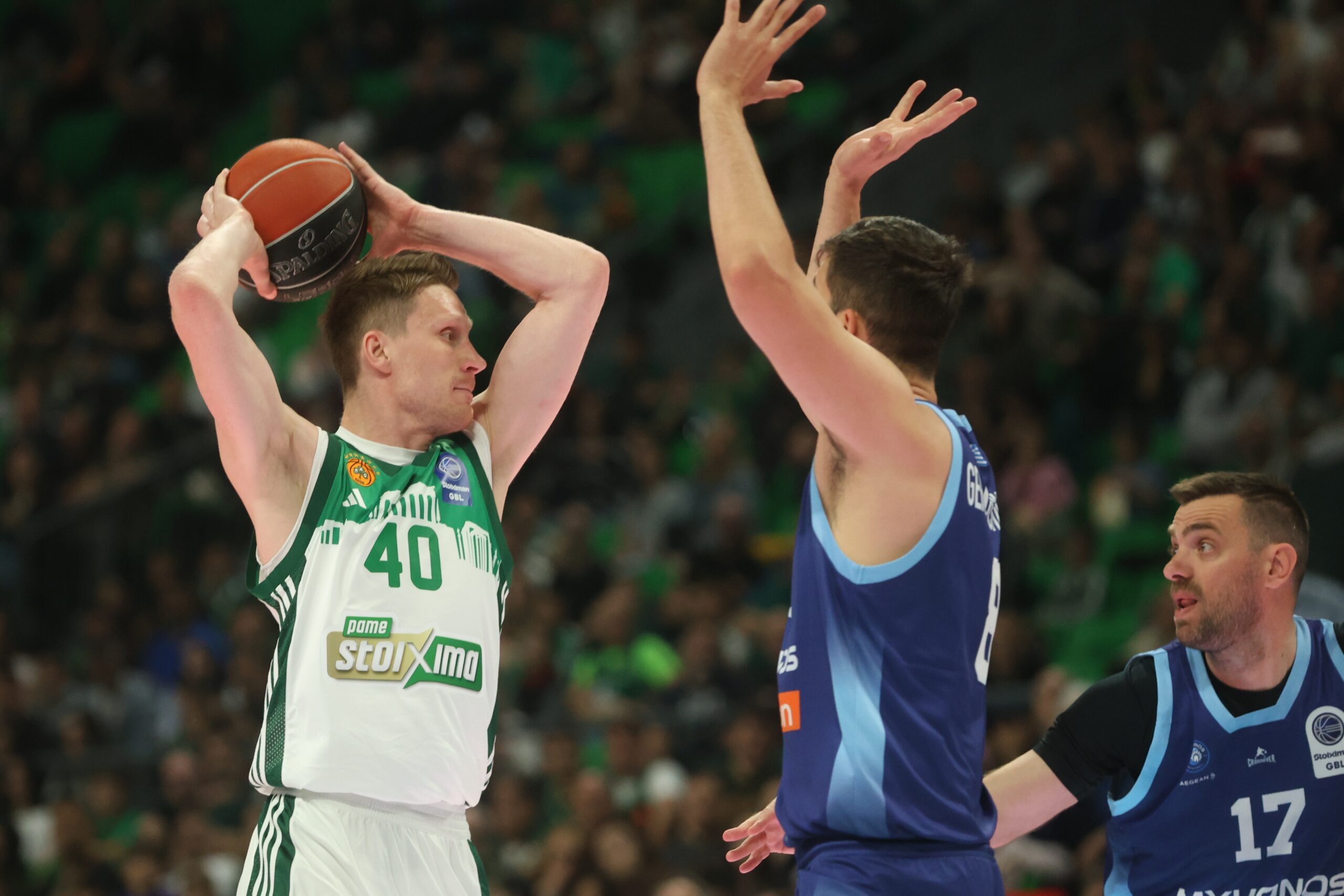
After five years with Panathinaikos, Marius Grigonis left this past summer and returned to his home country and to Žalgiris for his third stint with the Kaunas club.
Speaking to the official Zalgiris website, the 32-year-old forward discussed a wide range of topics, including his time with the “clover” and his relationship with Ergin Ataman.
ΣΧΕΤΙΚΑ ΑΡΘΡΑ


He also mentioned the injury that kept him sidelined for a long time, as well as the love he received from the “Greens” fans.
Here’s what he said in detail:
How would he describe his experience at Panathinaikos: “Organized chaos. The first year was interesting. It’s easy to talk about it from today’s perspective. Back then, of course, it was difficult. Everyone in the locker room was fighting and cursing at each other. The coach was cutting players from the team. Our own fans were cursing at us. They were spitting on us. You’d walk down the street and people would say all sorts of things to you.
And the next year, they’re carrying you on their shoulders because we won the EuroLeague. Again, we say that in Kaunas they’re fanatical about Žalgiris, but there it’s on a completely different level.
Their entire sports culture revolves around it. Of course, the local market is bigger and there are more people. They’re really crazy about it. They don’t even need beer to get that way—it’s just in their nature. That period was one of the best of my career.”
On the summer of 2024, when Panathinaikos built a superteam: “They’d told me, too, that I was free to leave, but I had a contract, so I said, ‘Do whatever you want.’ Later, they told me again that I was free to leave. And I came back again.
There were a lot of injuries at the start of the season. I remember that Mitoglou, Papapetrou, and Hernangomez were out. So I ended up playing 35 minutes per game. That’s how it goes in sports—you make your first few shots, and everyone tells you how good you are. Then you keep playing.
After that, Nan arrived and took us to another level. That’s how we bonded as a team—no rules, nothing. It just happened that way.
I remember we went to the Final Four and were convinced we’d win it. Even when we were down by 15 points against Real Madrid in the final, everyone was certain we’d win. That’s why I say that, because of that moment, you don’t regret getting injured or not playing. It makes up for everything.”
On his relationship with Ergin Ataman: “I’d like you to find me even one player who has a relationship with him. He completely distances himself from the players. That’s the stance he chooses to take. There’s no communication whatsoever.”
On his back injury and rehabilitation: “It was chaos. No one properly organized my rehabilitation, so I had to keep traveling to Germany on my own. Before the surgery, I was essentially paralyzed. I couldn’t do anything, and I couldn’t fly to Germany. I had to have the surgery there. Afterward, there were disagreements. My doctor said one thing, the team doctor said something else. The injury flared up again. By then, I was able to fly to Germany and spent the entire summer there.
After that, Panathinaikos brought in a Greek physical therapist with whom I’d worked in Russia as well. He’d also worked under Saras at Fenerbahçe. He’s a really great specialist. I continued my rehabilitation with him, and Kestas, who also works with Žalgiris, joined the process as well. I started to feel better as recently as January of last year. That’s when I finally began to feel that anything was possible again. It took a long time.
I definitely have a good relationship with Panathinaikos’s sports director, as well as with the team’s owner. There were no problems. At that time, of course, I had a disagreement with the team doctor. You can’t do things that way. Unlike at Žalgiris, in Europe they often take the selection of doctors and physical therapists far too lightly.”
On the fans and his return to action: “When you’ve made history with Panathinaikos and earned that star on your jersey, the fans see you differently. I really felt that personally. The fans showed me a lot of love. When you win, they make you feel like you can stay there and that everything will be okay.
Besides, I still wanted to give it one more shot. To have a role where I’m important, instead of just being there and collecting a paycheck. And yet, when I stepped onto the court at that moment, I definitely wasn’t ready yet. I needed to make a gradual return.
I’ve been in a lot of situations where no one is going to wait until you’re 100% healthy. If you’re at 70% and can run and shoot, they expect you to get on the court and play. I wasn’t ready yet, and maybe that worked against me, because everyone expected that after a year without playing, I’d come back and be fine right away. Something similar happened with Lesor. Then he needed a second surgery.
The club handled many injury situations poorly. I think they realize that themselves. A lot has changed, so things should be better now.”
Regarding the limited playing time he had last year and whether he spoke to anyone about it: “Who should I talk to? No. That’s not how things work with Ataman. You’re there and you just figure you’ll help out in practice. You’ll help out in the league. When they need you, they’ll call you.
There were times when you’d be driving home after practice and get a call: ‘Come to the airport. You have to fly out for the game.” Or you’d arrive at the locker room, and 25 minutes before the game, they’d bring you your uniform and tell you they needed you.
There were situations like that. I don’t think it’ll be anything like that with Zeljko. There were a lot of organizational issues of that sort.
I saw it this way: “I’m here, and I’ll try to do my job.” My contract says I have to help the team. Of course, I complained several times and voiced my opinion, but whenever they needed me, I was ready.”
*photo source: KYPE






