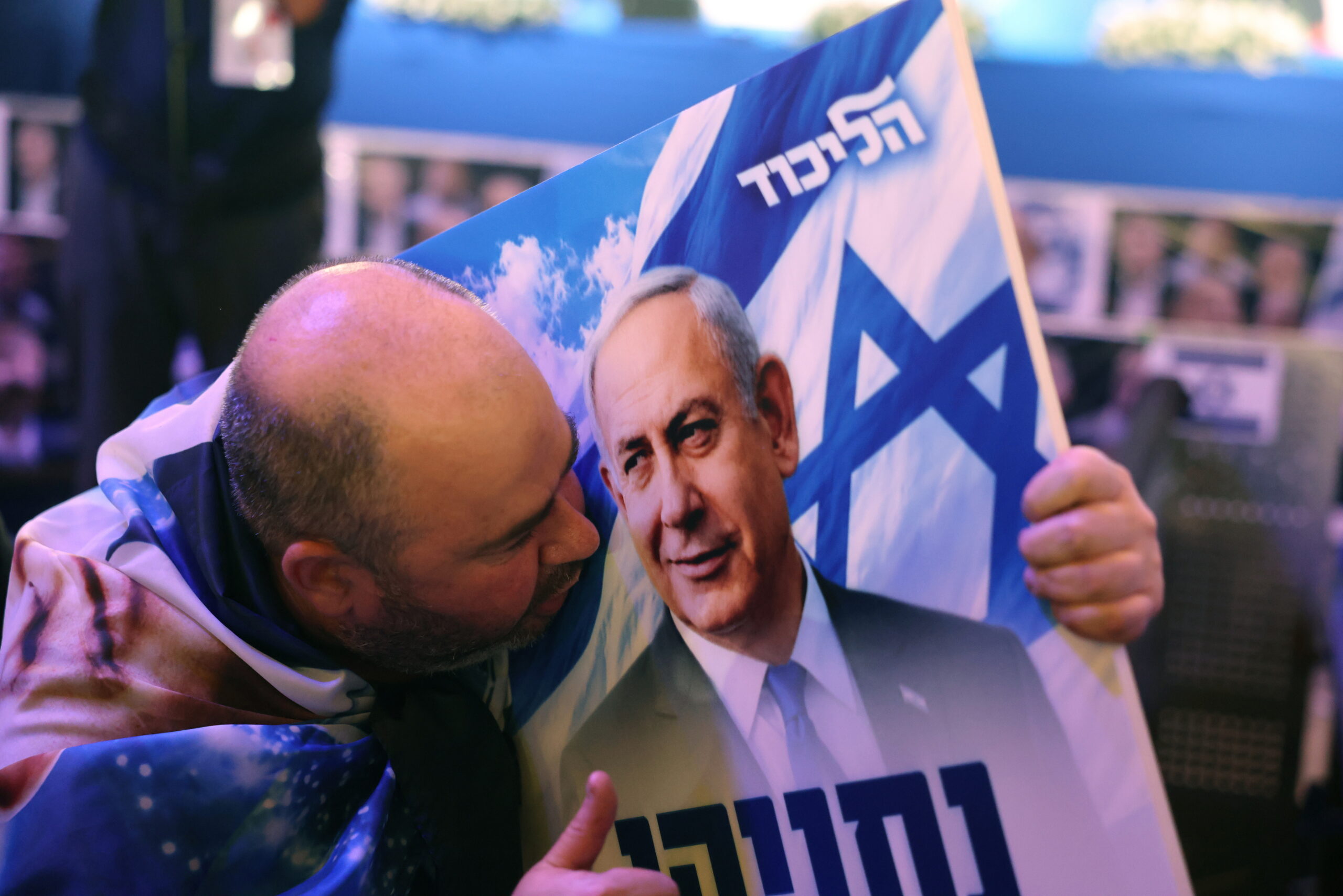
Benjamin Netanyahu appears set to remain Israel’s acting prime minister, as his unexpectedly strong support among Jewish voters has left his opponents with little chance of unseating him, despite the fact that his right-wing coalition lost its parliamentary majority.
With nearly 88.6% of the votes counted as of today, projections from Israel’s three main television networks indicated that Netanyahu’s coalition of right-wing, far-right, and ultra-Orthodox parties would win 53 seats in the 120-member Knesset, significantly more than the 48 held by the coalition of his opponent, Gadi Eizenkot. The distribution of seats remains unchanged from the previous count.
ΣΧΕΤΙΚΑ ΑΡΘΡΑ


The camp supporting Benjamin Netanyahu is expected to secure 53 seats, while his opponents will receive 67 — of which 48 are from Jewish-led parties and 19 from Arab-led parties. These figures correspond to 96% of the regular ballots counted. The counting of votes cast by soldiers, diplomats, prisoners, and certain other categories of voters will begin at 1 a.m. and is expected to be completed by tomorrow evening.
The fact that parties representing Israeli Arabs are projected to win a record 19 seats deprives Eisenkot of any realistic chance of coming to power without their broad support, which many Jewish political leaders reject.
The results may still change as the count continues, but Eisenkot’s coalition with the parties opposed to Netanyahu—which range from the center-left to the hard-line right— failed to reach the percentages predicted by pre-election polls, which had suggested a close race.
Netanyahu will remain caretaker prime minister during any negotiations to form a coalition government and possibly until new elections are held nextyear. While a caretaker government has certain limitations, experts say it retains powers, including those related to the war against Iran.
Netanyahu, addressing supporters of his Likud party shortly after 3 a.m. (local time and Cyprus time), called for the formation of “a strong, right-wing national government.”

He highlighted Israel’s military successes and raised the prospect of new joint military action against Iran alongside his ally, U.S. President Donald Trump, saying that the two countries have a “unique historical opportunity” to eliminate “once and for all” what he called the Iranian threat.
Trump, who had called on Israeli voters to keep Netanyahu in power so that the two leaders could “finish the job” in Iran, said that Netanyahu had done “very well” and claimed that the support he had offered him “helped him a lot.”
Eisenkot acknowledged that Netanyahu remains prime minister in an interim capacity, but warned that he might use the issue of security for political purposes.
“I call on the heads of the security agencies and public services: Netanyahu is a caretaker prime minister, without a mandate or the trust of the people,” he said. “Remain steadfast in the face of any attempt to challenge you.”
The prospect of a caretaker government without a parliamentary majority affected Israeli markets. The shekel fell about 1.6% to 3.10 against the dollar. The main indices on the Tel Aviv Stock Exchange fell by more than 3%.
A decisive shift in the Israeli political landscape
The result underscored the shift to the right among Israeli Jews during the years when Netanyahu was the country’s dominant political figure. The center-left, which had dominated Israel during the first half of its history, has been sidelined.
Nearly all Jewish parties now share Netanyahu’s rejection of a potential independent Palestinian state, which has been the foundation of international peace efforts since the 1990s.
Voter turnout reached 77.7 percent—the highest in more than two decades—and was particularly high among Israeli Arabs, that is, Israelis of Palestinian descent, who make up more than one-fifth of the population. Many were motivated by what they consider to be blatant racism within Netanyahu’s cabinet, which includes a party leader who has been convicted of inciting racial hatred against Arabs.
At the headquarters of the Joint List, an alliance of Arab parties, the crowd erupted in applause when the exit polls were released. “We reject occupation and racism, and we will remain here,” said Joint List candidate Faten Ghatas.
The coalition that ousted Netanyahu relied on a small Arab party, but Eisenkot’s poor showing means that the opposition will now need support from the Joint List itself. Since Israel’s founding, most Jewish leaders have avoided formal alliances with Arab parties.
One of the Joint List’s leaders told Agence France-Presse today that he is prepared to support an opposition government to oust Netanyahu, but without joining it.
“We don’t see how we could join a coalition under the current circumstances,” said Youssef Jabarin, head of the Joint List, citing primarily the war in Gaza and the situation in the occupied West Bank, where settlement activity is intensifying and settler violence is almost a daily occurrence.
“But to bring down” the outgoing governing coalition, “we could support an alternative government without joining it,” he added.
Source: APE-MPE