



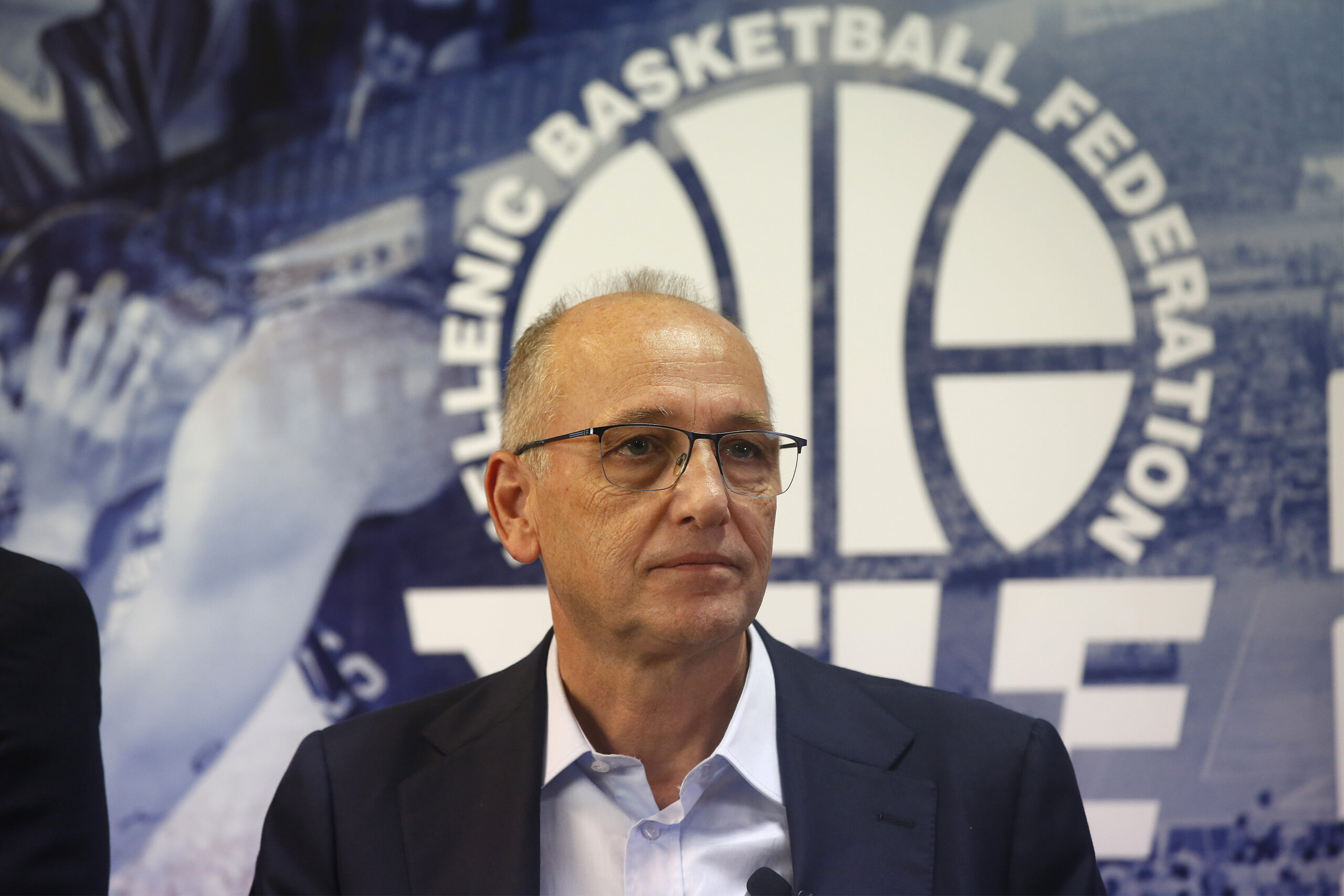
Vangelis Liolios bases a large part of his defense on the allegation that he was the target of blackmail and an organized effort to destroy him personally and professionally, denying all 49 charges attributed to him in the case involving alleged fixed basketball games.
In his defense brief, the former president of the Hellenic Basketball Federation describes his own version of the meeting with the owner of the Amarousio Basketball Club, Dimos Stasinopoulos, questions the credibility of witnesses and testimonies, and maintains that the evidence does not indicate any specific involvement on his part in influencing the referees. At the same time, he is requesting to be released on probation, stating that he is willing to resign from any administrative position at the Hellenic Basketball Federation (EOK) and to refrain from any involvement in basketball until the case is finally resolved.
ΣΧΕΤΙΚΑ ΑΡΘΡΑ


“I have absolutely no involvement—let alone being a principal perpetrator,” he states emphatically in his brief, denying the acts attributed to him. He refers to charges that, as he argues, damage his reputation, his character, and his professional career, while attributing his alleged involvement in the case to an attempt to remove him from the Federation’s leadership and to damage his business and personal reputation.
The meeting with Stasinopoulos and the allegation of extortion
A key point in his defense is the meeting that, according to him, took place on April 14, 2026, with Dimos Stasinopoulos at the EOK offices.
As he describes it, the owner of the Maroussi Basketball Club came to his office to discuss the team and the refereeing. According to Liolios, Stasinopoulos expressed complaints about the referees’ treatment of Amarousio and referred to his financial investment, saying: “I’ve put in a million. Why should I lose it?”
Subsequently, according to Liolios’s account, Stasinopoulos referred to private messages he had exchanged with Ilias Papatheodorou when the latter was working for Promitheas Patras. When Liolios asked him how he had become aware of the messages, he reportedly replied “Ilias,” while, as stated in the brief, he admitted that he had forwarded them to two individuals: government spokesperson Pavlos Marinakis and the president of the Hellenic Olympic Committee.
Liolios maintains that the meeting was of a blackmailing nature and that its purpose was to secure favorable arbitration treatment for Marousi. In this context, he writes: “Stasinopoulos, therefore, acting as a common extortionist, was the first to attempt to demand illegal benefits from me.”
According to him, the conversation was recorded by the security system at the EOK offices, which, he states, records both video and audio. Liolios claims that he filed a complaint with the Federation’s Ethics Committee and subsequently filed a lawsuit against Stasinopoulos, Papatheodorou, and others. In his brief, he links the case to the disclosure of personal messages, claiming that these were used against him.
Maglogiannis’s
Complaint In the same context, Liolios cites a referee’s complaint, which, according to his account, concerned messages with threatening content that he allegedly received after the Peristeri – Marousi game on December 6, 2025. As he describes in his brief, the referee had reported that the day after the game he received two messages from a phone number he attributed to the owner of the Marousi Basketball Club. Liolios cites this case, as well as the actions that, as he states, were subsequently taken by the relevant bodies of the Hellenic Basketball Federation (EOK).
These specific references form part of his argument regarding his relationship with Stasinopoulos and the dispute that, according to him, preceded the allegations against him.
“I do not know Kalogeropoulos” – He disputes the conversations
. Liolios makes specific reference to an arbitrator and key witness in the case, asserting that he does not know him personally and that they have never communicated or met. “I must make it clear once and for all that I do not know this gentleman. I have never even seen him in person, and I have certainly never spoken with him, never met him, and never had any contact with him,” he states.
At the same time, referring to a statement by the referee—who was a witness—in which he said: “Without being able to prove it, I am certain that Mr. Liolios was involved because of his relationship with Mr. Mavragani,” Mr. Liolios argues that this statement is not based on any specific incident or evidence linking him to interference in the refereeing.
He also disputes the completeness and accuracy of the referee’s testimony, arguing that there are discrepancies between the screenshots of the conversations and the text that was submitted. According to his claims, certain messages are missing, while in other instances there are discrepancies in the content. He cites, among other things, a discrepancy in the spelling of a name; as he notes, the name “Kapris” appears in a chat screenshot, while the memorandum lists “Crete.” Based on these discrepancies, he raises questions about how the material was gathered and presented, and about the fact that, as he claims, the referee’s cell phone was not seized so that the conversations could be examined in their entirety.
“Nowhere in these conversations is my name mentioned; nowhere is any action of mine mentioned; I am nowhere to be found,” he asserts.
The Messages with Papatheodorou
A significant portion of the brief also concerns his relationship with coach Ilias Papatheodorou, with whom, as he states, he maintained a close personal and professional relationship during the period when Papatheodorou was working at Promitheas Patras.
Liolios cites messages that, according to the brief, they exchanged in 2025, when Papatheodorou was considering an offer to take over as head coach of Amarousio. In a message dated May 28, 2025, Liolios reportedly wrote to him: “Our greatest treasure is our children. And only them. I’m not telling you this by chance. The fact that you’ll be in Athens and hugging your daughter every day is the most important thing. Above and beyond money and budgets… And you made the right decision for your family!!!”
In another message, dated June 7, 2025, it says she wrote to him: “Listen to me and trust me. If the offer is real, listen to me and trust me. Leave now. You’ll remember me.” Liolios cites these specific conversations to argue that their communication concerned personal and professional matters and that he encouraged the coach to move to Athens to be close to his.
He also refers to questions that, as he writes, were posed to Papatheodorou regarding incidents of interference in refereeing. According to the memorandum, the coach reportedly replied that he was not aware of any specific instance of interference by Liolios or his co-defendant Mavragani toward the Central Refereeing Committee.
Regarding a message mentioning the names of referees, Liolios maintains that it was sent after the appointments had already been made and not before them, insisting that there was no prior collusion.
The contradictions he cites regarding the witness testimonies
Liolios also questions the credibility of the witness—a former team owner—refuting what, according to the brief, he has testified regarding games and incidents in Greek basketball. He makes specific reference to the Greek Cup final between Promitheas Patras and AEK on February 16, 2020, which is included in the case. He cites differing descriptions of the game from witnesses, arguing that they do not agree with one another regarding the referees’ treatment of Prometheus.
In the brief, he cites, among other things, a statement attributed to a referee, which states that “Prometheus lost the cup; some human errors were made by the referees.” Liolios contrasts this specific account with the testimony given by the former team official, raising questions about the consistency of the testimonies regarding the same game.
At the same time, he refers to Promitheas’s games against PAOK and Olympiacos, in which, as he points out, the Patras team won by margins of 38 and 12 points, respectively. He cites these results in challenging the allegations, arguing that the indictment does not specify any particular refereeing decisions that would prove the results were tampered with.
In his defense brief, Liolios also refers extensively to the Professional Sports Commission, arguing that information regarding the proceedings against him was leaked to specific media outlets. He also cites the previous disputes with Panathinaikos BC regarding issues concerning the Central Arbitration Committee, as well as ASEAD Decision 51/2025, which he cites as part of the background to the dispute. He claims that members of the EEA had partisan preferences in favor of Panathinaikos and refers to actions which, as he notes, were taken against the Committee’s president.
He disputes the criminal nature of the acts
In the legal section of the brief, Liolios disputes the adequacy and clarity of the indictment, arguing that the actions he is alleged to have taken to fix matches are not specified in a concrete manner.
He also raises a question regarding the response from the Gaming Supervision and Control Commission as to which of the 49 matches were linked to betting events in Greece or abroad. As he notes, by the time the brief was drafted, he had not received the response he had requested; consequently, in his view, the basis for classifying the acts as felonies has not been clarified.
At the same time, he requests that four school championship games be excluded, arguing that schools are not recognized sports clubs within the meaning of Law 2725/1999.
“Today, I am being charged and detained even though the criminal nature of the acts attributed to me has not been clarified,” he states, while characterizing the indictment as “vague and unsubstantiated.”
In his brief, Liolios also refers to his business activities, his personal life, and his tax history. He cites his business career, the founding of Coffee Island, his family, and his clean criminal record. According to his statement, between 2015 and 2025, he paid a total of 75,425,531.14 euros in taxes and fees, while citing tax audits which, he claims, revealed no violations. He incorporates this information into his argument regarding his personal and professional history.
In conclusion, the defendant requested to be released on probation, proposing that he report regularly to the competent authorities and stating that he would accept, if deemed necessary, the imposition of a monetary bond.
Furthermore, he proposed as a specific condition of his release that he step down from any administrative position within the EOK and refrain from involvement in the sport until the final conclusion of the legal proceedings.
*photo source: KYPE








