



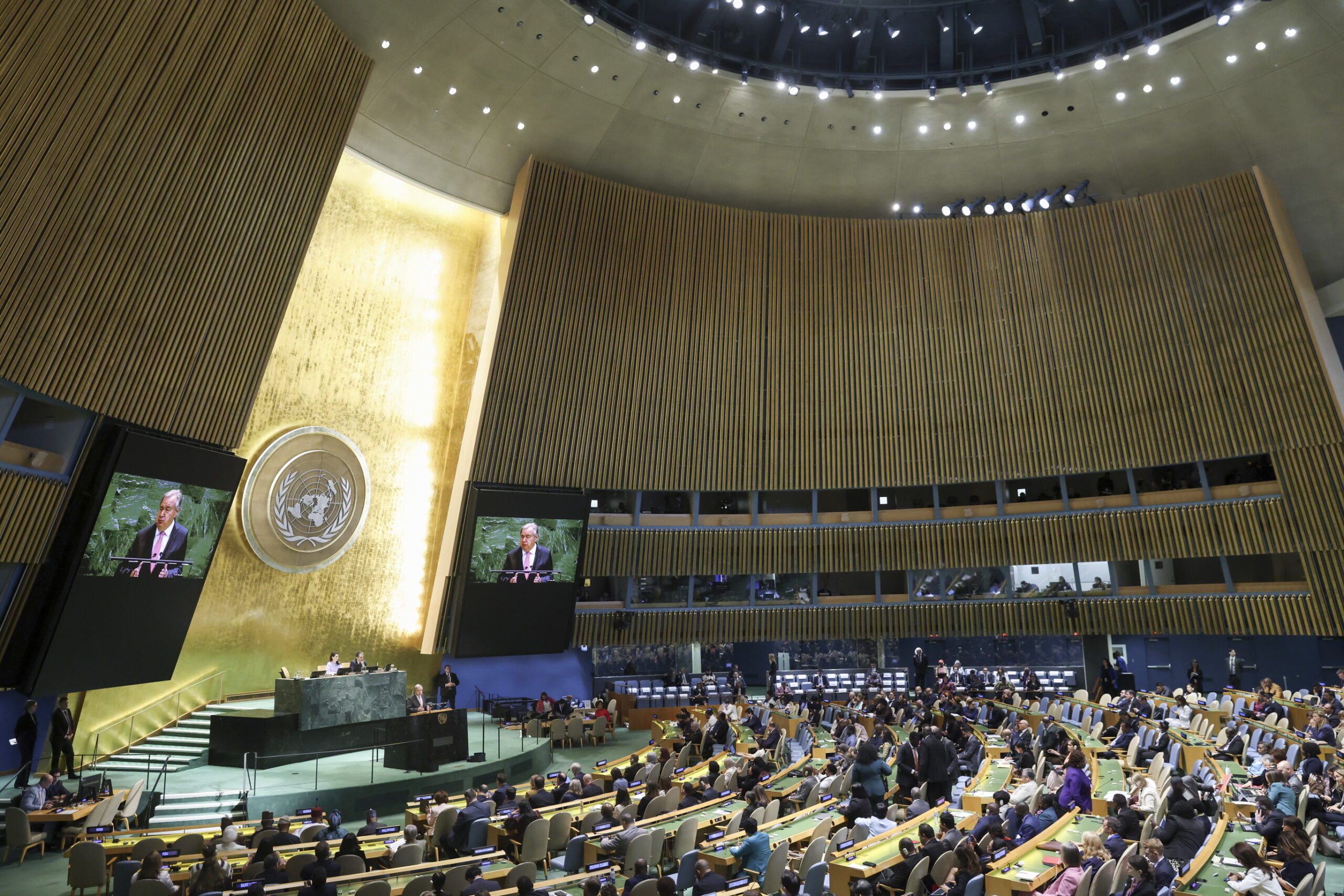
Following the Security Council’s briefing on developments regarding the illegal Turkey-Libya memorandum, Greece’s Permanent Representative to the UN, Ambassador Ag. Balta, sent an official letter yesterday to the Office of the UN Secretary-General to clarify Greece’s positions on the matter before the international community.
According to reports, the letter reiterates Greece’s long-standing positions, including that the Turkey-Libya memorandum is null and void, baseless, and has no legal effect vis-à-vis third states.
ΣΧΕΤΙΚΑ ΑΡΘΡΑ

S&P: Affirmed Greece’s credit rating at BBB with a stable outlook

It blatantly violates international law, specifically the United Nations Convention on the Law of the Sea (UNCLOS), by disregarding the sovereign rights and maritime zones of the Greek islands.
It states that Turkey and Libya have neither overlapping maritime zones nor common maritime borders, and adds that the approval/ratification of the agreement neither confers legitimacy upon it nor invalidates the validity of Greece’s positions.
At the same time, it reiterates that Greece is committed to delimiting maritime zones through peaceful means and in good faith, based on international maritime law, as evidenced by the corresponding agreements our country has already concluded with Egypt and Italy.
According to the same sources, other interested countries in the region are also expected to send similar letters.
Letter from Cyprus to the UN Secretary-General
“The Republic of Cyprus expresses serious concerns regarding the motives behind this move and the interests it aims to serve” the Republic of Cyprus expresses regarding the timing of the decision by the House of Representatives of Eastern Libya to approve the 2019 Turkish-Libyan memorandum.
In a letter sent today to UN Secretary-General António Guterres, Cyprus’s Permanent Representative to the United Nations, Ambassador Maria Michael, referred to the October 20 decision and reiterated the positions that the Cypriot government has articulated in its previous communications with the UN on January 20, 2020, April 24, 2020, and July 20, 2020, as well as in the note verbale of August 18, 2025.
“The independence, sovereignty, and territorial integrity of Libya must not be subordinated to the geopolitical aims and ambitions of third states,” Ms. Michael emphasizes in her letter. She notes that Turkey is exploiting the political and institutional conditions in Libya to advance illegal maritime claims, seeking “to impose an artificial maritime reality at the expense of the sovereign rights of third states.”
Such actions, it notes, reflect “a deliberate policy of escalation in the Eastern Mediterranean,” undermine international law, and constitute “a serious threat to regional peace, security, and stability.”
According to the letter, the Turkish-Libyan memorandum is inconsistent with international law, particularly with the rules governing the conclusion of treaties and with the Law of the Sea, as set forth in the United Nations Convention on the Law of the Sea (UNCLOS). Therefore, “it does not produce legal effects for third parties,” nor does it affect the rights of any third State in maritime zones, including its sovereign rights.
The Republic of Cyprus points out that the memorandum attempts to establish a boundary between two states that “do not have opposite or adjacent coasts,” thereby creating “a non-existent maritime boundary” and deliberately ignoring the presence and rights of other coastal states in maritime zones, including the Greek islands.
It recalls that Article 121, paragraph 2, of UNCLOS reflects customary international law and is also binding on states that are not parties to the Convention. It explicitly provides for the right of islands to “territorial waters, a contiguous zone, a continental shelf, and an exclusive economic zone.”
Ms. Michael emphasizes that maritime boundary agreements must be concluded between states with opposite or adjacent coasts, “in good faith and in accordance with the established principles of international law,” as codified in UNCLOS and guided by international case law. It further requests that the letter be circulated as a document of the General Assembly and the Security Council, as well as its publication on the website of the relevant UN Directorate and in the Bulletin of the Law of the Sea.
HALC Letter to M. Rubio
To publicly reject the Turkish-Libyan memorandum and clarify that it has no legal effect to the detriment of third countries, including Greece, as requested by the Greek-American Leadership Council (HALC) of U.S. Secretary of State Marco Rubio, warning that Turkish-Libyan claims also jeopardize U.S. energy and strategic interests in the Eastern Mediterranean.
In a letter to the head of U.S. diplomacy, the HALC—whose executive director is Eddie Zemenidis— criticizes the State Department’s recent stance, arguing that it is weaker than the position Washington had articulated in 2019.
This statement comes after the Libyan House of Representatives ratified the memorandum on October 20, a development that prompted a reaction from the European Union and brought back into the spotlight the implications of the agreement regarding maritime claims and energy exploration in the Eastern Mediterranean.
The organization contrasts the U.S. stance with that of the European Union, which on October 21, with the support of all 27 member states, reiterated that the memorandum violates the sovereign rights of third states, is inconsistent with the Law of the Sea, and is “null and void and cannot produce legal effects for third states.” As he points out, similar objections have been raised by Egypt and Israel.
In contrast, in its response on October 22, the State Department encouraged the resolution of maritime disputes through good-faith negotiations and bilateral dialogue between Greece and Turkey, as NATO allies. HALC recalls that in 2019, when the memorandum was signed, U.S. diplomats had characterized the agreement as “counterproductive and provocative.”
According to HALC, the absence of a clear U.S. position on the legal aspects of the memorandum carries the risk of being interpreted by Ankara and Tripoli as tacit acceptance of their claims.
U.S. energy investments take center stage
Particular emphasis is placed on the presence of U.S. energy companies in the maritime areas surrounding Crete.
The letter refers to the contracts signed by Chevron in February for the exploration and exploitation of hydrocarbons in four offshore areas in Greece, with a 70% stake, including the “South Crete 1” and “South Crete 2” blocks.
As noted, Libya has officially protested Greece’s exploration activities in these specific maritime areas, while the Turkish Ministry of Defense has argued that Chevron’s blocks overlap with the maritime zone that the Turkish-Libyan memorandum assigns to Libya.
At the same time, reference is made to ExxonMobil, which holds exploration rights as operator in two offshore blocks west and southwest of Crete, where seismic surveys have been conducted since 2022.
HALC links these specific investments to Europe’s effort to reduce its dependence on Russian natural gas and to the broader U.S. energy strategy in the region.
Citing the State Department’s own position—that the resolution of maritime disputes paves the way for commercial investments and exploration— the organization argues that disputes over maritime boundaries create uncertainty for U.S. companies that are being asked to invest significant capital in deep-sea exploration.
The Strategic Importance of Souda
The letter extends the issue to the realm of security, citing the importance of the U.S. naval facility at Souda, one of the most important U.S. and NATO facilities in the Eastern Mediterranean.
According to the HALC, efforts to challenge maritime jurisdiction around Crete are exacerbating instability in the base’s security environment and may jeopardize U.S. defense interests.
In this context, the organization calls on Marco Rubio to reaffirm Greece’s sovereign rights under international law, including the maritime zones extending from the islands, and to make it clear to Ankara and Tripoli that unilateral maritime claims must not hinder the legitimate exploration activities of U.S. companies.
It also calls for Washington to coordinate with the European Union and its regional partners to formulate a common position on the memorandum.
“Turkey and Libya must not be allowed to create a fait accompli at the expense of a NATO ally, U.S. security interests, and U.S. companies operating legally in Greek waters,” the HALC emphasizes, concluding that the United States’ position should be at least as clear as that of Europe.
SEE ALSO: Cyprus’s Letter to the UN on the Turkey-Libya Memorandum: A Deliberate Policy of Escalation in the Eastern Mediterranean | AlphaNews
Source: APE-MPE








