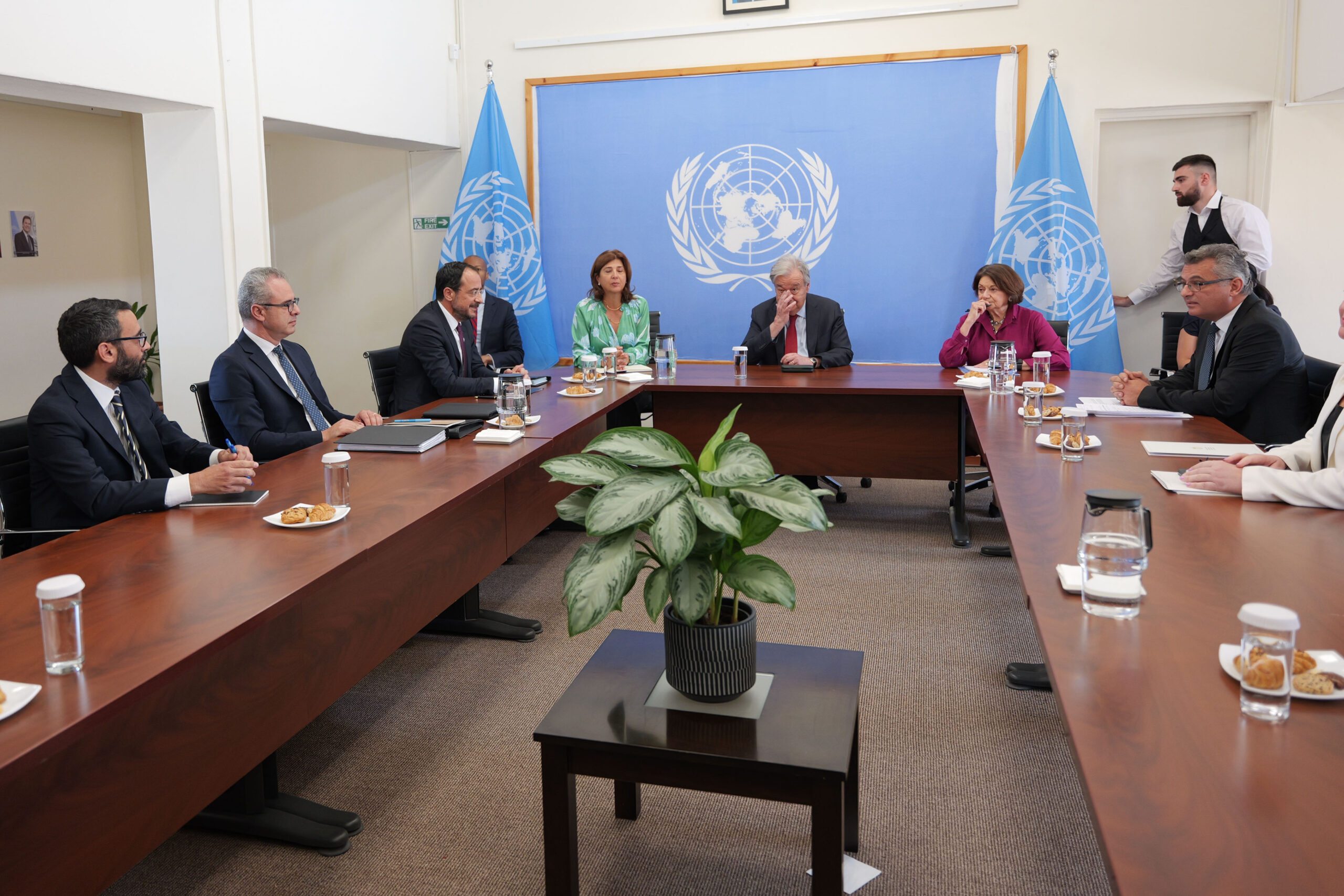
The meeting between President of the Republic Nikos Christodoulides and Tufan Erhurman lasted nearly three hours yesterday, Wednesday, the meeting between the President of the Republic, Nicos Christodoulides, and Tufan Erhurman, with the two leaders spending most of the time in private discussions.
Turkish Cypriot leader Tufan Erhurman, following his meeting with President of the Republic Nicos Christodoulides, stated that the negative developments of recent days run counter to the spirit of the Confidence-Building Measures (CBMs) and, rather than strengthening trust between the two sides, they have further undermined it.
ΣΧΕΤΙΚΑ ΑΡΘΡΑ

Rubio calls a Greek-Turkish conflict over GSI “unthinkable”

According to the Turkish Cypriot online press and the relevant social media post by the Turkish Cypriot leader, Mr. Erhurman stated that the meeting took place “in the shadow of the negative developments of recent days.” As he said, at the outset of the meeting, the Turkish Cypriot side presented its views on these developments and argued that they run counter to the basic logic of the MOUs.
The Turkish Cypriot leader stated that his side is ready to make progress on issues raised by the UN Secretary-General, including demining, the opening of new crossing points, citizenship rights for children of mixed marriages, sports issues, irregular migration, and the creation of joint mechanisms to address natural disasters.
Regarding the methodology of the talks, Mr. Erhurman reiterated the Turkish Cypriot side’s position on political equality, arguing that the issue cannot be subject to “give-and-take” with other topics. He added that without clarification on this specific issue, he does not consider progress possible on the remaining issues of methodology—including convergence—as well as on substantive issues.
He also noted that the two leaders agreed, following a previous proposal by the Turkish Cypriot side, to meet once a week, while the UN Secretary-General’s Personal Envoy, María Ángela Olguín, is expected in Cyprus toward the end of the first week of September.
Mr. Erhurman added that he will continue to work, as he put it, in good faith toward resolving the Cyprus issue and to convey his views directly to his counterpart regarding developments that may affect the process.
However, as reported by journalist Evangelos Agapiou on yesterday’s main news broadcast on Alpha, the meeting focused on three key areas: methodology, convergence, and the MOU. The two leaders discussed the roadmap that both sides must follow to convene a new five-party meeting—as sought by the UN Secretary-General—as well as the points of convergence, the documentation of which is already underway by the UN and is expected to be completed by September, and the MOEs, where the two leaders placed on the agenda the issue of roadblocks that had been discussed in March 2025 in Geneva.
The two leaders spoke for about two hours in private, without negotiators or United Nations officials present, with Evangelos Agapiou reporting that this is where the most substantive discussion took place, according to the information available.
Subsequently, negotiators on technical issues joined the discussion, and toward the end, a UN communiqué was drafted welcoming the UN Secretary-General’s efforts to resolve the Cyprus issue and scheduling weekly meetings between the two leaders, at least until the week of the UN General Assembly in late September, when the President of the Republic is optimistic that progress will be made.
The Greek Cypriot side believes it has come close to finalizing—even at the next meeting—the methodology for the next steps, particularly on issues concerning substantive convergence on the Cyprus problem.
READ ALSO: President of the Republic gives a positive outlook: Convergence, methodology, MOEs, and roadblocks were discussed with Erhurman
As for the MOEs, no substantive proposal was put forward—specifically regarding the four roadblocks—with the Turkish Cypriot leader insisting on his objections concerning Pyroi and Athienou.
Meanwhile, the President of the Republic raised the issues of enclaved persons, missing persons, and place names—specifically, that Greek place names be included on road signs in the occupied areas.
Milestones
The next milestones include the visit of María Ángela Oglin, who is expected on the island in early September, though the exact date has not yet been finalized. The goal is for her to attend the next meeting between the two leaders.
Meanwhile, as the President described it as an “informal milestone,” the UN General Assembly is scheduled for late September, where the President will meet with the UN Secretary-General, and after the assembly concludes, the Turkish Cypriot leader will meet with the UN Secretary-General.
READ ALSO: Christodoulides and Erhurman agreed to meet once a week; here is the statement issued after their one-on-one meeting
Statements by the President of the Republic
Substantive issues—specifically areas of convergence—as well as methodological issues and the terms of reference were discussed during their nearly three-hour meeting on Wednesday, the President of the Republic, Nicos Christodoulides, and Turkish Cypriot leader Tufan Erhurman, at the offices of the United Nations Good Offices Mission, in the Nicosia Airport area, within the buffer zone.
In remarks made after his arrival at the Presidential Palace, President Christodoulides said that the discussion—during most of which the leaders spoke privately—was positive.
“It was a good meeting—I must say— which is why it lasted nearly three hours, with the overwhelming majority of that time spent just between myself and the Turkish Cypriot leader. Preparations have begun based on what the UN Secretary-General has stated publicly,” he added.
As he said, the two leaders discussed substantive issues, specifically the areas of convergence, which, according to the President, “make it particularly important to safeguard the negotiating achievements right up until the last day in Crans-Montana.”
He also said they discussed the methodology. As he noted, the four points raised by Mr. Erhurman regarding the methodology are well known, with the President proposing “our own approaches on how negotiations can be more effective through a cross-cutting negotiation of all issues. We cannot discuss just one issue in isolation,” he said.
They also discussed issues related to the Joint Ministerial Committee (JMC). “Regarding the roadblocks, we did not limit ourselves to the well-known issue of Mia Milia and Pyroi-Athinou. We also discussed the other three that we had agreed upon with the Secretary-General in March 2025 in Geneva,” namely Pyroi, Athenou, Kokkina, Mia Milia, and Louroutzina.
“I submitted some proposals; some are repeats because we are awaiting a response regarding the enclaved persons, the missing persons, and the need to expedite the entire process, requests concerning the Maronite community, the Armenian community, requests regarding certain road signs in the occupied areas, as well as some other issues,” he said.
The President noted that he also emphasized to the Turkish Cypriot leader that any confidence-building measures must bring us as close as possible to a solution, based on the agreed framework, “and not in any way normalize the current unacceptable state of affairs.”
As he said, he expressed his readiness, if and when talks resume—which is the goal— “to consider additional unilateral measures on the part of the Republic of Cyprus, such as the 14 I had announced.”
“It was a good discussion; we agreed to meet again next week—we’ll be meeting every week, and more than once if necessary. Tomorrow we will announce the members of the Advisory Body whom we had proposed and who were accepted,” he said, adding that he views today’s discussion in a positive light.
Responding to a question about the opening of roadblocks, President Christodoulides said that when the UN Secretary-General was here, he had proposed a “reasonable, compromise proposal that must be accepted. We accepted the Secretary-General’s compromise proposal; some other issues were also raised, and within the context of those other issues—such as Louroutzina— we agreed to examine all four roadblocks, as we had discussed with the Secretary-General on March 18, 2025, in Geneva.”
Responding to another question on the issue of convergence, he said that the two leaders exchanged views on specific issues related to convergence, based on their respective positions and the need to safeguard the negotiating acquis. “Overall, the discussion on the acquis was a good one,” he said.
Regarding the methodology, the President, referring to the points raised by Mr. Erhurman, said that the first concerns the areas of convergence. “It is acceptable from our side; we insist on the negotiating acquis up until the early hours of July 7, when negotiations were suspended in Crans-Montana.” The second point concerns the timeline. “The timeline depends on whether we will pick up where we left off to cover the last mile, as the Secretary-General himself has stated. If we start from the beginning, we cannot speak of the ‘last mile.’”
Regarding the point raised by Mr. Erhurman about predetermined outcomes, the President said that this is unacceptable. “It is a disincentive to achieving a solution to the Cyprus problem,” he said.
Regarding the proposal he himself submitted on the methodology—specifically, cross-negotiation—he said that the chapters could be discussed in pairs. For example, he noted, the territorial issue should be discussed alongside the property issue, since they are directly intertwined, or governance alongside the security chapter.
“I look forward to the next meeting. Ms. Olgin’s presence will certainly be crucial to what we discuss,” he said, noting that the date of the next meeting has not yet been set. Responding to a question about whether Ms. Olgin would participate in the weekly meetings between the two leaders, he said that “whenever Ms. Olgin is in Cyprus, during my meetings with the Turkish Cypriot leader, I believe she will be present.”
Moreover, he added, there is the informal milestone of the week of the United Nations General Assembly, where all parties involved in the Cyprus issue will be present. He also recalled that the Secretary-General has repeatedly referred to the role of the guarantor powers, both in his public statements and in private meetings. “Everyone will be in New York for the United Nations General Assembly. The Turkish Cypriot leader will hold a meeting after the official week concludes, as is customary. It is a good opportunity there to take stock, with the aim of convening an expanded conference, during which the resumption of talks will be announced.”
When asked whether a joint meeting with the Secretary-General had been decided upon, the President said it is too early to discuss such a meeting. “If such a possibility arises, we are ready to participate in such a meeting and even in an expanded one. If the Secretary-General convenes it, we all have a duty to respond positively.”
Finally, responding to the issues raised by Mr. Erhurman during the discussion, President Christodoulides said that the Turkish Cypriot leader “raised the issues we have been seeing recently—which you also see in the Turkish Cypriot press—and I replied that these are very natural developments, resulting from the illegal state of affairs. And if we want to avoid such developments, we must work even harder—and clearly faster—so that we can achieve a solution to the Cyprus problem based on the agreed framework”.
READ ALSO: The President and Erhurman spoke privately for two hours: The “informal milestone” and the three main points of the discussion | AlphaNews