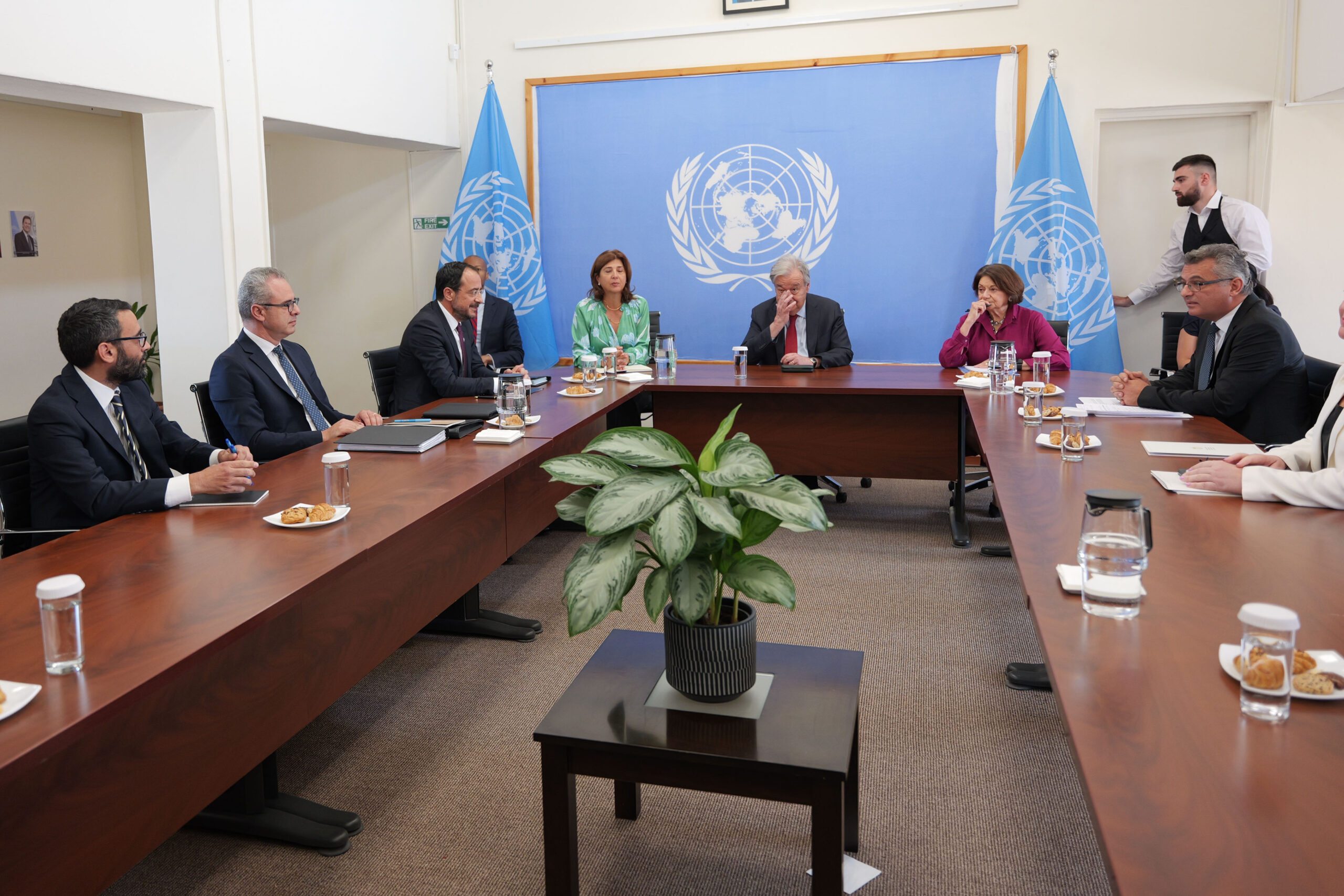
The President of the Republic, Mr. Nikos Christodoulides, presided over a meeting of the National Council today at the Presidential Palace.
Following the meeting, Government Spokesperson Mr. Konstantinos Letympiotis told reporters that “The President of the Republic briefed the country’s entire political leadership on current events, developments, meetings, and the developments following the last meeting of the National Council, which took place on August 3, 2026.
ΣΧΕΤΙΚΑ ΑΡΘΡΑ


Since then, the President of the Republic has held meetings with the Turkish Cypriot leader on August 26, on September 9 and on September 17, prior to President Christodoulides’ trip to New York, a meeting between the President of the Republic and the Personal Envoy on September 22 in New York, and, of course, the meeting between the President of the Republic and the Secretary-General of the United Nations, during which he briefed them on the proposals and recommendations he had also submitted to Mr. Erhurman at their last meeting, and they had the opportunity to discuss all of these proposals, which pertain both to the area and scope of Confidence-Building Measures and to the methodology and substance of the Cyprus issue.
READ ALSO: Perseverance, Pessimism, and Criticism: What Political Leaders Said After the National Council | AlphaNews
They were also briefed on the meetings the Greek Cypriot negotiator held during our stay in New York, both with Ms. di Carlo and with Ms. Olgin, as well as about the joint meeting he held with the Turkish Cypriot negotiator in the presence of Ms. di Carlo and Ms. Olgin.
At the National Council, there was a thorough exchange of views regarding the next steps in connection with the United Nations Secretary-General’s ongoing initiative, on how we can help strengthen this effort in light of Ms. Olgin’s visit to our country this coming October, in preparation for the informal expanded conference—a successful informal expanded conference, as defined and outlined by the United Nations Secretary-General.
They have also been thoroughly briefed on the proposals submitted by the President of the Republic, and therefore the effort certainly continues. Our commitment remains unwavering, as does our conviction that it is only through proposals—constructive proposals— our constructive stance, as well as the European Union’s contribution to the United Nations’ efforts, that we can see progress—provided there is the necessary, necessary political will on the part of all parties.”
When asked what we can expect, the Spokesperson said that “our approach and that of the United Nations Secretary-General himself—as he stated during his visit to Cyprus, as well as in the meetings we had, is that when there are challenges, the solution is not less dialogue. The solution is more dialogue. And when there are issues on which we can see progress, we must continue our efforts to achieve that progress. We have put forward many proposals; over the past three and a half years, President Christodoulides has put forward many proposals. Recently, proposals have been submitted in all three areas that the United Nations Secretary-General has identified as key areas where he wants to see progress. Therefore, this discussion must take place. This discussion must continue without ever losing sight of the role played by the occupying Turkish authorities and their stance regarding the Secretary-General’s efforts to convenean expanded session. The United Nations Secretary-General himself remains committed to this effort. The United Nations Secretary-General himself remains convinced that convening such an expanded meeting is feasible in the near future. However, I will repeat what I have said: an essential component, a necessary prerequisite, is the existence of political will. We cannot choose how difficult the path will be. We can choose to continue down this path and to continue doing so with proposals that will facilitate or further encourage this effort. Beyond that, the other side must also demonstrate the same constructive attitude.”
When asked if there are any thoughts regarding the period following the end of the current UN Secretary-General’s term, the Spokesperson said, “Certainly, but we are not there yet. I would remind you that the UN Secretary-General was in our country in early August, and he himself has set the goal of achieving this by the end of his term —and this is something we not only welcome but find entirely satisfying—that he has made it a personal commitment, if you will, to achieve substantial progress on the Cyprus issue by the end of his term. We still have time until the end of the United Nations Secretary-General’s term. In any case, however, we must remember where the terms of reference for both this UN Secretary-General and every UN Secretary-General stem from. The terms of reference of the United Nations Secretary-General derive from the resolutions of the United Nations Security Council, which clearly and repeatedly define, define, describe, and set forth the agreed-upon framework.”
When asked whether the UN Secretary-General had provided a list of 7 Confidence-Building Measures to the leaders of the two communities and to what extent the Secretary-General considers the CBMs a prerequisite, the Spokesperson said that “the UN Secretary-General, during his visit to Cyprus—and this is well known— as we had discussed the previous time as well, had submitted his compromise proposal—as he described it—regarding the crossing points, which we had accepted and continue to accept even today, and unfortunately, the other side has not accepted it. As for the remaining six points raised by Mr. Erhurman, we have clearly stated our position on all six of them, and we are publicly stating our position on each one. As for demining, I would like to remind you that we have had a proposal in place since April 2025—a specific proposal for the areas identified by the United Nations. To date, this proposal has neither been accepted nor discussed by the other side.
As for the Technical Committee on Natural Disasters, this was also a topic discussed during the joint meeting of the negotiators with Ms. di Carlo and Ms. Olgin in New York, namely that we accept the establishment of this technical committee, while the other side has expressed reservations. On the issue of sports, we reiterate that there is already an established framework, which was signed in 2013 between FIFA, UEFA, the Cyprus Football Association, and the corresponding Turkish Cypriot federation, and a friendly match has already taken place on September 19; with another one scheduled to take place in the occupied areas in October. And regarding the crossing points: We have submitted numerous proposals, which clearly demonstrate our constructive stance and approach.
On the issue of citizenship, we have repeatedly explained that this cannot be considered a confidence-building measure when it is based on fundamental provisions of legislation and, of course, also pertains to Europeanstatus. These applications are examined based on criteria and legislation, and, as announced by the President of the Republic, the review of these applications has already resumed following 2024. So, on each of these seven points, we have taken a public stance. Our positions are public, documented, declared, consistent, and steadfast. We stand by them. And it is for this reason, precisely because we insist on what we have agreed upon—we insist on what was agreed upon before the United Nations Secretary-General during the two expanded meetings as well as during the most recent meeting— that they will be discussed—that the President of the Republic has presented a set of 19 proposals, 19 points that can be discussed. And if we truly want to see progress, what is needed above all is political will, and what is needed above all is for this effort to continue. If what we’re all saying—that is, that we want to end the stalemate— it must truly be demonstrated in practice, because stagnation is not a neutral stance; it is an attempt to perpetuate the status quo, and the status quo cannot and will not be the horizon for the Cyprus issue.”
In response to a question, the Spokesperson said that “the negotiating achievements will not be lost. And I remind you that this is something Mr. Erhurman himself has included in his proposals, in the points he set forth from the very beginning. The negotiating achievements—those from the previous round and all previous rounds of negotiations—are not lost, nor will we allow them to be lost, nor, of course, were the negotiating gains of previous United Nations Secretaries-General or other Presidents of the Republic and Turkish Cypriot leaders ever lost. That is the essence of the matter. And this is something that, at least in terms of rhetoric but also in written statements, the Turkish Cypriot leader shares as well.”
When asked whether the UN had changed the procedure regarding the documentation of points of convergence, the Spokesperson said that “from the very beginning, this was our understanding—and this was the arrangement and the approach taken during the visit of the United Nations Secretary-General— it was that upon completion of the documentation of points of convergence, this document would be provided to all parties so that there would now be a shared understanding of the points of convergence that have been achieved, precisely to facilitate the process toward the resumption of negotiations—and not as a substitute for the resumption of negotiations itself. This is something that has been conveyed—it had already been conveyed during the visit of the United Nations Secretary-General and during the meeting with the President of the Republic, as well as following Ms. Olgin’s statement— it is something that was reiterated by the negotiator, Mr. Menelaou.”
When asked whether the Greek Cypriot side disagrees, the Spokesperson said that “we believe that this record of areas of convergence—which we had requested, along with an update on its status, and we have been informed that it is at an advanced stage—should be provided to all parties at this stage, precisely so that this process can contribute to the United Nations Secretary-General’s efforts to resume negotiations.”
When asked what we expect from Ms. Olgin, given the negative stance of Turkey and the Turkish Cypriot side, the Spokesperson said that “On the Cyprus issue, we cannot afford to stand still; on the Cyprus issue, we will never accept a fait accompli, and we will never allow Turkish intransigence or its diversionary tactics to lead us to abandon our efforts toachieve our desired goal, which is the resolution of the Cyprus issue.
Furthermore, let us be honest and acknowledge that the key question today is not whether there are challenges. Challenges do exist. The question is what we do and how vigorously we continue our efforts to overcome and rise above these challenges.
Let us not forget the point we made three and a half years ago, in March 2023, that when the President of the Republic took office, it was not possible to arrange a joint meeting with the Turkish Cypriot leader, or unacceptable conditions and demands were being imposed for such a joint meeting—a social meeting—to take place. Today, following two expanded meetings—during which important discussions took place in the presence of the United Nations Secretary-General, with the active involvement of the EU —and I have been pleased to hear political leaders refer to the role that the European Union can and must play—a goal that President Christodoulides had set from the very beginning, with a European Union Special Envoy for the Cyprus Issue preparing for important meetings, with the UN Secretary-General—who, in addition to visiting our country, is taking the initiative personally before his term expires.
And I mention all this not because I want to claim that the road ahead of us is easy, but because we must not forget how far we have come, and the effectiveness of our diplomacy, despite Turkey’s intransigent stance.
We will continue on this path of consistency, because it is only through consistency and perseverance that we can make progress. I repeat, however, that in negotiations, it takes two to achieve this progress. Our intention, our will, is not merely a declaration. I have spoken very specifically—and we have spoken very specifically throughout this entire period—about the initiatives we have undertaken and the initiatives we will continue to undertake, precisely to assist, to the extent that our own capabilities allow, the Secretary-General of the United Nations in fulfilling his own desire for progress on the Cyprus issue.”